Israel: Never a Vacation; Always a Trip (Part 1 of 3)
Part One of a Three-Week Odyssey
It’s been over six years since I’ve been to Israel. Let’s just say, I was way overdue. My connections there are deep and wide. Although I have a small number of actual relatives who made Aliyah in the 1970s, my network consists of dozens of Israeli friends cultivated over many years. It’s one thing to stay in touch virtually and by phone, but nothing can replace face-to-face contact. Israel for me is all about the people. Needless to say, since the cataclysmic events of October 7, 2023, I had been yearning to return to my second home. Covid had been an obstacle for a few years, and my late mother’s declining health added to the barriers in my path. As fortune would have it, this past year I learned of a groundbreaking travel mission to Israel sponsored by the Dror Israel movement that sounded like an opportunity too good to pass up. (More on that in a later installment).
The timing of my trip could not have been more opportune. Although I had originally planned to travel to Israel in the midst of the ongoing war in Gaza, I actually arrived one week after October 13, the date on which the twenty living hostages were released by Hamas. Of course, the entire country was euphoric on that day, as was I watching in real time at home at 3:00 a.m. What would the mood of the country be following this unexpected ceasefire and hostage release? Would people be optimistic about the future, or would anger, a sense of betrayal, fear and the ongoing impact of post-traumatic stress be the prevailing sentiment? And just how resilient were Israelis, in spite of it all? Rather than answer those questions directly, I decided to share a series of vignettes from my recent experience in Israel. In part I’m writing this piece to try to answer those questions. Honestly, I’m still not sure I can. On the surface, there are many aspects of Israeli society and daily life that feel very familiar and “normal.” Then again, beneath the surface this is not necessarily the case. Because I have a lot to share, I’ll do so in three-part series of articles, of which this is Part One.
How JD Vance interfered with my plans
Upon my arrival to Ben Gurion airport, I took great comfort in the knowledge that my young friend Shira would pick me up and deliver me to my first destination in Hod Hasharon, a city located northeast of Tel Aviv. However, global politics got in the way. Shira texted me to say that all access to the airport was blocked and my best bet was to hop on the train at the airport and head to Tel Aviv where she would meet me. Even a taxi was not an option. I won’t bore you with the challenges I encountered in purchasing a ticket when neither credit card nor cash worked at the machines (coins finally did.) Suffice it to say, with a little help from strangers (is anyone in Israel actually a stranger?), I procured the ticket, fought off the crowds, shlepped my heavy bag to the correct train platform and actually got off at the right stop. Phew! Welcome to Israel! Shira was her wonderful helpful self and drove me to my final destination. Initial observation: Israel always involves a bit of a “balagan” or chaos, but in the end, things somehow work out. In other words, it felt normal.
Visit to “Hand in Hand” School: Can co-existence still work post-October 7?
My second day in Israel was spent visiting an elementary school composed of Arab and Jewish Israeli students on the Beit Berl campus, located on the outskirts of Kfar Saba. I’d read a lot about these bilingual schools and was eager to see for myself. You might think that after the 2023 massacre, Jewish Israelis would have given up on the concept of shared society in Israel. Given the mutual feelings of heightened distrust and fear among Arabs and Jews, how could such a model be sustained? The school impressed me with its lively and positive culture. The children seemed happy and well- adjusted. There was even a little corner set aside for conflict resolution that walked children through five basic steps of engaging in dialogue to resolve disputes.
Their biggest challenge is that these schools attract far more Arabs than Jews. For the Arab students, it’s a golden opportunity to learn Hebrew in a much more organic environment and to integrate into Israeli society. For the Jewish students, there is less incentive to learn Arabic. Moreover, Jewish families have better educational alternatives than do their Arab counterparts. Overall, my visit left me feeling hopeful. One could argue that what the school accomplishes is a drop in the bucket, but its mission represents an effort to fulfill the ongoing promise of the Israeli Declaration of Independence: to create a democratic society where all citizens of Israel, including its non-Jewish minorities, receive equal rights and opportunities. At least some Israelis are committed to Israel’s highest ideals despite the horrific violence that might have led other countries to reject these aspirations and just give up. Mutual understanding and respect one person at a time still matters.
Furor over Haredi (ultra-Orthodox ) exemption from military service
In Jerusalem I visited with my wonderful female relatives, most of whom are Religious Zionists. Their sons have been serving in the IDF in Gaza for hundreds of days, some in combat roles and most in the reserves. Reservists’ lives have been completely upended for the past two years. My cousins are beyond furious over the Haredi refusal to serve in the IDF. In fact, in the course of our meetup, a younger cousin in her forties chided her mother for attending the wedding of family members who are Haredi. At issue is the fact that at some such occasions, anti-Zionist songs are sung by Haredim supporting their refusal to serve in the IDF. Unreal, huh? My cousin reported that she warned her own Haredi cousin in advance that if she heard any singing of this sort, she would depart the wedding immediately! Up until this point, most of the anger with the Haredim resistance to military conscription that I have personally encountered has come from secular Israelis, but my cousins led with this issue when we sat down to talk. Fear is also pervasive of course among the parents of soldiers still stationed in Gaza. Despite the ceasefire—a fragile one at best—their sons are still sitting ducks. My cousins and friends with sons in Gaza are not sleeping at night.
“There’s no place like home”
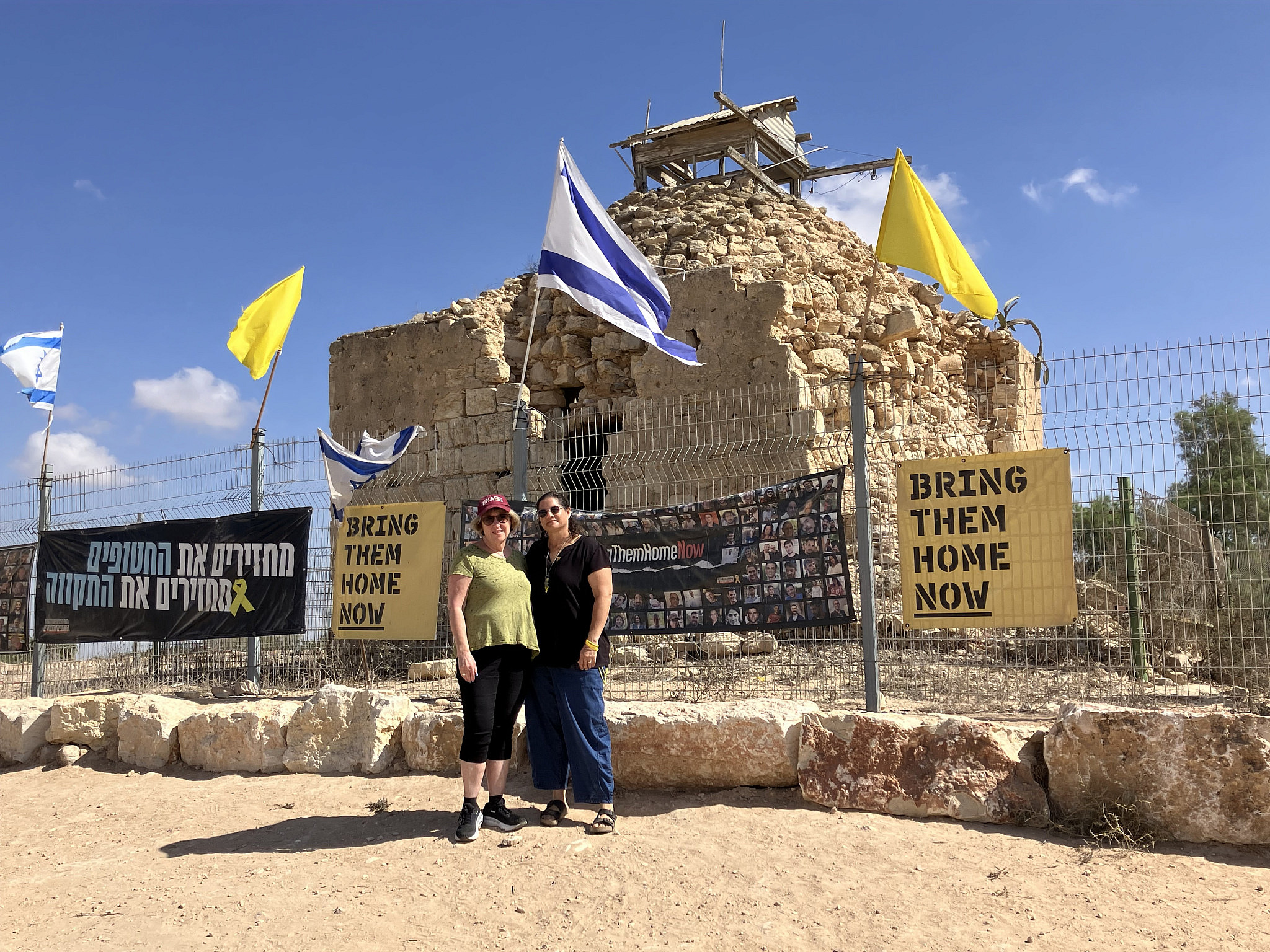
I had two opportunities to visit the Gaza envelope in southern Israel that experienced the massacre of October 7 first hand. The first time I found myself riding on Highway 232, the scene of the horrific murders of young Israelis trying to escape from the Nova Festival, I experienced an eerie sensation. I knew this was no ordinary road despite its unremarkable appearance. On October 7, it had literally been a killing field. Images of thousands of ruthless Hamas terrorists, dead bodies, innocent civilians being taken hostage and abandoned cars ran through my head. If you didn’t know about October 7, there was nothing on the road to remind you.
I was able to visit two of the kibbutzim that were attacked. One was Kibbutz Magen where I now have friends who have visited Boston on multiple occasions. Magen was among the “fortunate” kibbutzim who successfully defended their kibbutz and “only” lost two members on October 7. They are now mostly moved back and the kibbutz is humming. I was taken to the area where Hamas breached the fence on October 7 and shown in detail how a few brave kibbutzniks successfully fought back. Indeed, I encountered one of these heroes, who is over 70, was seriously wounded and lost a leg in the battle. Later that morning I met a group of kibbutz elders in a makeshift senior center. Despite the trauma they all suffered, they told me how good it felt to be back home. There’s a way to say this in Hebrew that does not translate with the same emotional resonance in English: “Hachi Tov Lihiyot Babayit.” (“There’s no place like home”). These elders went through over a year of displacement in a hotel in the Dead Sea. Despite all the kindness and generosity shown by fellow Israelis during their evacuation, there’s still no place like home. Mind you, their home has always been within shooting range of Gaza, and missile attacks were always part of their lives. It was a choice they made in their pioneering spirit a lifetime ago to live on a dangerous border. Without this kind of courageous ideological Zionist mindset, Israel would never have been able to ensure its territorial integrity.
I experienced a similar sentiment about the importance of being home from another angle later in my visit. It was at Kibbutz Be’eri, one of the kibbutzim that experienced the largest loss of human life with over 132 members murdered and 32 taken hostage. This was the largest loss of life of any of the villages attacked on October 7. There I encountered a young father who heroically saved his small children on October 7 by running from his besieged apartment set on flame by Hamas to another apartment on the kibbutz with his children in tow in the face of sniper fire. All of Kibbutz Beeri is now temporarily relocated onto the grounds of Kibbutz Hatzerim near Beer Sheva. The plan is to return in 2027. In the meantime, he wants his young children to understand that their real home is not Hatzerim, but rather Kibbutz Be’eri. So how does he do this? He brings the kids about once a month to Be’eri where they can run around in the fields and have a picnic.
Throughout the excruciating experience of waiting for the return of the live hostages, Israel’s most beloved anthem was the plaintive song “HaBayta,” or “Homeward.” Simply put, Israel is home, and within Israel—for the most part anyway—your pre-October 7 home is still your bayit, and there’s no place like home.
To be continued in Part Two of a Three-Week Odyssey….