
One of the People
Israel & Palestine: A Tale of Two Names
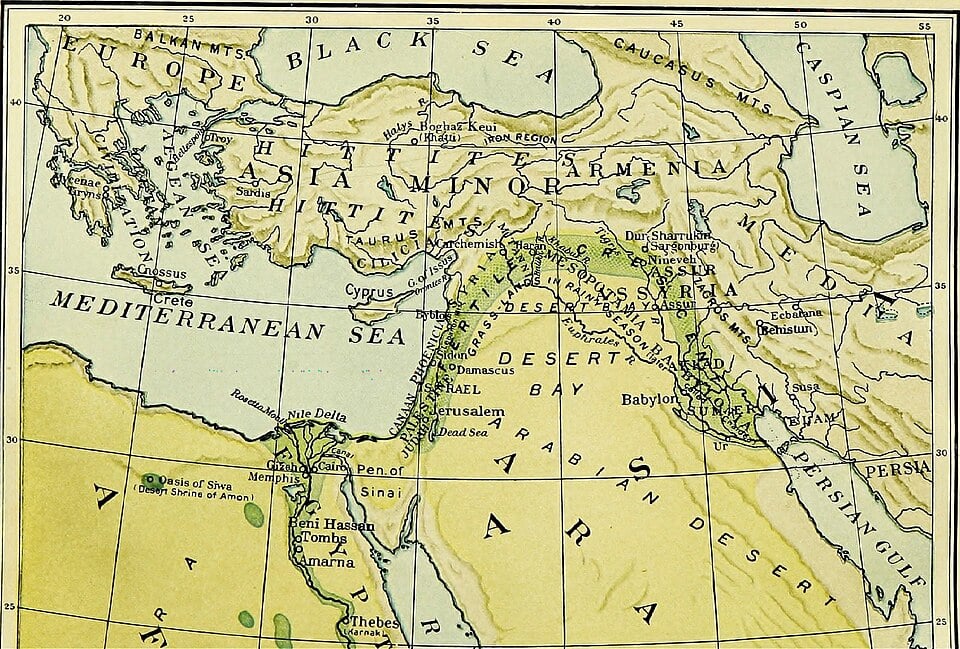
A map of the Levant with assorted overlapping toponym labels. Wikimedia Commons.
“What’s in a name? That which we call a rose /
By any other name would smell as sweet”
(William Shakespeare, Romeo and Juliet, Act II, Scene II)
When it comes to flowers, Shakespeare’s Juliet has a point; not so when it comes to lands or states or territories, whose names ought to be determined by their aboriginal people.
Few nomenclatural matters are as fraught as the rivalrous toponyms Israel and Palestine, though their opposition is largely a modern one. In the late ancient and early classical eras, when the name Palestine first entered the fray, these toponyms were more closely related than most people today realize.
In a pair of notable articles at the turn of the last century (the academic “Palestine and Israel”, BESOR, 1999 and its popular version “When Palestine Meant Israel”, Biblical Archaeology Review, 2001), British-Jewish classicist David M. Jacobson cogently argued that the toponym Palestine, in its original Greek form of Palaistine, was concurrently a literal translation of Israel and a transliteration of Peleshet (Philistia). This “dual interpretation”, as he called it, evinced the Greeks’ predilection for punning, particularly when it came to toponyms.
Jacobson traced the use of the term as originally found in the Histories of Herodotus (c. 450 BCE) and in Aristotle’s Meteorology (c. 340 BCE) and its Latin version, Palaestina, used by a series of Roman authors such as the historian and naturalist Pliny the Elder, the rhetorician Dio Chrysostom, and the poets Ovid and Statius. He cites the two classical Jewish authors—the philosopher Philo Judaeus (Yiddidyah HaAlexandroni) and the historian Flavius Josephus (Joseph ben Mattityahu)—who in their Greek works occasionally employed the term in relation to the Land of Israel.
Building upon the observation first made by German biblicist Martin Noth (“Zur Geschichte des Namens Palastina”, Zeitschrift des Deutschen Palästina-Vereins, 1939), Jacobson notes the uncanny similarity between the toponym Palaistine and the Greek word for wrestler, palaistes, “which share seven letters in a row, including a dipthong!” Since Israel was the name given to the patriarch Jacob after he wrestled and prevailed against an angelic adversary, the Greeks translated Israel (minus the theophoric element, El) into Palaistine, which conveniently functioned simultaneously as a transliteration of Peleshet, the Philistine pentapolis on the southern Coastal Plain of the Land of Israel and the portion of the southern Levant with which the Greeks were most familiar (the Philistines were themselves an Aegean people who had migrated from Crete, c. 1175 BCE).
Jacobson speculates “that the Greeks began by transliterating the Semitic Peleshet or some such word into their language but subsequently, prior to the time of Herodotus, they recognized the similarity between that early name and palaistes and also saw the connection with Yisrael, so that the place name became fixed as Palaistine.”
Throughout, his thesis and argumentation are learned and persuasive. It is only with the conclusions he draws that one is impelled to challenge his views, namely when he infers that Emperor Hadrian of Rome should be absolved of deliberately attempting to sever the connection between Jewry and its ancestral homeland, the Land of Israel, known at the time as Judaea (after the tribal territory of Judah that evolved into the southern Kingdom of Judah, then the Kingdom of Judea under the Hasmoneans and Herodians): “Hadrian’s replacement of Judaea by Syria Palaestina may be seen not so much as stemming from Rome’s desire to rub the Jewish nation off the map as from the desire to rationalize the name of the new province, which was much larger than geographical Judaea.” But this unhappy absolution falls down due to a number of crucial factors that Jacobson neglected to take into account, which are as follows:
- Judaea was an endonym or autonym (the name of a place applied by its natives), while Palaestina was an exonym (the name of a place applied by outsiders). Renaming Judaea was an inherently punitive measure that robbed the indigenous population of the right to call its land and polity by their historical names or by names of the natives’ choice.
- Choosing Syria-Palaestina instead of the more obvious Syria-Judaea evidences the intention to disrespect the autochthonous nation’s identity and heritage by imposing an exogenous toponym, even though legitimately precedented, upon their homeland.
- Hadrian had in fact done the same thing to Jerusalem around the same time. In 129/130 CE, he visited ruined Jerusalem and determined to rebuild the Holy City as a Roman colony to be named Aelia Capitolina, in honor of himself (Aelius Hadrianus) and of the Roman chief deity (Jupiter Capitolinus). In 135, he was able to implement his agenda following the failed Bar Kokhba Revolt (132–135 CE). By renaming Jerusalem after his own family (the Aelii) and his supreme god, he was effectively effacing the historical toponym while accenting Rome’s imperial-colonial domination of the ancient Jewish capital.
- Hadrian initiated the infamous Hadrianic persecutions (135–138 CE) of Jewry’s sages and leaders, including Akiva ben Joseph and Hananiah ben Teradyon, in a deliberate attempt to uproot the Torah and Judaism from the land and its native people.
- The Romans (like other peoples, including the Egyptians) had a longstanding cultural practice, known in Latin as damnatio memoriae (“condemnation of memory”), wherein an individual—usually a deceased emperor—was damned and subjected to erasure from the historical record. If the Roman Senate or a subsequent emperor despised the previous emperor, they could seize his property, erase his name from inscriptions and documents, and deface his statuary. Hadrian’s innovation was simply to apply this practice of damnatio memoriae on a national scale to a polity, whose people had repeatedly revolted and been defeated only at great cost to the Roman legions; what had been the Kingdom of Judea under the Hasmoneans and Herodians and then the imperial province of Roman Judaea would thenceforward be, and not by benign happenstance, Syria-Palaestina.
For the aforementioned reasons, Jacobson’s whitewashing of Hadrian remains unconvincing and thus unacceptable. It is unrealistic to ascribe merely an administrative motive to Hadrian, who proved both victorious and vindictive, for his renaming of Judaea. The facts, and human nature, suggest that he knew full well what he was doing, and from that time to this, the perspicacious have known it, too.
Related Topics
Related Posts