

Geopolitical Analyst: Bridging Somaliland & Israel to the world
Israel’s New Government: What’s at Stake for Somaliland?
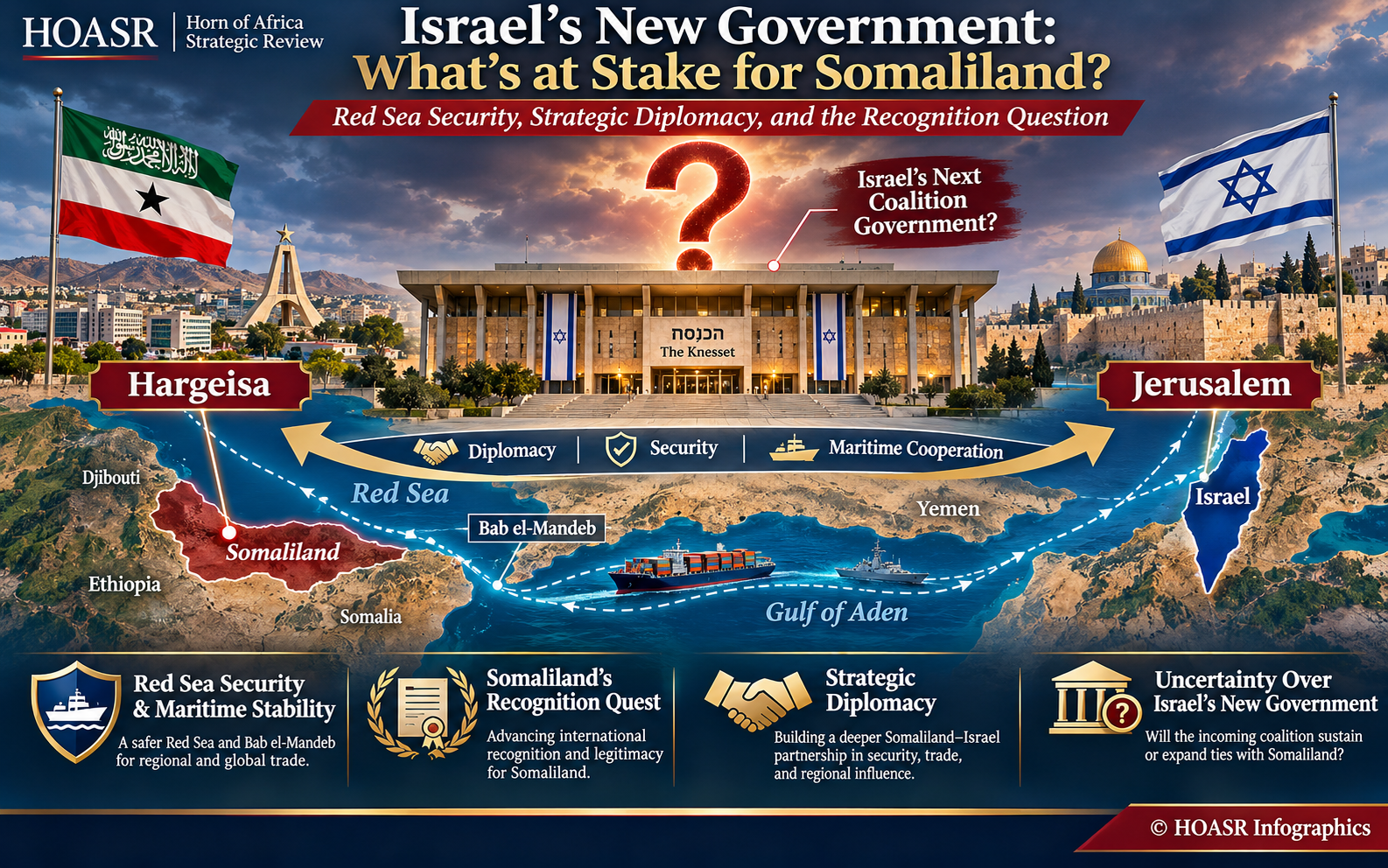
Israel’s political transition raises questions about the future of its strategic partnership with Somaliland, international recognition and maritime security in the Red Sea. © HOASR Infographics.
As Gadi Eisenkot seeks to form Israel’s next government, Somaliland faces a new diplomatic challenge: ensuring that historic recognition becomes a lasting strategic partnership, regardless of who governs in Jerusalem
Israel’s political landscape has changed, but its strategic geography has not. Following the October 27 parliamentary elections, Prime Minister Benjamin Netanyahu faces the prospect of leaving office, while former military chief Gadi Eisenkot has been entrusted with forming a new government.
For Somaliland, which received Israel’s historic diplomatic recognition less than eleven months ago, these developments raise an important question: Will the relationship survive a change of leadership in Jerusalem, and can it develop into something more consequential than the political circumstances that brought it into being? [Israeli Presidency]
The question deserves attention but not alarm. Israel’s recognition of Somaliland on December 26, 2025, was a sovereign decision announced by the Israeli government, accompanied by a joint declaration establishing diplomatic relations.
That decision was not merely a personal commitment between Netanyahu and President Abdirahman Mohamed Abdillahi Irro. The incoming Israeli government, whatever its political composition, will inherit that diplomatic reality, together with the strategic considerations that helped bring the two countries closer. [Israeli government recognition]
A Government in Negotiation, a Country at a Crossroads
On November 8, President Isaac Herzog formally entrusted Eisenkot, leader of the centrist Yashar party, with forming Israel’s next government. His decision followed consultations in which parties representing 67 members of the 120-seat Knesset recommended Eisenkot, compared with 46 recommending Netanyahu.
Yet those recommendations do not automatically translate into a governing majority, and Eisenkot must negotiate across considerable ideological and religious divisions. [Israeli Presidency] [Times of Israel]
The electoral arithmetic reveals the problem. Netanyahu’s existing political bloc secured 53 seats, eight short of a majority. Eisenkot’s principal opposition partners collectively hold 48, while Arab-led parties control another 19.
Although the parties opposed to Netanyahu could theoretically command 67 seats, disagreements over the participation of Arab parties, ultra-Orthodox military exemptions, and leadership responsibilities have complicated the formation of a workable coalition. [Times of Israel] [Eisenkot’s coalition proposal]
Both Netanyahu and Eisenkot have invoked the need for national unity, but their proposals differ fundamentally. Netanyahu has called for a broad government under Likud’s leadership, while Eisenkot has advocated a national emergency coalition and ruled out serving under Netanyahu.
The disagreement became more pronounced on November 10, when Eisenkot canceled a planned meeting with Likud negotiators following Netanyahu’s remarks at the opening of the new Knesset. [Israel Hayom] [Associated Press]
Israel remains in a period of political transition. Whether negotiations produce a broad unity government, a narrower coalition or another attempt at government formation, the incoming leadership will confront familiar security challenges: Iran, the aftermath of the Gaza war, regional diplomatic relationships and the protection of vital maritime routes.
Netanyahu Opened the Door. Israel Must Decide How Far to Walk Through It.
Somaliland has good reasons to acknowledge Netanyahu’s role in its diplomatic breakthrough. His government’s decision on December 26, 2025, ended decades in which Somaliland’s restored sovereignty remained outside formal recognition by individual United Nations member states.
Foreign Minister Gideon Sa’ar also played an important role in developing bilateral engagement, culminating in the announcement of full diplomatic relations and plans for cooperation in agriculture, technology, health and economic development. [Israeli recognition announcement]
The Israeli foreign ministry’s immediate instruction to institutionalize ties reinforced the seriousness of that commitment. Recognition was presented as a starting point for direct governmental engagement rather than an announcement confined to diplomatic language. [Israeli Foreign Ministry]
Netanyahu’s contribution deserves recognition in Somaliland’s diplomatic history. However, there is a fundamental difference between acknowledging the statesman who initiated a relationship and allowing the relationship itself to become dependent upon his political future.
Somaliland cannot afford to treat Israel as synonymous with Netanyahu, just as Israel should not regard Somaliland as a diplomatic initiative tied exclusively to one administration. Both states have institutional interests extending beyond individual leaders, political parties and electoral cycles.
This contrast is particularly important because Eisenkot’s possible premiership would introduce a different governing style and set of domestic priorities. His military background may influence the emphasis placed on national security, regional deterrence and strategic partnerships.
Nevertheless, it would be premature to assume his prospective government would automatically preserve every initiative of the outgoing administration. There has been no confirmed coalition agreement establishing the incoming government’s Somaliland policy. The prudent course for Hargeisa is to prepare for continuity while remaining attentive to possible policy adjustments.
The Red Sea Does Not Change with Israel’s Government
Geography provides the strongest argument for continued Israeli engagement with Somaliland. The Gulf of Aden and the Bab al-Mandab Strait form one of the world’s critical maritime corridors, connecting the Indian Ocean with the Red Sea and the Suez Canal. Threats to commercial navigation, regional instability and Iranian-linked military activity make the security of these waters relevant to Israel’s economic and strategic interests.
Somaliland occupies an important strategic position along the southern side of this corridor. Its coastline, Berbera Port and access to the Ethiopian hinterland offer opportunities for maritime cooperation, logistics, commercial development and regional connectivity. These geographical characteristics do not disappear when a government changes in Jerusalem.
Yet Somaliland’s strategic location should not be mistaken for an automatic entitlement to Israeli military assistance or investment. Strategic partnerships require negotiated agreements, reciprocal interests, credible institutions and clearly defined responsibilities.
Although, the establishment of diplomatic relations creates political foundation; it does not substitute for the practical work required to build a durable long-lasting partnership.
Even though, a future Israeli government may approach the region differently, particularly in its dealings with African states, Arab partners and Western allies. But any assessment of maritime security around the Bab al-Mandab would still have to account for Somaliland’s location and its established governing institutions.
Obviously, that is where Somaliland’s diplomatic efforts should concentrate: demonstrating that cooperation with Hargeisa serves enduring Israeli interests rather than the preferences of a particular political coalition.
From Historic Recognition to Institutional Responsibility
Formal recognition has already established a diplomatic foundation. The subsequent challenge is to expand working relationships between foreign ministries, trade and investment agencies, agricultural institutions, universities and relevant security bodies.
Additionally, technical cooperation in water management, food security, medical services and technological innovation would also give the relationship practical value beyond high-level diplomacy.
When President Irro met Israel’s Ambassador to the United Nations, Danny Danon, in September 2026, Somaliland’s Foreign Ministry reported discussions covering maritime security, economic development, technology, agriculture, investment and regional stability.
In fact, these areas provide a useful basis for sustained cooperation, although implementation must ultimately be judged by agreements, projects and measurable outcomes. [Somaliland Foreign Ministry]
For Hargeisa, diplomatic engagement should extend to the full spectrum of Israeli political and institutional leadership. That includes the office of the president, the Knesset, the foreign affairs and defense establishments, and political figures who may enter the next coalition.
Such engagement would not represent a departure from the relationship established under Netanyahu. Rather, it would strengthen the possibility that the relationship becomes a national Israeli commitment maintained across successive governments.
The African Dimension Cannot Be Ignored
Israel’s recognition of Somaliland also carries implications beyond bilateral relations. It challenges a diplomatic environment in which Somalia continues to claim sovereignty over Somaliland despite Hargeisa’s separate institutions, territorial administration and declared restoration of independence in 1991.
Somaliland’s case remains contested internationally, particularly within the African Union, where territorial integrity and the implications of recognition for other disputes are central concerns.
Somalia rejects Somaliland’s independence, while Somaliland maintains that its claim arises from the restoration of sovereignty first obtained from Britain on June 26, 1960, before the attempted union with the former Italian-administered territory.
Israeli recognition did not resolve this dispute or establish a binding precedent for other countries. It did, however, demonstrate that an individual state was prepared to establish full diplomatic relations with Somaliland despite objections from Mogadishu.
Whether Israel is governed by Netanyahu, Eisenkot or a broader coalition, that decision will remain part of the diplomatic record.
The Scoop: Recognition Was the Beginning, Not the Destination
For Hargeisa, the strongest diplomatic strategy is to build upon existing recognition while independently advancing Somaliland’s case with African, Western, Asian and Middle Eastern governments.
The negotiations now unfolding in Jerusalem will determine who forms Israel’s next government. They will not, by themselves, determine the ultimate value of Somaliland’s recognition.
Netanyahu’s government made a consequential diplomatic decision. Eisenkot, if he succeeds in forming a government, would inherit both that decision and the broader regional geopolitical circumstances surrounding it
Hargeisa should neither tie its expectations to Netanyahu’s political survival nor presume that a successor would necessarily be indifferent to Somaliland.
The real test is not whether Benjamin Netanyahu remains prime minister but whether Israel’s recognition has matured into a relationship that can withstand the ordinary changes of democratic government and the dynamics of geopolitics in the region.
Related Topics
Related Posts