
Greek Jewish roots. New York voice. Unfiltered perspective.
Israel Votes, Part II: After October 7, What Are Israelis Actually Voting For?
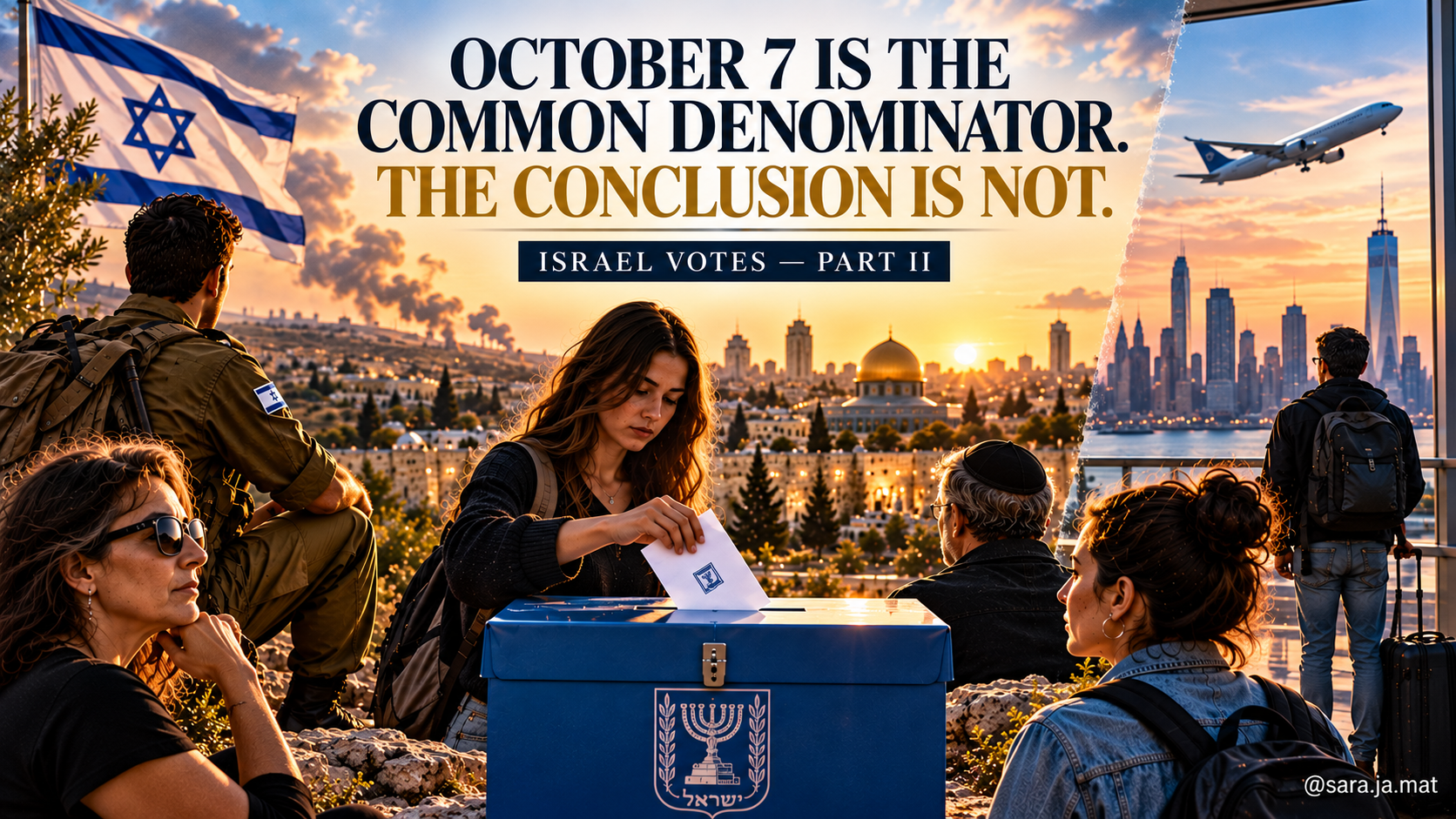
I asked Israelis in Israel and Israelis abroad — soldiers, immigrants, first-time voters and people who have been voting for decades. They did not give me one answer. That may be the answer.
In Part I of this series, I asked why a soccer mom in Nebraska should care about an Israeli election.
I explained the parties. The threshold. The coalitions. The scramble to get to 61 seats.
And I introduced you to a 22-year-old American who moved to Israel at 20 and will vote in her first Israeli national election.
I promised we would come back to her.
But first, I wanted to stop talking about Israelis as polling data and start talking to them.
So I sent questionnaires. I conducted interviews. I had conversations with Israelis in their 20s, 50s and 60s. People born in Israel. People who chose Israel. People who left Israel decades ago but never quite left it behind. Soldiers who fought in Gaza and Lebanon. Israelis who watched October 7 from America. An Israeli in the south who experienced rockets falling near her building.
I asked many of them the same questions.
Did October 7 change you politically?
What matters most now?
Security? Accountability? Gaza? Iran? The economy? The Haredi draft? Religion and state?
Is this election about Benjamin Netanyahu?
And twenty years from now, what do you think this election will have been about?
Israel will vote on October 27 in its first national election since October 7.
A September 2026 Israel Democracy Institute survey found that 68% of Jewish respondents consider October 7 a central factor in deciding which party to support. Among Jewish respondents, foreign affairs and security and the economy and cost of living were the two leading considerations.
One 56-year-old woman who has lived in Israel her entire life put the stakes more starkly.
“This election feels like a life-and-death election.”
She told me she would not even plan a trip abroad around Election Day because she refuses to risk missing her vote.
My interviews are not a scientific poll.
A few dozen conversations cannot tell us what millions of Israelis will do.
But they can tell us something polls sometimes cannot.
Why.
And after listening to their answers, one thing became very clear.
October 7 is the common denominator.
The conclusion is not.
THE 22-YEAR-OLD I PROMISED YOU
Let’s go back to the young woman from Part I.
She grew up in New York and made aliyah at 20. She is now 22, studying in Israel and preparing to vote in her first Israeli national election.
She was in America on October 7.
She remembers being in synagogue as the information coming from Israel became progressively worse.
October 7 did not frighten her away from Israel.
It did the opposite.
It pushed her harder toward aliyah.
She told me that what happened that day, followed by what she experienced as growing hostility toward Israel in America, strengthened her conviction that her future belonged there.
Politically, however, she is much less certain.
She describes herself as independent. She is critical of how the war was handled. She believes there were serious failures surrounding October 7. She thinks Israel may need new leadership.
But when I asked about the alternatives, she wasn’t sure.
She hasn’t decided how she will vote.
That distinction stayed with me.
She seems more certain about Israel than she is about Israeli politics.
Then I spoke to young Israelis who had been asked to do something she had not.
Fight for it.
THEY FOUGHT FOR ISRAEL. NOW THEY WANT TO KNOW IF THEY CAN BUILD A LIFE THERE.
One is 22.
On the morning of October 7, he was home asleep. It was Shabbat. His parents were away.
His phone kept ringing.
Half-asleep, with no idea what was unfolding outside his bedroom, he just wanted to go back to sleep.
But the calls kept coming.
His commander was trying to reach him.
Eventually, his parents contacted a neighbor — a woman he had never even met — and asked her to wake him.
Imagine being 22 years old, asleep at home on a Shabbat morning, and suddenly being shaken awake by a stranger telling you that Israel is under attack and your commander has been trying to reach you.
He was called to duty.
Friends of his would not survive the war.
When I asked how everything since October 7 had changed him, he didn’t begin with politics.
He began with life.
“Life is short,” he told me.
He talked about watching friends die young and what that taught him: don’t give up on your dreams.
We talk constantly about how October 7 changed Israeli politics.
We talk less about how it changed what it means to be 22.
Another young Israeli I interviewed is 23, recently discharged from mandatory service and still serving in the reserves. He told me he spent more than 500 days fighting in Gaza and Lebanon.
He lost friends too.
“I don’t think people who haven’t experienced combat can truly understand what it means to be in a war — to fight, to see difficult things, and to lose friends,” he told me.
He believes there has not been sufficient accountability for the failures surrounding October 7. He also sees a distance between those making decisions and those carrying them out.
“It is very easy to sit in the Knesset while young soldiers are the ones entering Gaza and facing the reality of the war on the ground.”
But when I asked what issues mattered most in this election, his answer wasn’t only security.
It was security and the cost of living.
“I want Israelis to be able to live with financial stability and also feel safe in their own country.”
The other 22-year-old former soldier told me essentially the same thing.
October 7 wasn’t what made him question whether he could stay in Israel.
The economy was.
He talked about the price of apartments and how impossible it can feel for someone his age to imagine buying even a small home in central Israel.
How do I build a life here?
That is the question underneath his answer.
Israel is asking this generation to defend the country.
Some are asking whether they will be able to afford to live in the country they defended.
WHO CARRIES THE LOAD?
Both young former soldiers brought me, in different ways, to another issue: burden sharing.
The 22-year-old spoke emotionally about Haredi men who do not serve while young people like him are sent to fight.
His frustration wasn’t with religious Jews as people. He distinguished between people he knows who work, serve and contribute and a system he believes allows others not to carry an equal burden.
Then I heard something similar from a 56-year-old woman who has lived in Israel her entire life.
She wants the religious community to participate more fully in society.
That doesn’t necessarily mean combat service, she told me. It could mean helping the elderly, performing national service or contributing in other ways.
Her phrase was simpler:
“A fair division of responsibility.”
The Israel Democracy Institute’s September survey found that 27% of Jewish respondents named a party’s position on conscription as one of their two most important considerations when deciding how to vote.
But the interviews make the abstraction personal.
Who fights? Who serves? Who works? Who carries the burden?
For some voters, those have become questions of fairness.
ACCOUNTABILITY — BUT NOT THE WAY YOU MIGHT EXPECT
I expected October 7 accountability to divide neatly along political lines.
It didn’t.
A woman in her 50s who was raised in Canada and the United States, made aliyah and now lives in Israel describes herself as right-wing.
She wants an independent investigation.
One word appeared emphatically in her answers:
ACCOUNTABILITY.
A 61-year-old Israeli-born woman living in southern Israel experienced repeated rocket fire on October 7, including rockets landing close to her building.
She supports the current government.
She also believes what happened on October 7 has not been investigated deeply enough.
A 56-year-old Israeli-born man who has lived in America since the 1980s supports Netanyahu.
He too wants what he describes as a proper, independent and nonpolitical investigation into the failures preceding October 7 and the response during the early hours of the attack.
Then another 56-year-old Israeli woman told me almost the opposite.
She isn’t interested in looking backward for accountability.
“I care about what will happen from now on.”
Demanding accountability does not, at least among the people I spoke with, fit cleanly into a left-right box.
Neither does deciding that accountability isn’t the priority.
IS THIS REALLY AN ELECTION ABOUT BIBI?
Ask almost anyone about Israel’s election and eventually one name arrives.
Benjamin Netanyahu.
Yet several people with very different political views independently resisted reducing this election to him.
The 61-year-old woman in southern Israel supports the current government. Yet when I asked what people would say about this election twenty years from now, she wondered why so much attention had been paid to Netanyahu and so little to the fundamental goals of the country and how to achieve them.
One of the 22-year-old former soldiers, who is critical of Netanyahu, made essentially the same complaint from the opposite direction.
He sees voters who love Netanyahu and voters who hate him and worries that both can become so focused on one man that they stop examining everyone else asking for their vote.
The 23-year-old reservist put it this way:
“I think this election is about all of Israel, not just one person.”
The 56-year-old Israeli woman who has lived in Israel all her life plans to support a Netanyahu alternative. Yet she told me that while she does not plan to vote for him, she respects what she believes he has contributed to the country.
She sees herself as voting for someone, not simply against Netanyahu.
These people don’t agree about Netanyahu.
That’s the point.
They are asking a larger question:
What are we actually choosing?
“BUT DISTANCE DOES NOT MEAN INDIFFERENCE.”
Then there are the Israelis watching this election from thousands of miles away.
Most ordinary Israeli citizens living overseas cannot simply request an absentee ballot. Israeli election rules provide overseas voting only in specified circumstances; otherwise, eligible voters abroad generally have to return to Israel to cast their ballots.
So I asked Israelis living in America:
Do you care enough to get on a plane?
It turns out the more interesting question isn’t about airfare.
It’s about moral standing.
One Israeli-American told me that Israel remains home to him in a profound sense. Much of his family is there.
October 7 made the distance painful. He was safe while people he loved were not.
He is also acutely aware that watching Israel from America is not the same as living through sirens, reserve duty, evacuations, economic disruption and war.
Then he gave me the sentence that became the title of this section:
“But distance does not mean indifference.”
He intends to get on a plane and vote.
“When I get on the plane to vote, it will not simply be because I think one particular politician is the answer to Israel’s problems,” he told me. “It will be because I believe that Israel’s future is important enough to participate in its democracy.”
Another Israeli woman grew up in Eilat and has lived in New York for about 30 years.
October 7 brought Israel roaring back emotionally.
“That’s my home and where my heart is,” she told me.
Yet she questions whether someone who has lived abroad for decades should help choose the government for those who live there every day.
Still, if she could vote by mail, she says she would. If someone subsidized the trip, she says she would go.
Then came a third Israeli living in New York.
Born in Haifa, he moved to the United States in 1984. He describes Israel as his homeland and America as his adopted home.
His description of Israel stopped me:
Israel is the insurance policy of the Jewish Diaspora.
“We never know when we might need to cash that policy,” he told me.
He cares deeply about Israeli politics. He supports Netanyahu.
And he will not vote.
Not because the flight is too expensive.
Because he believes voting when he doesn’t live with the consequences would be wrong.
“The interests have to be aligned.”
Three Israelis in America.
One will get on the plane.
One questions whether she should vote but would if the logistical barrier disappeared.
One believes that even if the barrier disappeared, he still shouldn’t vote.
Does citizenship give you a voice?
Does residency create a greater claim?
Does loving a country from afar create an obligation to participate?
Or an obligation to step aside?
They don’t agree.
THE PEOPLE WHO CHOSE ISRAEL
And then there are the Israelis who weren’t born Israeli at all.
They chose it.
Earlier, I mentioned the woman in her 50s who wants an independent investigation into October 7. Her story began long before the war.
Raised in Canada and the United States, she first encountered Israel as a young woman. She made aliyah in 2004 and later returned to America.
On October 7, she was in North Carolina.
She was alone.
And something crystallized:
“I was Israeli.”
In May 2025, she returned to live in Israel.
Then there is the 22-year-old American from Part I.
She didn’t run from Israel after October 7.
She moved toward it.
Put those two women beside the Israelis in America debating whether they should vote, and the question of who is “Israeli enough” suddenly becomes much harder.
One person can be born in Israel and decide that living abroad means he shouldn’t vote.
Another can be born in America, make aliyah at 20 and prepare to cast her first Israeli ballot.
Identity does not move in only one direction.
Neither does belonging.
SO WHAT ARE THEY VOTING FOR?
After dozens of conversations, I cannot tell you what “Israelis” are voting for.
That would be dishonest.
The people I spoke with are not Israel.
But I can tell you what I heard.
Security and the cost of building a life. Accountability and the desire to move forward. Who serves. Who contributes. Who gets to vote. What Israel owes its young people — and what its citizens owe Israel.
I heard people who support Netanyahu, people who don’t and people who haven’t decided.
And across those divisions, I heard something larger than one politician.
October 7 may be the common denominator.
It is not the common conclusion.
Maybe the question underneath Israel’s first national election after October 7 isn’t simply:
Who should lead Israel?
But:
What kind of Israel are they being asked to lead?
A country its young people can imagine not merely fighting for — but living in.
Twenty years from now, I don’t know how the people I interviewed will answer that.
Neither do they.
But one answer from the youngest voter I interviewed keeps coming back to me.
I asked the 22-year-old American who made aliyah what she thought people would say about this election twenty years from now.
She didn’t manufacture an answer.
She simply said:
“I’m not really sure what to answer, to be honest.”
She is 22.
She chose Israel.
She watched friends go to war.
She is about to vote there for the first time.
She knows where she wants to belong.
She just doesn’t know exactly what Israel will become.
Perhaps none of them do.
And perhaps that is why this election matters so much.
Related Topics
Related Posts