
Geopolitical Analyst: Bridging Somaliland & Israel to the world
Israel Votes Today and Somaliland Faces the Politics of Recognition
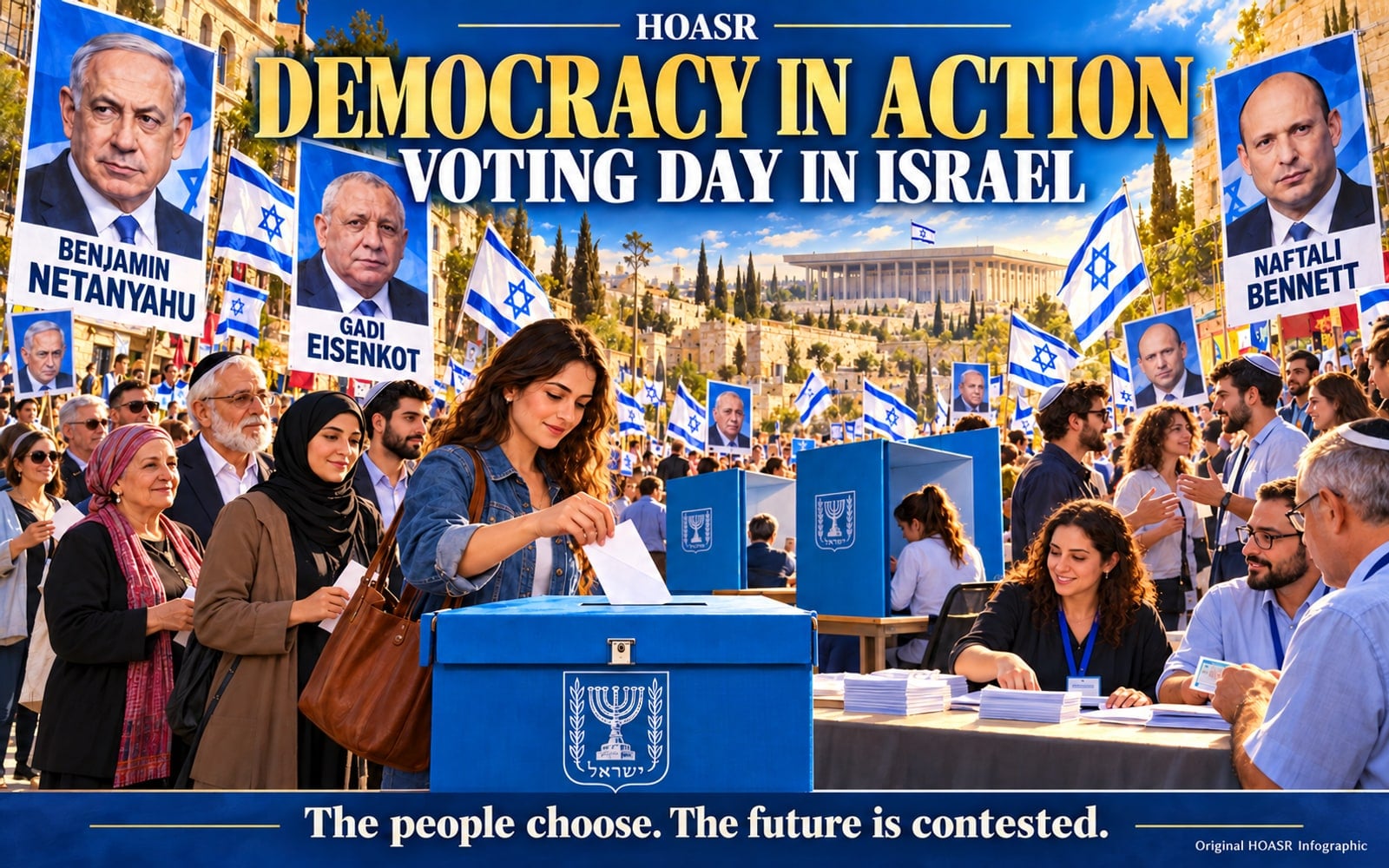
Democracy in action: Israeli voters, competing campaigns and the right to choose political leaders. Original HOASR Infographic.
Israel’s election today offers Somalilanders a reason to celebrate and a reason to think carefully. The celebration belongs to democracy: citizens can judge their leaders, challenge their promises and remove them from office.
The caution concerns Somaliland’s own diplomatic expectations. A foreign election can create an opening, produce a delay or rearrange the people through whom a relationship has developed.
Somaliland approaches this moment with an experience many of its neighbours cannot claim. Its 2024 presidential election brought an opposition candidate to power through the ballot box. International observers recorded a peaceful, well-managed election day.
Such an achievement gives Somalilanders a natural interest in another society’s competitive politics, even when its choices are contentious and its policies invite criticism. Observers
The democratic connection is strongest when it includes accountability. Somaliland’s election delays and Israel’s arguments over judicial independence show how much depends on institutions between elections.
Voting provides citizens with an opportunity to demand better government. It does not excuse every decision a government makes, or settle every question about the rights of people affected by its power. VOA FreedomHouse
For Israelis, the immediate contest concerns leadership after the October 7 attacks and the wars that followed. Benjamin Netanyahu faces Gadi Eisenkot and a fragmented opposition, with neither side assured of a governing coalition.
Even a major electoral setback for Netanyahu might be followed by lengthy negotiations rather than an immediate transfer of power. Somalilanders watching the count should expect the political bargaining to continue afterwards. Reuters
The most revealing development before voting was Trump’s renewed endorsement of Netanyahu. Netanyahu presented his access to the American president as a reason to keep him in office. Eisenkot responded that he expected Trump to cooperate with any leader Israelis elected.
Their disagreement exposed a familiar vulnerability in international relations: how much of a partnership belongs to its institutions, and how much depends on personal access? Reuters
Somaliland has good reason to follow that argument. Netanyahu’s government made the recognition decision in December 2025. Hargeisa can acknowledge the political courage involved without turning gratitude into an obligation to campaign for his re-election.
Israeli voters have their own responsibilities, grievances and priorities. Friendship with Somaliland cannot reasonably require them to suspend those judgments. Israel
There is also a practical problem with reading every Israeli political development through Somaliland’s hopes. An Israeli voter worried about military service, family income or an independent inquiry into a security failure is not voting on Hargeisa’s international standing.
Foreign-policy decisions are made by governments whose survival depends largely on domestic concerns. Somaliland’s interests enter that process alongside many others.
The government’s recognition decision remains an important foundation. A new coalition could change its pace of engagement or the weight it gives particular projects. The ballot itself supplies no verdict on Somaliland’s recognition.
The composition of the next cabinet, its diplomatic programme and its actual decisions will be more useful indicators than the emotional claims made during a campaign.
Israel’s strategic reasons for looking toward Somaliland extend beyond any individual politician. Red Sea insecurity and threats from Yemen have increased the importance of reliable regional relationships.
Research published by ISPI connects Israel’s renewed Horn of Africa engagement to those security concerns. Such interests can support continuity, although they do not guarantee the approval of every proposed agreement. ISPI
For Somaliland, that creates an opportunity accompanied by a responsibility. A durable relationship needs benefits visible to its own population: medical cooperation, productive investment, agricultural skills and opportunities for students.
Security cooperation may be valuable, but a partnership explained entirely through other countries’ military requirements will struggle to command broad public confidence. Somalilanders are entitled to know how cooperation improves their future. This is especially important while regional governments are arguing over who may choose Somaliland’s partners.
The China–Djibouti communiqué published on 22 October opposed Somaliland’s diplomatic recognition and its relationship with Taiwan. Its language connects Hargeisa’s recognition campaign directly to Beijing’s dispute with Taipei. Somaliland is being drawn into a confrontation larger than the original bilateral relationship. Communique
The resulting pressure reaches beyond an objection to one embassy or one visiting delegation. It challenges Somaliland’s ability to maintain relationships according to its own judgment. That is why the issue resonates at home.
A country that has repeatedly asked outsiders to respect its voters cannot easily accept that external powers should possess the final word over whom its elected government may engage.
The El Alamein declaration earlier this month reinforced the difficulty. Egypt, Sudan, Eritrea and Somalia opposed recognition of Somaliland while asserting coastal states’ exclusive responsibility for Red Sea governance.
The different governments have divergent interests, but their positions can combine to narrow Hargeisa’s diplomatic space. The pressure does not stop because an Israeli coalition is being negotiated. Declaration
Ethiopia’s military leadership has meanwhile reaffirmed its determination to defend national interests in the Red Sea. Field Marshal Birhanu Jula’s 25 October address placed maritime aspirations alongside Ethiopia’s interests in the Blue Nile.
Those remarks demonstrate the continuing regional contest. However, Addis Ababa has not yet made a new commitment to recognise Somaliland or implement a particular maritime agreement. ENA
The latest developments reveal a difficult imbalance of timing. Somaliland’s partners have elections to contest and governments to form. Its opponents can continue issuing joint positions and building diplomatic support for restrictions.
Delay therefore carries consequences even when no friendly government has reversed its policy. The strategic environment can become less accommodating while the formal diplomatic position remains unchanged.
Nevertheless, life goes on and democracies must attend to their citizens, and sometimes government formation can be slow. It does mean that Somaliland cannot measure progress only by warm statements or photographs. Implementation, official representation and sustained working relationships provide a clearer account of whether a diplomatic opening is becoming useful.
The American election is another issue of concern for Somalilanders. On 3 November, voters will determine control of Congress. The latest Reuters/Ipsos poll puts Trump’s approval at 32 per cent and shows Democrats leading Republicans among registered voters on the national congressional ballot. Those findings indicate a difficult environment for Republicans; they cannot settle the outcome of individual House and Senate races. Reuters
The implications for Somaliland are more complicated than the familiar division between friendly Republicans and hostile Democrats. Congressional committees influence spending, hearings and the legislation through which a relationship develops. A change of majority could replace important gatekeepers. Individual members’ views on Somaliland would still require examination; party membership alone would not supply a complete answer.
Israel faces the same complication on a much larger scale. Criticism of its government has become more pronounced in American politics, while opinion varies within both parties. Pew’s research documents substantial differences between younger and older Republicans in their attitudes toward the Israeli government. An assumption of permanent support from one party overlooks changes already occurring inside that party. Pew
For Somaliland, association with Israel should therefore strengthen its independent case rather than swallow it. Its democratic record and history deserve a hearing on their own terms. An American legislator may object to Israeli policy in Gaza while remaining open to engagement with Somaliland. Conversely, support for Israel does not automatically answer every American concern about the Horn of Africa.
A Democratic victory would increase the possibility of investigations and confrontation with Trump. It would not automatically produce impeachment, and impeachment would not itself remove him.
The House brings charges; conviction requires two-thirds of senators present. Somaliland’s diplomatic planning gains little from treating either Trump’s removal or his freedom from congressional pressure as a predetermined outcome. Senate
The president would retain a significant constitutional power: formal recognition of foreign states. The Supreme Court has held that this authority belongs exclusively to the executive. Congress nevertheless shapes the resources and legislation that can give a recognition decision practical effect. A president’s authority and his willingness to use it remain separate political considerations. Congress
Trump could seek a diplomatic achievement if the midterms weaken his domestic position. He could also become more absorbed by political conflict at home. There is no dependable rule that adversity in Washington produces action in Hargeisa’s favour. Somalilanders have grounds for hope, but hope becomes vulnerable when it is repeatedly presented as an approaching announcement without a confirmed decision.
The Abraham Accords remain relevant because Israel’s recognition announcement explicitly invoked their spirit. Somaliland offers the possibility of expanding peaceful relations with a Muslim-majority society willing to cooperate openly.
But Washington’s priorities, the next Israeli government’s calculations and the terms of any arrangement would still have to align. A legacy argument can attract attention without determining the final policy. Israel
The democratic argument also carries moral obligations. Somaliland can reject antisemitism without endorsing every Israeli action. It can defend its friendship with Israel while expressing concern for Palestinian civilians and supporting lawful political rights.
Respect for Jewish security and respect for Palestinian dignity are compatible principles. A confident diplomatic relationship should allow both to be stated plainly.
Whatever happens today, the next Israeli government will inherit a country seeking security, domestic confidence and a more sustainable international position. Netanyahu’s rivals do not all promise a fundamental change in policy toward the Palestinians.
Some differences concern settlements, political partners and the enforcement of law rather than agreement on Palestinian statehood. Expectations of sweeping transformation deserve the same caution as predictions of complete continuity. Reuters
For Somalilanders, the most useful response to this election is neither panic about losing a friend nor premature celebration of a preferred winner. The real test comes afterwards, when cabinet appointments, diplomatic decisions and practical cooperation reveal the direction of policy.
Israel’s citizens will determine who receives the authority to make those choices.
Somaliland has a mandate of its own. Its people have chosen leaders, sustained institutions and asked the world to recognise the political reality they have built.
Their future deserves more than an anxious wait for another country’s campaign to end. Today’s Israeli vote can change the circumstances around Somaliland’s diplomacy. It cannot decide whether Somalilanders possess a legitimate voice in their own future.
Related Topics
Related Posts