
Geopolitical Analyst: Bridging Somaliland & Israel to the world
Somaliland Pushes Beyond the Containment Ring By China-Djibouti-Somalia-Axis
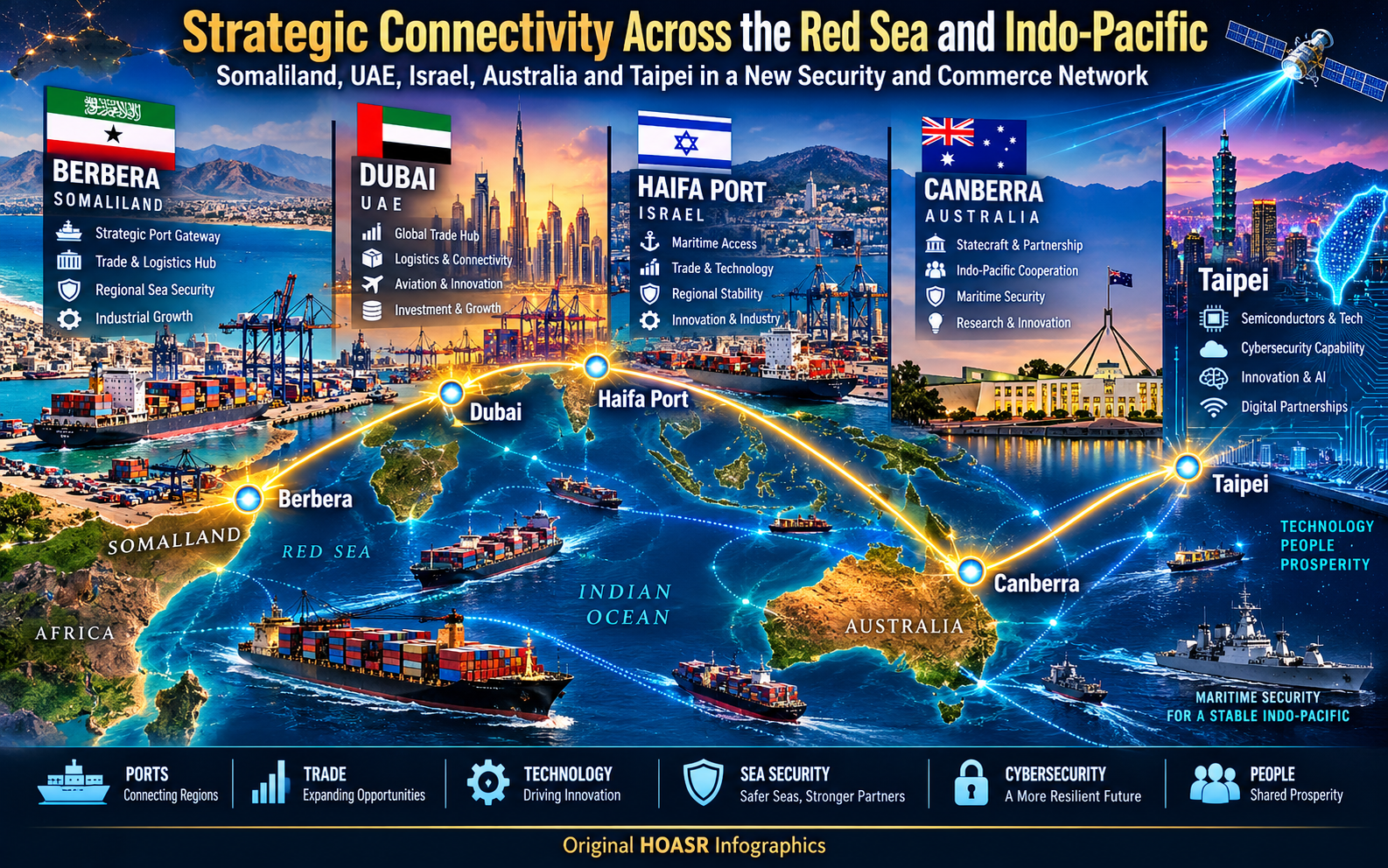
Strategic Connectivity Across the Red Sea and Indo-Pacific — linking Berbera, Dubai, Haifa, Canberra and Taipei through trade, technology, maritime security and cybersecurity. Original HOASR Infographics.
Sydney Is More Than a Speech
President Abdirahman Mohamed Abdillahi Irro’s scheduled appearance in Sydney next month should not be filed away as another presidential trip.
The Jerusalem Post Australia Summit on 19 November brings together business leaders, investors, policymakers, security figures, innovators and academics.
Irro is listed as President of the Republic of Somaliland, while Somaliland’s ambassador to Israel, Dr. Mohamed Hagi, is also among the featured speakers. The agenda includes national security and defence technology, cybersecurity, research partnerships, shipping, logistics and trade corridors. (Post)
That agenda fits Somaliland’s present strategic story unusually well. Berbera, Bab el-Mandeb, Red Sea shipping, Emirati logistics, Israeli security cooperation and Taiwanese technology all meet on the same map.
Sydney gives Irro a chance to present Somaliland less as a diplomatic grievance waiting to be settled and more as a useful strategic partner sitting on one of the world’s most important maritime approaches.
Australia Widens the Field
Somaliland’s recognition campaign has traditionally revolved around Washington, London, Brussels, Addis Ababa, the African Union and a handful of Gulf capitals. Australia broadens that geography.
Canberra is part of Five Eyes (FVEY): The Five Eyes Intelligence Alliance — Australia, Canada, New Zealand, the United Kingdom, and the United States. AUKUS (Australia–United Kingdom–United States Security Partnership) and The Quad: Quadrilateral Security Dialogue — Australia, India, Japan, and the United States, and its foreign policy gives growing weight to maritime security, economic resilience, cybersecurity and critical technologies across the Indo-Pacific and Indian Ocean.
Those priorities make the western end of the Indian Ocean more relevant to Australia than a narrow reading of the Horn of Africa might suggest. (DFAT)
Berbera belongs in that conversation. It faces the Gulf of Aden and sits on the maritime chain linking the Indian Ocean to Bab el-Mandeb, the Red Sea, Suez and European markets. DP World now describes the port as a strategic East African gateway connected to international shipping and inland trade.
For an Australian audience accustomed to thinking in terms of sea lanes and resilient supply chains, Somaliland can be discussed as part of a wider maritime system rather than simply as an unresolved Somali constitutional dispute. (DPWorld)
There is already a constituency for that argument. The Australian Strategic Policy Institute’s publication The Strategist has carried a case for recognition based partly on Indo-Pacific interests and Chinese competition.
The Australian Institute of International Affairs later published another argument asking whether Canberra should reconsider Somaliland’s status. Neither piece represents government policy, but both show that Somaliland has already entered Australia’s foreign-policy debate. (ASPI) (AIIA)
Beijing Has Sharpened the Pressure
China’s opposition to Somaliland’s ties with Taiwan is not new, but its public language has become louder `and the diplomatic field around that opposition has widened. The most notable recent move came on 21 October, when Chinese Foreign Minister Wang Yi and Djibouti Foreign Minister Abdoulkader Houssein Omar met in Beijing.
Their joint communiqué linked Horn of Africa stability, Red Sea shipping, Somalia’s territorial position and opposition to Somaliland’s relations with Taiwan. The two governments also signed a memorandum to advance cooperation under China’s Global Security Initiative. (China)
Djibouti’s participation gives the statement extra weight. Beijing has always had its own Taiwan policy; Djibouti is Somaliland’s neighbour, a major port state and a direct logistics competitor.
China’s Foreign Ministry also used the visit to encourage deeper investment in Djibouti and to highlight the Addis Ababa-Djibouti railway and Djibouti’s role as a regional trade and connectivity hub.
The Chinese and Djiboutian move is not only designed around Berbera, but also does show that diplomacy, security and logistics are increasingly being discussed in the same strategic frame. (Beijing)
Taiwan Is the Pressure Point
Taiwan is central to Beijing’s calculation because Somaliland has refused to treat the relationship as symbolic. Since the representative offices were established in 2020, cooperation has expanded into health, agriculture, education, digital systems and institutional development.
In July 2025 the two sides signed a coast-guard cooperation agreement, adding maritime security to the partnership. That is exactly the kind of state-to-state behaviour Beijing wants other governments to avoid. (Taiwan)
For Somaliland, the Taiwan relationship is also a test of diplomatic independence. Beijing would prefer Hargeisa to accept the one-China framework as the price of easier relations with China. Somaliland has so far chosen another course.
The wider issue for Sydney is not whether Australia should adopt Somaliland’s or Taiwan’s political position. It is whether smaller political sovereign states should be able to choose their partners without coercive pressure from a larger power like China.
The UAE Makes Isolation Harder
The UAE plays a different role. Israel supplied the diplomatic breakthrough. Taiwan built a durable development and technology partnership. Abu Dhabi helped build the physical infrastructure that makes Somaliland difficult to treat as a blank space.
DP World’s Berbera investment tied the port to an international logistics network, while the economic zone and road connections give the relationship a commercial life that extends beyond formal recognition. (DPWorld)
It would be a mistake, however, to describe the UAE as part of a simple anti-China camp. Abu Dhabi maintains a strong strategic partnership with Beijing. Only days before Wang Yi’s meeting with Djibouti’s foreign minister, he met UAE presidential envoy Khaldoon Khalifa Al Mubarak and both sides publicly praised the depth of China-UAE relations.
The UAE can work closely with China while investing in Berbera, maintaining close ties with Israel and protecting its own commercial interests. That flexibility is one reason its relationship with Somaliland is so valuable. (China)
What the Containment Pressure Actually Looks Like
There is no public evidence of one centrally directed campaign in which China, Somalia, Djibouti, the African Union, the OIC and other governments are following a single operational plan against Somaliland.
The picture is more complicated. Their motives differ, and in several cases their interests compete. What matters is the cumulative effect: many separate policies can still narrow Somaliland’s diplomatic room in the same direction: containment strategy.
The diplomatic layer is straightforward. Somalia continues to mobilise support for its territorial claim. The African Union rejected Israel’s recognition and reaffirmed its longstanding position that Somaliland remains part of Somalia.
The OIC went further, calling on members and international organisations to avoid official or quasi-official engagement with Somaliland outside Mogadishu’s framework. These positions raise the political cost for governments considering closer relations with Hargeisa. (AU) (OIC)
The administrative layer is less dramatic but can be just as consequential. Airspace management, electronic visas, airline systems, international coding and other technical arrangements determine how Somaliland is presented to travellers and institutions every day. These disputes are not merely bureaucratic irritants; they concern who is treated as the competent authority in practice. (Airspace)
This is why the word containment is useful if it is used carefully. Somaliland is not being physically blockaded, and its government is not being prevented from conducting foreign relations.
The pressure is subtler: keep recognition politically expensive, keep international systems routed through Mogadishu, make Taiwan ties costly, discourage third countries from opening new channels and preserve the assumption that Somaliland is an internal Somali matter.
If enough institutions follow that path, diplomatic isolation can reproduce itself without any single dramatic confrontation.
Sydney Is a Countermove
Against that background, the Sydney appearance carries more meaning than its conference format suggests. Only weeks after China and Djibouti publicly reinforced opposition to Somaliland recognition and Taiwan ties, Irro is scheduled to appear in Australia under the title President of the Republic of Somaliland.
A conference badge is not recognition, but international legitimacy often advances through repeated practical treatment long before governments alter formal policy. (Post)
Every direct meeting, investment agreement, university partnership, security dialogue and international platform makes it harder to keep Somaliland inside the old diplomatic box. Somalia’s strongest position is the presumption that foreign governments should deal with Hargeisa only through Mogadishu.
Somaliland’s answer is to create enough direct relationships that this presumption becomes increasingly detached from everyday reality.
The Scoop
The significance of Sydney is not the microphone. It is the timing. Israel has broken the recognition barrier. Taiwan is deepening cooperation despite Chinese pressure. The UAE has embedded Berbera in a commercial network that Mogadishu has been unable to reverse.
China is now irritated and is speaking more openly about Somaliland and Taiwan, while Djibouti has now attached itself publicly to that position. At the same time, Mogadishu continues to use diplomatic and administrative channels to reinforce its claim of authority in order to isolate Somaliland.
Somaliland’s response is to move outward rather than inward: Washington, New York, Jerusalem and now Sydney. The contest is increasingly between efforts to keep Somaliland diplomatically contained and Somaliland’s effort to create enough international facts on the ground that the old framework can no longer hold but to crumble.
The most useful measure of Irro’s Australia visit will depend upon whether Canberra and Australian security thinkers, investors, policymakers and institutions begin to see Somaliland differently:
Berbera as a strategic gateway rather than a disputed Somali port; Taiwan as evidence of independent foreign policy rather than an inconvenient complication; Israel as the beginning of a diplomatic opening rather than an isolated event; and the UAE as proof that serious international partnerships can survive Mogadishu’s objections.
Recognition rarely arrives because one speech changes a government’s mind. It arrives after the strategic facts change, the network of interests widens and the old policy begins to look less realistic than the new one. Sydney gives Somaliland another chance to move that process forward.
Related Topics
Related Posts