
Life in the AI era: Israel and beyond
Israel’s AI Inventing Worlds Real-Time Gets $300M
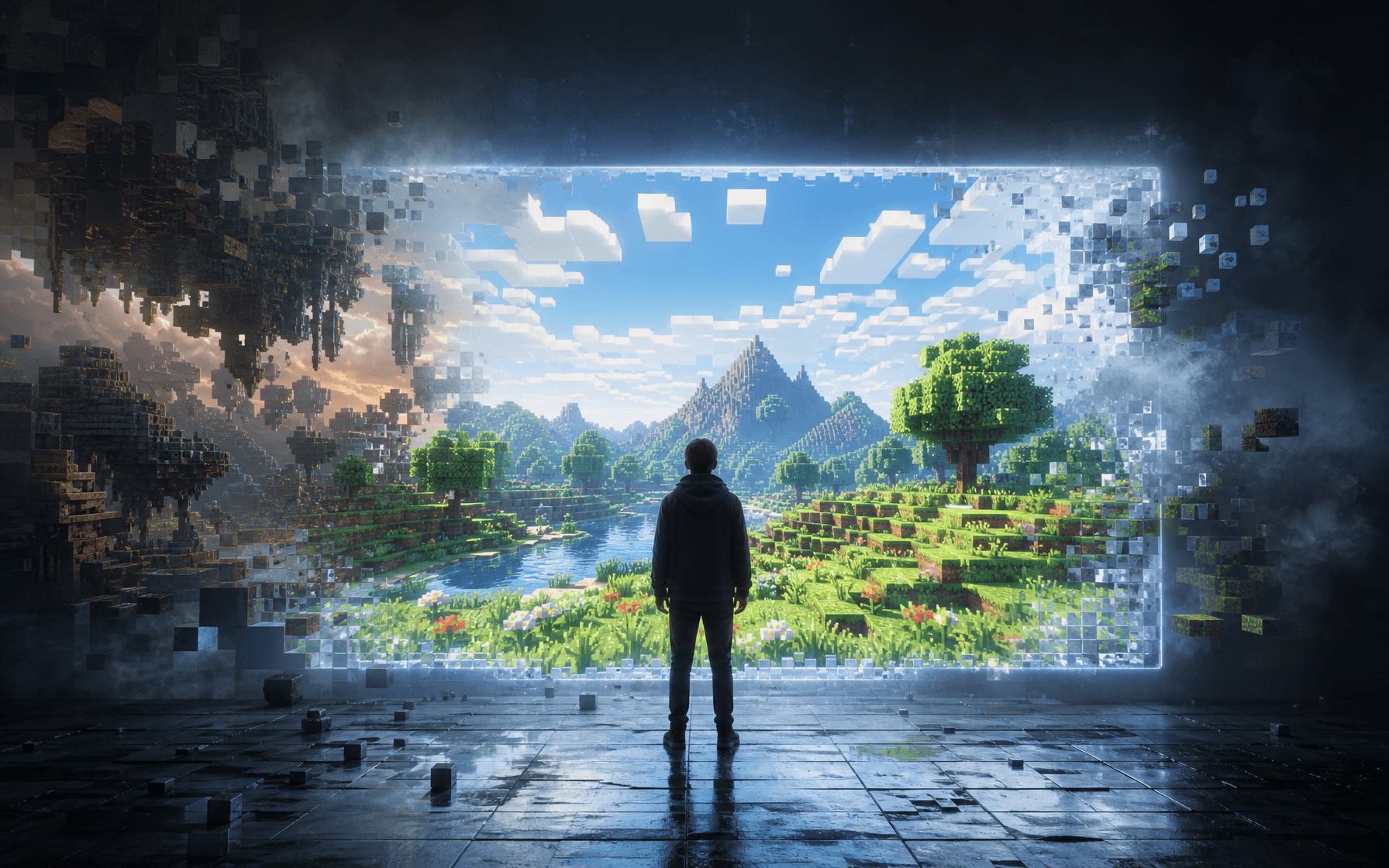
A world in the making. Illustration created with AI.
There is a game you can play right now in which not one line of the game was ever written. No designer placed the trees. No programmer coded the physics or the way the light falls on the grass. You press a key to walk forward, and the world simply appears in front of you, invented on the spot, around twenty times a second, by an AI that is guessing what should come next. It looks like Minecraft because it learned from millions of hours of Minecraft. But there is no Minecraft underneath. There is only the machine, imagining.
The uncanny part is what happens when you turn around. Place a block, look away, look back, and it may be gone, replaced by a hillside that was never there a moment ago. The world has the logic of a dream, which is close to what it actually is. The system keeps only a short memory of where you have been, and when that memory fills up, it improvises, the same way you never quite notice the walls rearranging behind you in a dream.
The company doing this is called Decart, and it is Israeli. It was founded in 2023 by Dean Leitersdorf and Moshe Shalev, who met in the reserves of Unit 8200, and it is run out of Tel Aviv. On May 18 it raised 300 million dollars at a reported four billion dollar valuation, in a round led by Radical Ventures, with Nvidia as an investor and Amazon as a customer. Among the smaller backers, for flavor, are one of OpenAI’s co-founders and the founding family of Nintendo. The category they are building has a name that used to belong to science fiction and is now a product line: world models.
Here is the idea in plain terms. For decades, a video game or an animated film was a set of instructions a computer followed exactly. Someone built the world in advance, and the machine drew it. A world model throws the instructions away. It watches enough video to learn how a world tends to look and move, and then it generates each new frame based on what you just did and what it just showed you.
Your screen can turn into a portal, into some imaginary world that doesn’t need to be coded, that can be changed on the fly.
This is already more than one demo. Their first, called Oasis, the playable imagined world, drew what the company says were millions of players within days of its release in 2024. Another, called Mirage, points the same trick at live video: you stand in front of a webcam, type a sentence, and it re-skins reality around you while you move, turning a stick into a lightsaber, a kitchen into the deck of a ship. This week they showed a version that generates hours of photorealistic driving from a written prompt, built to train self-driving cars on streets that do not exist.
None of it is finished, and the honest reviewers all notice the same thing. Drive that imagined car around the block, and the intersection you started from may be gone when you circle back. The worlds are genuinely real-time and genuinely astonishing, and they cannot yet hold themselves together for more than a few minutes before they start to forget. That makes it tempting to call the whole thing either a miracle or a parlor trick. It is mostly just early.
What actually changed here is the price. Generating a second of this kind of video used to cost real money and real time. Decart says it has pushed the cost of a generated video under a quarter. When something expensive suddenly becomes nearly free, people stop using it carefully and start using it for things nobody planned. A child narrating a bedtime story and watching it appear on the wall. An architect walking a client through a building that has not been drawn yet. A street rehearsed by a self-driving car ten thousand times before a single real car drives it.
There is a familiar Israeli story in here, two people out of an army intelligence unit building something improbable, and a familiar temptation to file it under Start-Up Nation and move on. That misses what is new. Israel has exported an enormous amount of the plumbing for other people’s technology, the security layer, the chip, the optimization underneath. This is a different kind of bet. Decart is not selling the pipes for someone else’s imagined world. It is trying to build the medium itself, the place a billion screens might soon point. That ambition, sitting in Tel Aviv, is worth noticing.
The founders say, with the particular confidence of people in their twenties who have just raised a great deal of money, that whatever replaces TikTok and Netflix and gaming “is going to be us.” They are probably wrong about the specifics and may be right about the direction. For now, the worlds still forget you the moment you look away. But you can already step into one that no human hand built and feel the floor hold under you for a minute before it dreams up something new. A year ago, that sentence was science fiction. This week it is a demo. That, more or less, is the speed of this thing.
Related Topics
Related Posts