
A Moroccan Journalist
Israel’s Only Crime Was Being Born Too Late
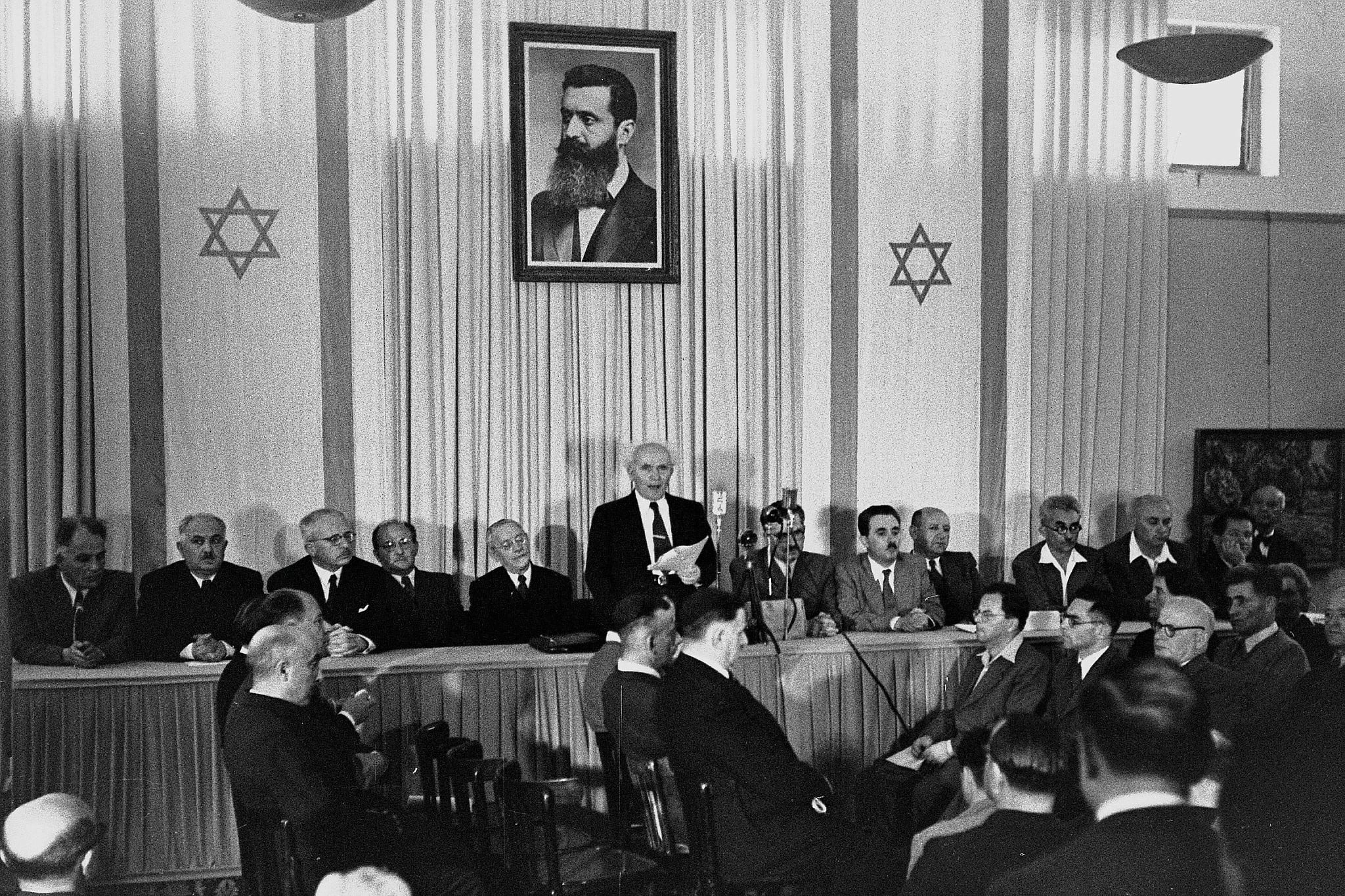
David Ben-Gurion, the first Prime Minister of Israel, publicly proclaimed the Declaration of the Establishment of the State of Israel on May 14, 1948, in Tel Aviv. The ceremony took place in the old Tel Aviv Museum of Art on Rothschild Street, beneath a large portrait of Theodor Herzl, the founder of modern political Zionism. (Wikipedia)
History is a graveyard of conquest. From the ashes of Carthage to the plantations of the Americas, from the Mongol plains to the British Raj, states were not founded – they were forged. Every border we now trace on our maps is a scar left by war, occupation, extermination, or expulsion. Civilization itself is built on the bones of the vanquished. Yet only one state – the Jewish one – is endlessly placed on trial for the same historical processes that produced every modern nation.
The moral paradox is stunning: if Israel’s creation was a sin, then so was America’s, France’s, Turkey’s, Russia’s, and indeed the entire post-Westphalian order. But Israel’s true misfortune was not its methods of birth – it was its timing. The Jewish state was born in 1948, in the age of cameras, resolutions, and conscience; an era that pretended to have transcended conquest while living comfortably on its legacy.
Let us recall: the United States emerged through the annihilation of indigenous nations – the Trail of Tears, the Wounded Knee Massacre, the cultural genocide of entire civilizations. Australia stands upon the bones of the Aboriginal peoples; New Zealand upon the suppression of the Māori. France, champion of “liberté,” slaughtered nearly a million Algerians to preserve its colonial vanity. Turkey’s national rebirth followed the extermination of the Armenians and the Greeks. The Slavic nations expelled millions of ethnic Germans after World War II in acts that would today be called ethnic cleansing. And the Arab world – self-proclaimed guardian of the oppressed – drew its own borders through coups, massacres, and wars of annexation.
None of these crimes disqualified their perpetrators from legitimacy. None provoked permanent moral outrage. None generated hashtags, boycotts, or theocratic resolutions. Time, it seems, sanctifies conquest – provided it happened before the smartphone.
Israel’s “original sin,” therefore, is not colonization, displacement, or victory – it is modern visibility. The Jewish people returned to sovereignty precisely when humanity had just invented the mirror of its own hypocrisy: the United Nations, the Geneva Conventions, the global press, and later, the internet. When Caesar burned Gaul, there were no tweets. When Britain incinerated villages in Bengal, there was no Security Council. But when Israel defended its right to exist – in a land where Jews were a majority long before London or Paris were dreams – the moral theater of modernity was ready to televise every shot fired.
Cultivation theory explains this well: the media does not reflect reality; it cultivates perception. A single airstrike, repeated endlessly on a screen, can eclipse entire centuries of forgotten atrocities. An image becomes an empire; a narrative becomes a verdict. The camera replaced the sword as the weapon of power, and Israel – the most scrutinized state in human history – became the scapegoat for the world’s newly discovered conscience.
Zionism is often accused of being a colonial enterprise. Yet the term collapses upon inspection. Colonialism implies a metropole sending settlers to exploit a foreign land. But where was the Jewish metropole? London? Warsaw? Baghdad? The Jewish return to Zion was not the extension of an empire but the resurrection of a people. Jews did not come as conquerors of others’ lands; they came as heirs reclaiming ancestral ruins, purchasing, cultivating, defending – not extracting.
Moreover, the Arab states that now preach anti-colonial virtue were themselves creations of European cartographers. Iraq, Syria, Jordan – all born from the pens of Sykes and Picot. The same diplomats who partitioned the Levant and erased Kurdistan now lecture Israel on self-determination. History, it seems, forgives everyone except the Jew who dared to write his own chapter.
Moral outrage today is a function of recency, not of principle. The conquest of North America is forgiven because it was completed before the camera arrived. Iran’s quiet colonization of Ahwaz, the forced Persianization of Arabistan, vanished from global memory simply because there were no hashtags to record it. The destruction of Tibet, the Uyghur camps, the wars of Africa, the Syrian carnage – all sink beneath the horizon of selective attention. But the Jewish farmer defending his kibbutz, filmed in high definition, becomes the villain of civilization.
Why? Because Israel performs an ancient act – survival – in a modern theater obsessed with moral optics. It is not the act that offends, but its visibility. The world no longer tolerates the reminder that its comforts were purchased through conquest. Israel is a mirror reflecting the buried crimes of humanity, and mankind, hating its reflection, smashes the glass.
Every accusation hurled at Israel presupposes a pristine moral world that never existed. “Occupation”? Then the French still occupy Corsica, the Spanish still occupy Andalusia, the Turks still occupy Constantinople, the Chinese still occupy Tibet, the Americans occupy half a continent. If we were to dismantle every state built on conquest, we would return to the caves.
Israel, by contrast, occupies only the territory from which it was attacked. Every inch of land under Israeli control was won in wars of survival – wars it did not start but was forced to finish. To call this “occupation” is to criminalize self-defense and canonize aggression.
The international order that condemns Israel was itself baptized in blood. The United Nations rose from the ruins of empires that exterminated half the world’s peoples. The same Europe that slaughtered six million Jews now moralizes about “proportionality.”
The same Arab regimes that once colonized the very region the Romans had called Palestina – Arabizing its people through the early Islamic futuhat (conquests), reshaping its identity, and erecting the Al-Aqsa Mosque atop the ruins of the Jewish Temple – the very regimes whose ancestors, under the same banner of expansion, subjugated Amazigh lands in North Africa and seized vast territories across the Mediterranean – now lecture about refugees. And the same West that flattened Dresden and Hiroshima now lectures on “restraint.”
Israel’s tragedy, then, is not moral but temporal: it arrived too late to commit its wars in peace. Its founding occurred after humanity had decided – conveniently – that history’s rules no longer applied. But if justice were truly retroactive, no nation would survive the tribunal of its own birth.
When I look at history objectively, I see that genocide, conquest, and mass violence are recurring mechanisms through which nations are formed. Every civilization has committed such acts at some stage, and they have all eventually been legitimized, forgotten, or forgiven with time.
As an observer, there is a painful irony in realizing that the world accepts every genocide – even normalizes them – except the one that failed to exterminate the Jews. The Holocaust did not succeed; the Jewish people survived and built a state. And that survival – instead of earning permanent sympathy – somehow provoked renewed resentment and moral suspicion (expressed in the endless condemnation of Israel).
Israel’s survival offends because it defies the natural order of victimhood. A people meant to vanish returned armed, sovereign, and unashamed. And so, history’s oldest scapegoat became the moral outlaw of modernity.
Yet the truth remains immovable: Israel is not the last colonial state; it is the first post-colonial one – the reclamation of indigenous sovereignty after two millennia of exile. Its existence is not a sin but an antidote to history’s greatest crime.
If the world cannot forgive Israel, it is not because Israel did wrong – but because Israel reminds it what everyone else once did, and would rather forget.
Disclaimer:
I know this reflection will sound deeply unpopular, especially in the Arab world. It may even seem like an unapologetic defense of Zionism – but it is not. It is an observation, not an endorsement; a realist reading of history, not a moral justification. Nothing written here legitimizes killing, displacement, suffering, or domination in any form. To analyze history is not to justify it.
Humanity has, through its bloodied evolution – through Nuremberg, decolonization, and the slow awakening of moral conscience – come to understand that power without restraint destroys not only others, but the soul of civilization itself. We live in an era built painfully upon the recognition of human dignity, on the ruins of the very atrocities our ancestors once normalized. Humanity evolved through the ashes of its own cruelty – through trials, reckonings, and the gradual moral awakening that finally gave meaning to words like rights and law.
Realists are pessimistic about human progress because they believe that international relations mirror human nature – self-interested, fearful, and power-seeking. As Hans Morgenthau argued, politics is rooted in a struggle for power that arises from this intrinsic desire for survival and dominance. In a world without a global authority – an “anarchy,” in Kenneth Waltz’s terms – states operate in a self-help system where trust is perilous, and today’s ally might become tomorrow’s enemy. This pessimism stems not from cynicism but from historical experience – from Thucydides’ account of Athens and Sparta to the failures of the League of Nations – all reminding us that peace is temporary and power politics eternal.
As a realist, I cannot ignore what history keeps teaching us. Realists from Thucydides to Morgenthau remind us that politics is not about morality but survival – that human nature, and by extension the state, is driven by fear, ambition, and the pursuit of power. The “Hobbesian war of all against all” is not a metaphor – it is the permanent state of international life.
From Athens and Sparta to Gaza and Jerusalem, the lesson remains cyclical: peace is merely a pause between rival insecurities. States do not act out of virtue, but necessity. My point is not that Israel is innocent, but that it is anachronistic – a late project trying to play an ancient game in a modern arena. Israel’s mistake was not its birth, but its timing. Had it been born a century earlier, it would have been just another empire among empires, and the world would have moved on as it did from every other conquest. But to arrive in 1948, in the age of conscience, cameras, and collective guilt, was to be condemned for what everyone else had done before there was a word for “war crime.”
It attempted to do in 1948 what every other power had done for centuries – build survival upon strength – but it did so in a world that had just declared strength immoral. Had Israel launched its project in the age of conquest rather than the age of conscience, it would have been judged as history, not as sin.
This is not moral approval – it is tragic recognition. Israel did not break the pattern of history; it merely repeated it too late. The world did not change its nature – it only changed its vocabulary.
Related Topics