


Geopolitical Analyst: Bridging Somaliland & Israel to the world
ISRAEL’S PRE-EMPTION MOMENT: From Cyprus to Somaliland, Türkiye Is Expanding.
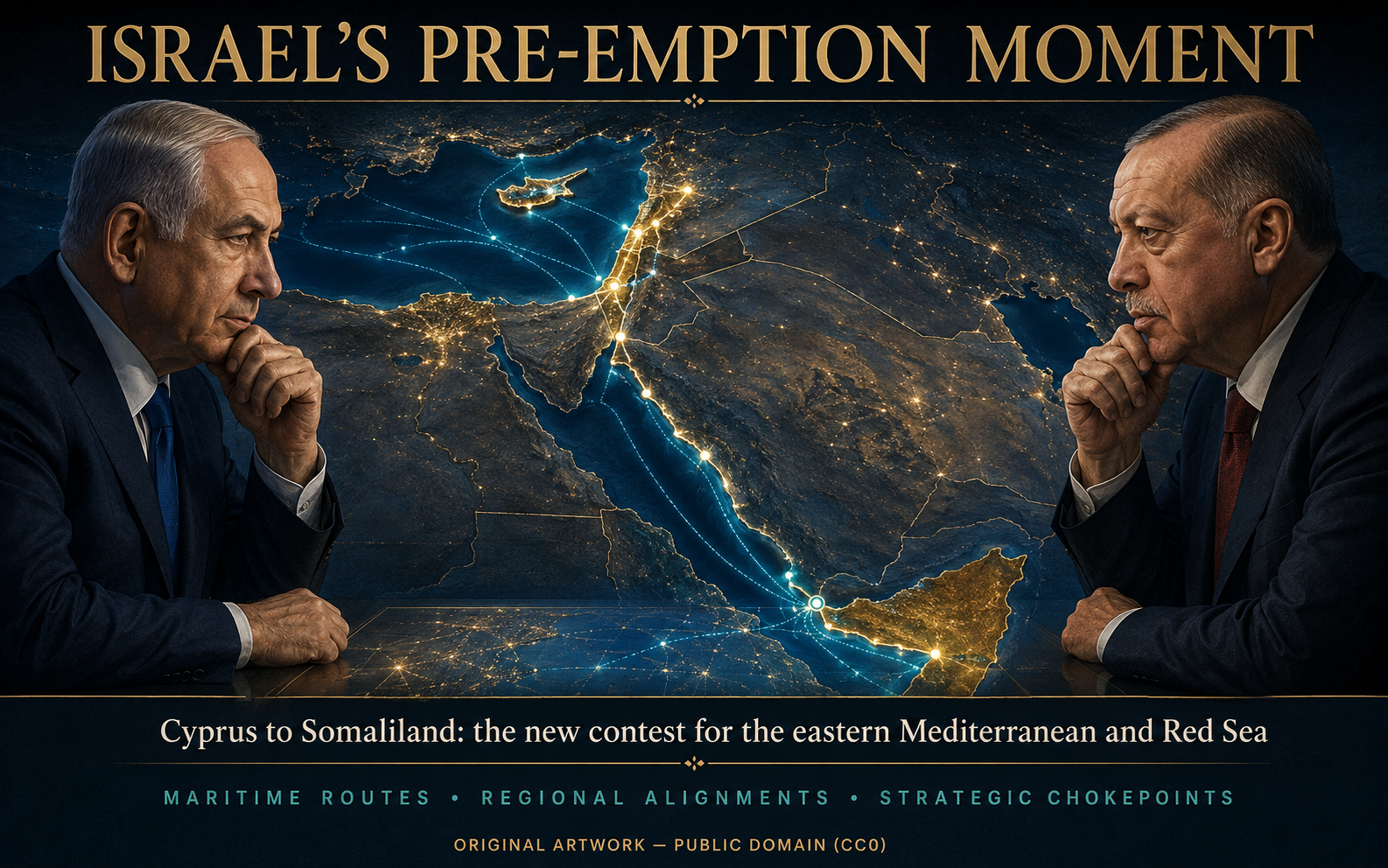
Benjamin Netanyahu and Recep Tayyip Erdoğan contemplate the strategic corridor from Cyprus to Somaliland, where maritime routes, regional alignments and control of key chokepoints are reshaping the eastern Mediterranean and Red Sea. Credit: HOASR Original Infographic Art Work Public Domain (CCO)
The response to Ankara’s expanding regional reach cannot wait for a formal hostile alliance or a crisis at Bab el-Mandeb.
Israel’s strategic problem is no longer confined to one border, one militia network or one maritime threat. A wider political and military geography is taking shape—from Syria and the Eastern Mediterranean to the Red Sea, the Gulf of Aden and Somalia—in which Türkiye is increasingly able to connect theatres that Israel has traditionally treated separately.
The immediate danger is not that Türkiye has assembled a formal anti-Israel coalition with a unified command. No such coalition has been publicly established. The Makkah Joint Defence Agreement, signed on August 7 by Saudi Arabia, Türkiye and Pakistan, has no publicly disclosed integrated command, automatic war plan, common nuclear doctrine or published operational protocol. Somalia is not a treaty member.
But that is precisely why Israel should act now.
Pre-emption in this context does not mean escalation or military adventurism. It means building the political, maritime, intelligence, technological and logistical relationships that prevent an adverse security architecture from hardening around Israel’s interests before a crisis forces reactive choices that could be dangerous.
The Makkah Pact is an institutional beginning, not a finished alliance. Its public language commits the three signatories to regard an armed attack on one as an attack on all and to expand defence cooperation. Türkiye has since described plans for political and military coordination among foreign ministers, defence ministers and military chiefs, alongside joint land, naval, air and cyber exercises, drones, electronic warfare, artificial intelligence, technology cooperation and defence-industrial logistics.
That does not prove the pact is aimed at Israel, Somaliland, Cyprus or Greece. Its members deny that it targets any country. Yet security architecture matters not only because of declared enemies, but because of the capabilities, access routes and political options it creates.
Türkiye’s Expanding Strategic Map
Türkiye already operates across the theatres that matter most to Israel’s security environment.
In Syria, Ankara retains substantial military influence, direct operational experience and a capacity to shape the political-security environment near Israel’s northern frontier. In the Eastern Mediterranean, its dispute with Greece and Cyprus is inseparable from competing claims over maritime jurisdiction, energy routes and political legitimacy. In Somalia, Türkiye has its largest overseas military base, and has developed an unusually deep relationship through military training, infrastructure, political influence, energy and maritime-security cooperation. In the Gulf of Aden and Red Sea system, that presence gives Ankara a strategic connection to routes increasingly threatened by Houthi attacks, piracy, weapons trafficking and wider Iranian-linked regional instability.
The problem for Israel is not any one Turkish position. It is the possibility that Türkiye’s separate positions begin reinforcing each other.
Türkiye’s expanding defence relationship with Pakistan and Saudi Arabia gives its regional position greater diplomatic and military strength. Its longstanding security role in Somalia gives it a foothold next door in Somaliland on the Gulf of Aden. Pakistan’s new military cooperation with Mogadishu—including discussions on maritime security, naval cooperation, air-force capacity-building and training—adds another layer to that picture.
So far, Somalia remains outside the Makkah Pact. But it is now linked to all of the pact’s three founders through separate security relationships: Türkiye through deep institutional entrenchment, Pakistan and Saudi Arabia through a rapidly developing defence partnerships. For Israel, this is not an abstract Horn of Africa question. It is an emerging strategic corridor.
Syria, Cyprus, Greece and Somaliland Are Connected by Geography
Israel cannot stop Türkiye from having interests in Syria, Somalia or the Mediterranean. Nor should every Turkish activity be treated as hostile. But Israel must recognize that the same state challenging the political order in Cyprus, competing with Greece in the Eastern Mediterranean and opposing Israel’s recognition of Somaliland, but is also expanding its military and diplomatic partnerships from the Levant to the Horn.
The strategic answer for Israel lies in strengthening the geography Türkiye is attempting to bypass or constrain.
Greece and Cyprus give Israel depth in the Eastern Mediterranean: access, exercises, energy-security cooperation, joint air and maritime capabilities, and political partnership inside Europe. The Israel–Greece–Cyprus relationship is already far more than symbolic diplomacy. It is an established security partnership built around shared concerns over maritime routes, critical infrastructure and regional deterrence.
The United Arab Emirates provides the Gulf and commercial-logistics connection. Somaliland provides the southern strategic anchor: Berbera, the Gulf of Aden coastline, maritime-surveillance awareness, logistics capacity and close proximity to Bab el-Mandeb.
The United States could become a further strategic enhancement of this network—but it has not yet done so. American security engagement with Somaliland has become more visible, yet Washington has announced neither recognition nor a Berbera basing agreement.
This does not constitute a formal Israel–Greece–Cyprus–UAE–Somaliland alliance. It is better understood as an emerging counter-alignment: a network of states and partners whose common interests overlap around freedom of navigation, resilient supply routes, intelligence-sharing, port access and resistance to hostile domination of maritime chokepoints.
Somaliland Is the Pre-Emption Test
Israel’s recognition of Somaliland transformed a geographic fact into a political partnership. Before recognition, Berbera’s location mattered, but international diplomacy treated Somaliland’s assets as subordinate to Mogadishu’s territorial claim. After recognition, Israel gained an open state partner on the African side of the Gulf of Aden.
The next question is whether that recognition becomes strategically durable.
Although Somaliland’s defence minister denied that negotiations for an Israeli base were underway, President Irro adopted a more strategically open position during his June 2026 visit to Israel. Asked by i24NEWS whether Somaliland might host an Israeli military base, he answered that it would not happen “now” but added that he “cannot rule it out.” His remarks did not constitute a formal basing offer, but they clearly preserved military access or basing as a possible subject of future bilateral negotiation.
President Abdirahman Mohamed Abdullahi Irro has since made the policy more explicit. In a recent interview with The Economist, he said Somaliland was ready to offer Berbera base access to Israel and the United States if they were interested, presenting next door Djibouti’s base-hosting model as both a security and economic precedent. He also said there was no Israeli or American presence yet. The offer is consequential; it is not a concluded agreement.
This change should not be misinterpreted as a rush to militarize Berbera. It is a bid to turn Somaliland’s geography into a negotiated security partnership—one with sovereign consent, commercial logic and a stated contribution to Red Sea security.
The stronger strategy is practical pre-emption: maritime surveillance; coast-guard cooperation; port protection; search-and-rescue capability; cyber resilience; counter-smuggling intelligence; emergency logistics; agricultural and water-security investment; and direct diplomatic representation.
These measures would not threaten Somalia or require militarizing Somaliland. They would make the Gulf of Aden more governable, make commercial shipping more resilient and reduce the strategic vacuum that hostile actors exploit.Somalia’s Strategy to Contain Somaliland: Israel Recognition Alone Is Not Enough
The American Decision Is Political, Not Procedural
President Irro’s forthcoming Washington visit should therefore be read as a strategic test, not simply another lobbying mission. His argument is increasingly direct: Somaliland offers a capable democratic partner, a long runway and port at Berbera, Red Sea access, and a willingness to support mutually agreed security arrangements. Recent senior AFRICOM engagements in Hargeisa and Berbera show that the United States is assessing the geography seriously, even though U.S. policy has not changed.
The obstacle is not a constitutional inability to recognize Somaliland. Under Zivotofsky v. Kerry, the power to control recognition determinations belongs exclusively to the U.S. President. Congress can shape incentives, oversight and resources, but a presidential recognition decision would not require waiting for a new act of Congress or for the bureaucracy to resolve every internal disagreement.
That does not make a Trump recognition decision imminent, and it should not be reported as such. It does mean that Somaliland’s recognition campaign is no longer confined to a slow bureaucratic bungling process. If the White House concludes that recognition serves U.S. security and commercial interests, it has the constitutional authority to act.
The Cyprus Signal
Somalia’s recent Northern Cyprus controversy adds a political warning to this strategic map.
When Somalia’s parliamentary Speaker used Ankara’s preferred terminology for the Turkish Republic of Northern Cyprus, Mogadishu had to retreat publicly and reaffirm the territorial integrity of the Republic of Cyprus under UN resolutions. The episode did not alter Somalia’s foreign policy. It did, however, expose the tension between Mogadishu’s legal doctrine and the political language of its principal patron, Turkiye.
Somaliland has correctly used that moment to ask Greece and Cyprus to reconsider the false analogy between Somaliland and Northern Cyprus. Somaliland’s case rests on prior independence, inherited borders, voluntary union and restoration of sovereignty—not on the model condemned in UN Security Council Resolutions 541 and 550.
For Israel, this opens a diplomatic avenue. Greece and Cyprus need not recognize Somaliland immediately. But with Israel’s diplomacy, its now the perfect time to begin a structured dialogue on maritime security, trade, technology, humanitarian logistics and the legal distinctions between Somaliland and Northern Cyprus.
That is how counter-alignments develop: first through shared analysis, then functional cooperation, then geopolitical confidence.
Israel Should Move Before the Structure Hardens
Amichai Chikli, Israel’s Minister of Diaspora Affairs and Combating Antisemitism, has already identified the strategic outline. He described the Makkah Pact as a dangerous development and urged deeper Israeli relationships with Greece, Cyprus, the UAE and Somaliland.
His remarks were not an Israeli treaty announcement or settled government doctrine. They were more valuable than that: a warning that Israel’s political class is beginning to see the same connected geography.
Israel should now convert that warning into policy.
It should deepen the Israel–Greece–Cyprus security triangle; reinforce its Abraham Accords cooperation with the UAE; formalize a civilian-maritime and resilience partnership with Somaliland; and bring India and the United States into a structured conversation on freedom of navigation, Indian Ocean security and the risks of Pakistan’s expanding westward defence network.Somaliland Could Be the Abraham Accords’ African Test Case
India has already said it is examining the Makkah Pact’s implications for national security and regional stability, while separately monitoring Pakistan–Somalia defence cooperation. That does not make India part of an anti-Türkiye coalition. It does demonstrate that the emerging architecture and its future implications is being read and studied well beyond the Middle East.
The strategic choice is therefore clear. Israel can wait until formal mechanisms, joint exercises, defence-industrial links and political commitments create a more rigid opposing framework. Or it can act now—through deterrence, diplomacy, partnerships and maritime public goods—to ensure that no single power can turn the Eastern Mediterranean, Syria, the Red Sea and the Gulf of Aden into one connected zone of geopolitical pressure.
Somaliland is not a peripheral issue in that calculation. It is one of the places where Israel can still shape the outcome before the next crisis chooses it instead.