Geopolitical Analyst: Bridging Somaliland & Israel to the world
Somaliland Could Be the Abraham Accords’ African Test Case
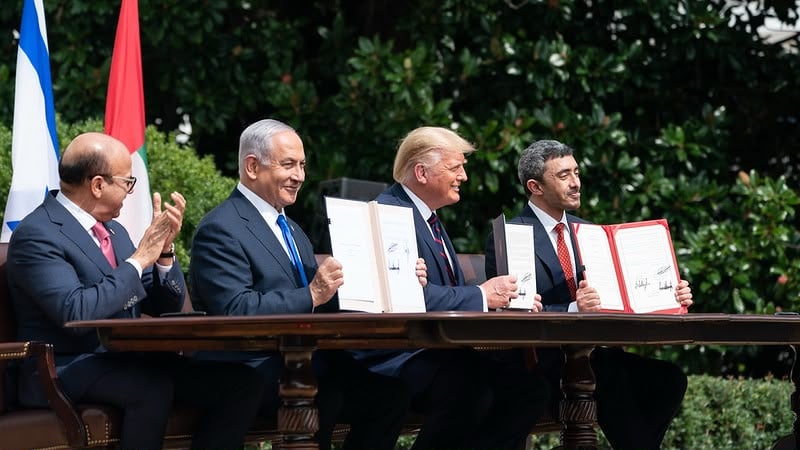
The Abraham Accords signing ceremony at the White House on September 15, 2020. From left: Bahrain Foreign Minister Abdullatif bin Rashid Al-Zayani, Israeli Prime Minister Benjamin Netanyahu, U.S. President Donald Trump and UAE Foreign Minister Abdullah bin Zayed Al Nahyan. Photo credit: Official White House photo by Joyce N. Boghosian — public domain.
Can the Abraham Accords evolve from a Middle Eastern normalization project into a practical model of Muslim–Jewish partnership, development and maritime security — with Somaliland as the bridge to Africa?
The experiment begins where the old diplomatic map runs out
The Abraham Accords were never merely a collection of ceremonies. Announced in 2020 under U.S. sponsorship, they represented a strategic attempt to change the structure of the Middle East: move Israel from diplomatic isolation within much of the Arab world toward a network of normal relations, commercial links, security contacts and people-to-people exchange.
The original breakthrough came with the United Arab Emirates and Bahrain in September 2020, followed by Morocco and Sudan. The official U.S. text presented the project in deliberately broad language — peace, tolerance, commerce, science, medicine and cooperation — rather than as a conventional peace treaty alone.
That architecture has proved more durable than its critics expected. Yet it has also exposed a fundamental limitation: the Accords have been strongest when governments act on pragmatic interests and weakest when public opinion, the Palestinian question, domestic politics or wider regional wars become dominant.
Carnegie’s 2025 review found that the UAE, Bahrain and Morocco maintained diplomatic relations despite the Gaza war, but that societal-level contact and public enthusiasm weakened sharply. The Washington Institute likewise concluded that the architecture survived but that expansion would require a credible diplomatic pathway around Gaza.
Somaliland now presents a different kind of test. It is a Muslim-majority society in Africa, not an Arab state; it did not fight a war against Israel; it is not party to the Arab–Israeli peace process; and it has spent more than three decades campaigning for recognition of its own statehood. On December 26, 2025, Israel became the first UN member state to formally recognize Somaliland, and Prime Minister Benjamin Netanyahu explicitly said the declaration was “in the spirit of the Abraham Accords.” Somaliland’s leadership declared its intention to join the Accords.
What the Abraham Accords changed — and what they did not
Historically, Arab–Israeli diplomacy had been structured around Egypt’s 1979 peace treaty, Jordan’s 1994 treaty, the failed Oslo process, the 2002 Arab Peace Initiative and repeated efforts to link normalization to Palestinian statehood. The 2020 Accords altered that sequence. Instead of waiting for a final Israeli–Palestinian settlement, several Arab governments concluded that direct national interests — Iran, technology, trade, investment, tourism, aviation, intelligence and U.S. partnership — justified normalization first. The model was geoeconomic as much as diplomatic.
The record is substantial. The UAE–Israel Comprehensive Economic Partnership Agreement entered into force in 2023, direct air links expanded, travel barriers fell, and trade in goods surged. OECD analysis notes that the Accords also created frameworks for cooperation in tourism, security, communications, technology, energy, health, culture and the environment. UAE government data put two-way UAE–Israel trade at about $3.21 billion in 2025. Across Israel’s Accords partners, official Israeli trade data cited by the Heritage Foundation put 2025 goods trade at roughly $4.56 billion, although such figures exclude important services, investments, software, cyber and defense transactions.
But the Accords are not one uniform bloc. Sudan signed the declaration in 2021, yet never completed the bilateral normalization process; a military coup and then civil war effectively froze implementation. Morocco’s relationship has deepened in security and diplomatic terms but remains more politically sensitive in society. Bahrain has maintained relations but with more limited economic depth.
Kazakhstan joined in November 2025, an important symbolic expansion because it shows that the framework can be attractive to a Muslim-majority country that already had diplomatic ties with Israel. That accession was largely symbolic; the real test would be a country joining from a different geographic and historical environment.
The religious complication: “Abrahamic” is an idea, but the conflict is modern
The word “Abraham” is deliberate. Abraham/Ibrahim is a major figure in Judaism, Christianity and Islam, and the name was designed to emphasize shared religious heritage rather than permanent civilizational conflict. This narrative gave Israeli and Emirati leaders a language of common ancestry that could support political reconciliation.
Yet it would be historically misleading to describe Jewish–Arab Muslim hostility as existing “since time immemorial.” The decisive political conflict that shapes contemporary attitudes is modern: the rise of Zionism, the creation of Israel in 1948, wars between Israel and Arab states, the Palestinian displacement and statehood question, and decades of regional political mobilization. This distinction matters for Somaliland: Somaliland has no direct history of interstate war with Israel, and its national political trauma is centered primarily on its own experience of war, state collapse and contested sovereignty.
That distinction helps explain why the Somaliland–Israel relationship can look unusual in a Muslim-majority setting. Contemporary reporting from Hargeisa has documented visible public celebration after Israel’s recognition, while also recording that reactions are not unanimous.
Al-Monitor described strong popular enthusiasm in parts of Somaliland, rooted not simply in affinity for Israel but in the conviction that Israel had done what other states had refused to do: recognize Somaliland after more than three decades of diplomatic isolation. Reuters and other reporting likewise found public celebration and political excitement, while later reporting showed that divisions within Somaliland remain and that the eastern regions do not necessarily share Hargeisa’s outlook.
A society shaped by the sea — and by exchange (Iidoor)
There is another historical reason the Somaliland case deserves to be treated differently. The Gulf of Aden has never been an isolated cultural frontier. Ports such as Berbera and Zeila sat within wider trading systems connecting the Horn of Africa to Arabia, the Red Sea, India and, indirectly, the Mediterranean.
Jewish merchants were part of the coastal commercial history of the Somali territories in the late nineteenth and early twentieth centuries, including Berbera and Zaila; by the late 1940s the old communities had almost entirely disappeared. The surviving historical record is small, but it eliminates the idea that contact between Somalis and Jews is entirely alien to the region.
That history should not be romanticized. Nor should it be used to claim that Somalilanders are inherently “liberal,” uniformly cosmopolitan or free of conservative religious beliefs. Such sweeping claims are not supported by evidence. A better proposition is that Somaliland’s political culture has been influenced by pastoral society, commercial towns, diaspora networks, education, maritime trade and decades of outward-facing diplomacy. The society is traditional in many respects, but political pragmatism is also strong. In the 2024 presidential election, power passed peacefully to an opposition leader after a competitive vote — one reason Freedom House identifies Somaliland as a political system that has permitted democratic transfers of power, even while criticizing restrictions on civil liberties, minority marginalization and election delays.
Why Israel’s recognition changed the equation
Israel’s recognition was therefore more than a diplomatic gesture for Hargeisa. It altered the psychological equation of Somaliland’s foreign policy. For 35 years, recognition was the missing piece of an otherwise unrecognized functioning state.
Israel broke that barrier on December 26, 2025. Ten days later, Foreign Minister Gideon Sa’ar made the first high-level Israeli visit to Hargeisa, where he met President Abdirahman Mohamed Abdullahi and said Israel intended to institutionalize relations across a wide range of fields. Reuters reported that the two sides discussed the full range of bilateral ties and that Somaliland’s president accepted an invitation to visit Israel.
The next stage was even more consequential. In June 2026, Somaliland’s president made the first state visit by a Somaliland president to Israel and opened Somaliland’s embassy in Jerusalem. The Israeli Knesset recorded the embassy opening as a significant step and emphasized that it was followed by the first official Somaliland presidential visit to Israel. Somaliland was not merely normalizing relations; it was converting recognition into institutions — an embassy, ambassadors, state visits and a standing diplomatic channel.
That is precisely where the Abraham Accords can become more than a brand. If the Somaliland relationship develops into joint programs in water, agriculture, digital government, health, vocational training, port logistics, renewable energy, environmental management and higher education, then the Accords would acquire an African development dimension that was not central to the original Gulf-centered breakthrough.
Why Somaliland could become the African link
The argument for the case for Somaliland as an “African test” can primarily be based on five unusually strong features. First, it is Muslim-majority but non-Arab, allowing the Accords to move outside the Arab political system without leaving the broader Islamic world. Second, it sits on the African side of the Red Sea–Gulf of Aden maritime system, adjacent to one of the world’s most strategic shipping corridors, the Bab-El-Mandeb. Third, it has institutions that already function including a presidency, parliament, courts, security services, currency and diplomatic network, giving cooperation an institutional partner rather than a purely militia or commercial counterpart. Fourth, it has deep commercial connections with the Gulf, especially through the UAE’s role in Berbera port. Fifth, its leaders have publicly linked recognition with a development national agenda rather than with a theological or ideological project.
The fifth point is the most important. A successful Somaliland chapter in the Accords would change the metric of success. The question would no longer be: “Did two governments open embassies?” The question would be: “Did normalization improve the lives of ordinary people and strengthen state capacity?” A water project that reduces Hargeisa’s chronic water stress, an agricultural program that raises crops, a health partnership that improves diagnostics, a digital identity system that makes public services more reliable, or a maritime training program that improves maritime would be more persuasive than a dozen ceremonial photographs.
In that sense, Somaliland can test an idea the original Accords only partially answered: can diplomatic normalization create development that is visible enough to build public legitimacy? The answer matters because public opinion has been one of the greatest weaknesses of the broader Accords. Arab Barometer’s 2022 survey found broad rejection of normalization across most surveyed Middle Eastern and North African countries, even though Morocco and Sudan were relative exceptions. The core lesson is that state-level normalization cannot automatically manufacture social acceptance.
The political and regional complications are formidable
Somaliland’s opportunity is inseparable from its vulnerability. Somalia rejects Somaliland’s sovereignty and condemned Israel’s recognition and Saar’s visit. A joint statement involving Arab and Muslim governments, the Organization of Islamic Cooperation and the League of Arab States rejected Israel’s move and invoked Somalia’s territorial integrity. The African Union has likewise treated the question through the prism of Somalia’s sovereignty, meaning that any expansion of recognition will meet a substantial legal and political barrier.
There is also the Palestine question. The Accords were criticized from the beginning for bypassing Palestinian statehood. The Gaza war then transformed that criticism into a major political liability. Carnegie found that popular opposition to normalization surged during the war even while governments kept the formal architecture intact. Any Somaliland–Israel relationship that appears to ignore Palestinian suffering would therefore risk importing precisely the public legitimacy problem that has constrained the original Accords.
A second complication is internal. Somaliland should not confuse Hargeisa enthusiasm with national unanimity. Oxford researchers in 2026 highlighted the political divide between the capital and Las Anod, noting that Israel’s recognition occurred in a territory where Somaliland’s control is contested in parts of the east. For the Accords to strengthen Somaliland rather than deepen internal fragmentation, development benefits must reach beyond the capital and should include communities and regions with different political opinions.
The emerging opportunity for maritime security alignment
The strategic logic is obvious. Somaliland’s Berbera port sits close to the Bab el-Mandeb and Gulf of Aden, across the water from Yemen. Somaliland is strategically important because of its position on shipping routes disrupted by continued Houthi attacks. Israel is a Red Sea state and has a direct interest in Red Sea maritime security, while the UAE already has a major commercial and security role around Berbera. Israel, Greece and Cyprus are also deepening defense and maritime cooperation in the Eastern Mediterranean.
There is credible evidence of a growing strategic web: Greek–Israeli and Cypriot–Israeli security cooperation, UAE involvement in regional logistics, and Somaliland’s increasing strategic role around Berbera. Strategy papers and commentary have begun to describe these connections as an emerging corridor or alignment, but that is not the same thing as a signed multilateral defense agreement. A rigorous article should distinguish the two.
The timing is nevertheless important. On August 7, 2026, Saudi Arabia, Türkiye and Pakistan signed the Mecca Joint Defence Agreement, committing to treat an armed attack on one member as an attack on all three while emphasizing that the pact is defensive. Turkey has said the arrangement can be expanded and has pointed to wider regional security coordination. This creates a new regional security fact that the Abraham Accords camp cannot ignore.
The strategic response should not be a mirror-image bloc built around permanent confrontation. The stronger Abraham Accords proposition is a network of interoperable civilian and defensive capabilities: maritime domain awareness, port security, coast-guard training, anti-piracy cooperation, shipping insurance, cyber protection of ports, undersea cable security, disaster response and environmental monitoring.
Somaliland could contribute geographic access and local knowledge; Israel could contribute technology; the UAE logistics and capital; Greece and Cyprus maritime and European links; and the United States, could provide a broader security umbrella. Such cooperation would make the Accords tangible without requiring Somaliland to become an instrument in somebody else’s ideological war.
What would make Somaliland a successful Abraham Accords partner?
The first requirement is development before symbolism. Israel and Somaliland should build a public-facing portfolio of projects with measurable outcomes. Water should be at the top of the list, followed by climate-smart agriculture, primary health care, digital public services, vocational and technical education, fisheries, solar power, logistics and port management. These are sectors where the tangible benefits can be seen by ordinary citizens rather than by diplomatic elites.
The second is institutionalization. An embassy is only the beginning. A Somaliland–Israel economic commission, annual business forum, scholarship scheme, health partnership, technology incubator and maritime-cooperation program would create a durable ecosystem. The UAE and other partners could be invited into selected projects so that normalization becomes a platform rather than a closed bilateral relationship.
The third is public diplomacy. Somaliland should present the partnership as choosing cooperation and development over isolation. It should continue to support international humanitarian law and a credible political horizon for Palestinians, while defending its own right to pursue peaceful diplomatic relations. That is not a contradiction; it is precisely the kind of distinction a mature foreign policy needs.
The fourth is African diplomacy. If Somaliland wants to make the Abraham Accords an African success story, it cannot rely only on Jerusalem and Washington. It needs to speak to Addis Ababa, Nairobi, Kigali, Accra, Abuja and other African capitals in the language of trade, ports, development, maritime safety and democratic institutions. The case should be that Somaliland is a bridge — not a wedge — between Africa and the Middle East.
The fifth is restraint. Recognition by one country is historic, but it is not international legitimacy in the full sense. The INSS warned before recognition that Israeli engagement could create backlash in Muslim countries and complicate wider normalization. That warning remains relevant. Somaliland must avoid appearing to trade strategic access for recognition or to become a military outpost for another country. Its strongest case for further recognition remains the credibility of its institutions and the peaceful character of its diplomacy.
The real Abraham Accords test is whether the circle can widen without shrinking
For six years, the Accords have survived an extraordinary stress test. Israel fought Hamas, Hezbollah and Iran-linked actors; Gaza became the dominant issue in Arab public opinion; regional alliances shifted; Sudan collapsed into civil war; and Saudi Arabia repeatedly signaled that its own normalization decision would be linked to wider Palestinian and strategic conditions and is now open to join the Accords if the US provides it with peaceful civilian nuclear technology. So far the core relationships survived. That is not failure. It shows that pragmatically useful interstate relationships can outlast political shocks.
But survival is not the same as transformation. The next phase needs a new geography and a new measure of success. Kazakhstan’s accession shows that the framework can move beyond the Arab world. Somaliland could take the next decisive step: an African, Muslim-majority, institutionally functioning democratic partner that has not been drawn into a historic Arab–Israeli war and that sees the relationship through the lens of recognition, cooperation, technology, development and maritime security.
That is why Somaliland could be the Abraham Accords’ African test. Not because Somaliland is somehow “less Muslim,” “less conservative,” or free from the sensitivities that affect other Muslim societies — Rather, Somaliland offers a different historical starting point. Its deepest grievance is diplomatic invisibility; its most urgent economic needs are development and investment; its geography creates immediate value for maritime cooperation; and its people have now experienced, in a very tangible way, the political power of recognition.
The most successful version of the Accords would therefore not be an ever-growing list of flags at signing ceremonies. It would be a network in which a citizen in Hargeisa can see better water service, a farmer can access better technology, a young graduate can get a technical scholarship, a port worker can receive maritime training, a shipper can move cargo more safely and a domestic disagreement can be managed without violence. If that happens, Somaliland will have done more than join a diplomatic club. It will have helped prove that normalization can be converted into institutions, development and shared security across the Red Sea — from the Middle East into Africa.
The Bottom line
The strategic proposition is simple: the Abraham Accords will become truly consequential when they demonstrate that Muslim–Jewish cooperation can generate public goods in places where the original Arab–Israeli political history does not define the relationship. Somaliland is uniquely positioned to test that proposition. Its success would not erase the Palestinian question, resolve Somalia–Somaliland tensions, or remove the regional security competition. But it could show that the logic of normalization can travel — and that the strongest bridge between the Middle East and Africa may be built in Berbera, not from slogans, but from water, ports, technology, institutions and people-to-people cooperation.
Selected sources.
• U.S. Department of State — The Abraham Accords
• UN Treaty Collection — Israel–UAE Abraham Accords Peace Agreement
• OECD — Israel 2025: trade after the Abraham Accords
• Carnegie Endowment — The Abraham Accords After Gaza
• Washington Institute — Resilience and Roadblocks
• Arab Barometer — Public opinion on normalization
• Reuters — Israel recognizes Somaliland
• Reuters — Strategic importance of Somaliland
• Reuters — Gideon Sa’ar visits Somaliland
• Israeli Knesset — Somaliland president and Jerusalem embassy opening
• Israeli MFA — Herzog hosts Somaliland president
• Freedom House — Somaliland 2025
• Somaliland Constitution — Religion and state
• INSS — Somaliland and Israel: recognition and cooperation
• Oxford School of Global and Area Studies — Somaliland internal political paradox
• Reuters — Mecca Joint Defence Agreement
• AP — Turkey clarifies Mecca pact
Related Topics
Related Posts