
Time for Positive Change...
Israel’s Security Choice: Control or Partnership?
The 2026 elections offer a chance to turn Jewish–Arab cooperation into a national security strategy.
Israel can win military battles and still face an expanding circle of enemies. Its long-term challenge is not just to defeat those who attack it, but to change the system that keeps producing hostility.
What if Israel treated its Arab citizens primarily as a strategic security asset rather than a potential liability? What if partnership at home became a practical foundation for eventually living alongside a secure, functioning Palestinian state?
This is neither a substitute for a strong Israeli military nor a plea for unconditional concessions. It is a proposal to add a missing dimension to Israeli security: make cooperation work better than confrontation.
Attitudes change with action
I understand this may sound like an unrealistic, dangerous fantasy. I’m also aware only 17% of Israelis think a two-state solution is possible.
But attitudes change with lived innovations. Polster Louis Guttman reported that between the 1973 Yom Kippur War and Sadat’s visit to Jerusalem in 1977, only about 10% of Israelis surveyed believed a peace with Egypt lasting ten years was possible. During Sadat’s visit, that figure surged to 54%, and to 74% after the peace deal was signed in 1979.
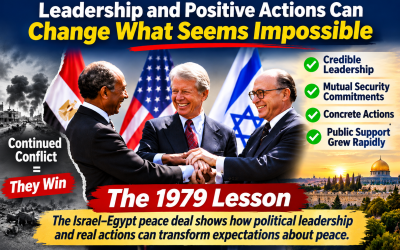 The forever conflict trap set by Israel’s enemies
Hamas, Palestinian Islamic Jihad, and the IRGC must be cheering that 17% outcome.
They have opposed any peace arrangements that recognize Israel as a legitimate Jewish state. Violence designed to disrupt coexistence is central to their strategy, not merely an unfortunate consequence of conflict.
Hamas attacks helped sabotage the Oslo years; the Second Intifada reinforced Israeli distrust; and the October 7 massacre devastated lives while disrupting an emerging Israeli–Saudi normalization effort.
Their strategic logic is simple: ongoing hostility discredits moderates, strengthens recruitment, and makes permanent confrontation appear inevitable and harms Israel’s cohesion, regional and international standing.
These groups win when Israel chooses indefinite control over collaboration. That choice sustains the cycle of conflict on which violent rejectionist movements depend, even when Israel defeats their fighters.
So far, it seems to me, terror is winning.
Israel must dismantle armed threats, protect its borders, and act decisively against terrorism. But it must not let terrorists determine its relationship with millions of Arabs and Palestinians who are not terrorists. An attack is important; however, the deeper strategic question is which institutions, fears, incentives, and grievances allow the violence to regenerate, and what realistic options offer the best long-term solution.
Two elections, one unusual opening
Israel’s October 2026 election left the Netanyahu bloc with 53 seats, the Jewish-led opposition with 48, and Arab-led parties with 19. No bloc has a majority. While this doesn’t build trust or erase genuine security disagreements, it does create an opening to test a different kind of approach.
For Jewish parties, working with Arab representatives can become a security initiative, not simply a coalition bargain. For Arab parties, it offers a chance to demonstrate the difference between a security-first, collaborative approach and politics built around grievance or rejection. Ra’am and the Joint List have distinct positions; neither should be treated as a monolith. Their practical commitments should matter more than labels.
The November US midterms created a second opening. Democrats will control both chambers of Congress from January 2027, while President Trump retains his veto and executive powers. Now imagine the Democrats confronted with an Israeli government not only in partnership with ‘Palestinian’ Israelis, but also:
- A stated new agenda which aims to support Israeli Palestinians as an ethical and security need;
- An approach to help develop Palestinians in the occupied territories as peaceful neighbors.;
- An immediate halt to settlement expansion in the West Bank and tough policing to stop settler violence against Palestinians; and
- Progress the phased disarmament of Hamas alongside phased, matched withdrawal of IDF from Gaza.
That is, an overt approach to supporting Palestinian development as a peaceful neighbour while opposing those who seek to undermine it.
Rather than more acrimony, expect the next two years to feature bipartisan hearings, oversight, technical assistance, negotiated funding, and joint projects that could produce measurable results. Neither Israel nor Palestinian welfare would become a partisan American trophy.
Start at home
More than two million Arab Israelis and 5.6 million Palestinians in the West Bank and Gaza are not going anywhere. Neither are Jewish Israelis. A strategy premised on permanent mutual suspicion therefore guarantees a permanent security burden. A plan that builds mutual trust and respect over time is one our children and grandchildren can celebrate.
Israel’s 1948 Declaration of Independence invited Arab inhabitants to participate in building the state with equal citizenship and offered peace to neighboring peoples. This was not simply good Jewish ethics; it was strategically vital. That promise has not yet been fully realized. Yet it remains a strategic starting point: a secure inclusive, Jewish nation-state whose democracy also protects equal rights, religious freedom, and cultural dignity.
In the Israel Democracy Institute’s 2025 survey, 90% of Israeli Arab respondents favored integration into Israeli society, and 70% believed Palestinian identity could coexist with loyalty to Israel. Only 16% of Jewish respondents thought those identities compatible. That is an understandable yet concerning gap and a security opportunity to develop.
Begin with the immediate crisis of organized crime in Arab communities. Families need reliable policing, protection from extortion, effective prosecution, witness protection, schools, jobs, and municipal services. Arab leaders must be partners in designing solutions, not substitutes for the state’s obligations. Every improvement in safety and trust weakens criminal networks and strengthens the legitimacy of lawful cooperation.
Invent a better way to work together
Good intentions and coalition negotiations will not be enough. Jewish and Arab parties should commission professionally facilitated deliberation: a structured process in which representatives, local leaders, security professionals, and citizens agree on shared goals, rules of engagement, evidence, and methods for resolving disagreements.
Start with achievable commitments: fewer murders, safer neighborhoods, better schools, fairer public services, and clear condemnation of attacks on civilians. Use neutral facilitators, mixed working groups, citizen assemblies, transparent scorecards, and independent evaluation. Protect legitimate dissent. Apply security safeguards to actual risks and roles, not ethnicity.
A successful model would be worth copying beyond Israel. Crucially, it would show that Jewish–Arab cooperation can protect citizens without requiring either community to surrender its identity.
From stability to two cooperating states
Arab citizens of Israel and Palestinians in the West Bank and Gaza face very different circumstances. The next stage cannot simply copy the domestic model. It needs a phased, conditional, incentivized, reciprocal process grounded in security and genuine Palestinian self-determination.
First, consolidate security and civic partnership within Israel. In parallel, stabilize Palestinian areas by preventing armed groups from rebuilding, protecting civilians from violence by anyone, and improving legitimate governance and daily life.
Commanders for Israel’s security recommend a security-first, civic separation in the West Bank to progressively reduce unnecessary daily friction and overlapping civilian administration, while maintaining agreed, intelligence-led security coordination. Transfer defined civilian responsibilities such as services, planning, local economic development, and accountable administration to more capable Palestinian institutions as benchmarks are met. This is separation of governance and daily-life systems, not ethnic segregation, abandonment of security, or a license for unilateral annexation.
The Palestinian Authority must be able to develop as a functioning partner, not merely an adversary to be contained or a subcontractor without legitimacy. That requires Palestinian ownership, anti-corruption reform, accountable policing, credible elections when conditions permit, and reciprocal Israeli steps, including action against unlawful settler violence and policies that needlessly undermine Palestinian livelihoods.
Gaza requires its own transition: dismantling independent militant capabilities, preventing rearmament, restoring civilian services, and building legitimate governance with independent verification. Regional and international partners can offer expertise, guarantees, investment, and monitoring. Eventually, demonstrated security and institutional performance could support negotiated two-state arrangements and growing economic cooperation.
Make the hardest objections part of the plan
Israelis will reasonably ask whether concessions invite another October 7. Palestinians will ask whether “phases” merely disguise endless occupation and settlement expansion. Both objections identify real failure modes. The answer is not blind trust; it is reciprocal, independently verified steps, meaningful security safeguards, genuine political horizons, and consequences for spoilers on either side.
With Israeli policy now overtly supporting Palestinians, including the development of preconditions for Palestinian self-governance, the international community should be invited to contribute money and expertise to demonstrate their commitment to Palestinian self-determination and a more peaceful Middle East. Progress should be judged by outcomes: fewer violent attacks and murders, stronger institutions, less civilian suffering, greater trust, and more Israelis and Palestinians with something valuable to lose in renewed conflict.
The strategic choice is not between force and goodwill. It is between a security system that repeatedly contains the next crisis and one that also works to reduce the production of crises.
Israel’s greatest long-term achievement would be not only the enemies it defeats but the neighbors it helps turn into willing partners. The 2026 elections provide a rare moment to begin.
Related Topics
Related Posts