
Founder & Principal, Line of State
Israel’s Wars Are Won in Reality, Not on Screens
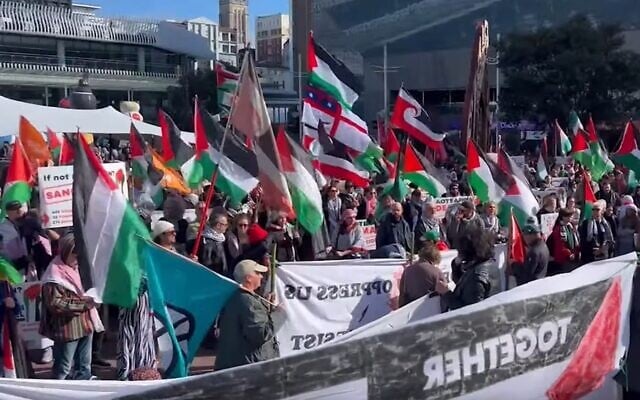
Pro-Palestinian, anti-Israel protesters rally in Auckland, New Zealand, September 13, 2025. (YouTube screenshot: used in accordance with Clause 27a of the Copyright Law)
Israel’s recent wars were fought twice – on the ground and in the global mind. In the age of pixels and algorithms, it wasn’t “Hasbara” that shaped the outcome, but actions that re-defined the moral language of reality.
With the end of the war and the entry into a full ceasefire – and the moment when every living hostage finally returned home – it is time to reckon with a concept that has haunted every Israeli war since the state’s inception: global public opinion.
On October 7, I said aloud what many preferred not to hear: today, when Israel is wounded, the world finds it easy to show sympathy; in a few days, when we remind it how strong we are, that sympathy will turn to resentment. It was not a prophecy – it was a media pattern. The world loves victims, especially distant ones; it struggles to love victors. That is precisely what happened. During the first 48 hours after the massacre, the world stood with us almost instinctively – from heads of state to landmarks lit in blue and white. And then, as expected, the sympathy faded, replaced by new symbols and new definitions.
By July 2025, according to a Gallup poll in the United States, only 32 percent of Americans supported Israel’s military action in Gaza – a historic low. A simultaneous YouGov survey found that in Western Europe, sympathy for Israel had plummeted: in Germany, France, and Spain, less than 20 percent of respondents expressed a positive view, while majorities expressed disapproval or hostility. The protests, statements, and endless visual flood on social media converged into a single, unified critical narrative.
These numbers reflect more than shifting sentiment – they mark the erosion of Israel’s moral framing in Western public discourse, from editorial boards to university campuses. The world now measures wars like marketing campaigns: emotionally, not morally, and certainly not by outcome. Israel found itself fighting not one war, but two – one in the field, and another in the global arena of narratives and algorithms. Hamas calculated targets in kilometers; the world calculated them in pixels. It was a real war against an imagined reality. And there is no way to win both. Whoever tries to please both, loses both.
In an age where the TikTok effect has replaced the CNN effect, wars are judged by the aesthetics of suffering. Algorithms reward outrage over context. Israel – perhaps the last democracy that still understands what “national security” actually means – learned, mid-battle, to stop playing that game.
And alongside that, it is time to abandon the word Hasbara.
For decades, Israel has relied on what it called Hasbara – a Hebrew word for “explanation” that became synonymous abroad with defensive spin. It was never diplomacy; it was an effort to make the unreasonable seem reasonable. In today’s world, where everything is recorded and translated, any attempt to “explain” looks like an evasion of decision. Hasbara is not strategy – it is the symptom of a country talking about itself instead of standing behind itself. It is apology disguised as policy, an effort to appease an audience that has already made up its mind. A nation uncertain of its own justice explains; a nation confident in it simply acts.
Jerusalem’s clarity of purpose
In the end, it wasn’t polls, networks, or hashtags that ended the war. It was Jerusalem’s clarity of purpose – a policy that knew exactly what it wanted to achieve. Public opinion always reacts to the last image and the first word, but only one language defines results: the language of actions.
The gap exposed between two years in Gaza and twelve days in Iran is the difference between image and substance. In Gaza, we spoke a hesitant language – between military necessity and polite remorse. In Iran, we spoke differently: short, cold, confident – and the world understood. Operation “Raising Lion” (12 Days War) shifted the global discourse into our language: deterrence, prevention, survival. Even our critics had to use the terms we set. In Gaza, we were trapped in someone else’s vocabulary. When you don’t define yourself, others define you.
The war in Iran made Israel grow up. Instead of “defying” the world, it established priorities: security first, messaging later. It is always easier to evoke empathy for the victim than to justify the strength of the defender. But when power translates into outcome, even the critics are forced to confront reality. That is what happened with Iran. Even opponents of the operation analyzed its deterrence logic – not out of sympathy, but because the facts demanded it.
Public opinion matters – but only as accompaniment, never as replacement. It can help build partnerships and reduce friction, but it cannot decide wars. The fighting ended not because the trend dictated it, but because reality did. And reality itself became the moral argument – one tested through deeds, not slogans.
No United Nations has yet been born that can prevent a sovereign nation from defending itself when attacked. From this truth, even in the West, a new understanding is emerging: Israel is not a moral problem; it is a moral test. Whoever supports Israel’s right to self-defense supports the very idea of the state – any state. As Thomas Hobbes reminded us in the 17th century, the purpose of a state is to protect its citizens from chaos – not to win applause, but to ensure life. A simple principle, forgotten in a world that judges wars through images more than through reality.
The cost is clear: a wave of antisemitism without precedent in the modern West. But even that does not justify a policy of fear. This is a lesson the West itself will eventually learn in an era where networks manufacture emotion and leaders panic before it. Democracies that trade clarity for comfort will lose both. Nations are not measured by shares or hashtags – but by the responsibility they assume, and by the quiet nights they grant their citizens.
—
The above was first published in Hebrew on Walla (Israel). This is a revised version prepared by the author.
Related Topics
Related Posts