Evolve Hadassah Midwest, Hadassah Writers' Circle
It Takes a Village – One Family’s Alzheimer’s Journey
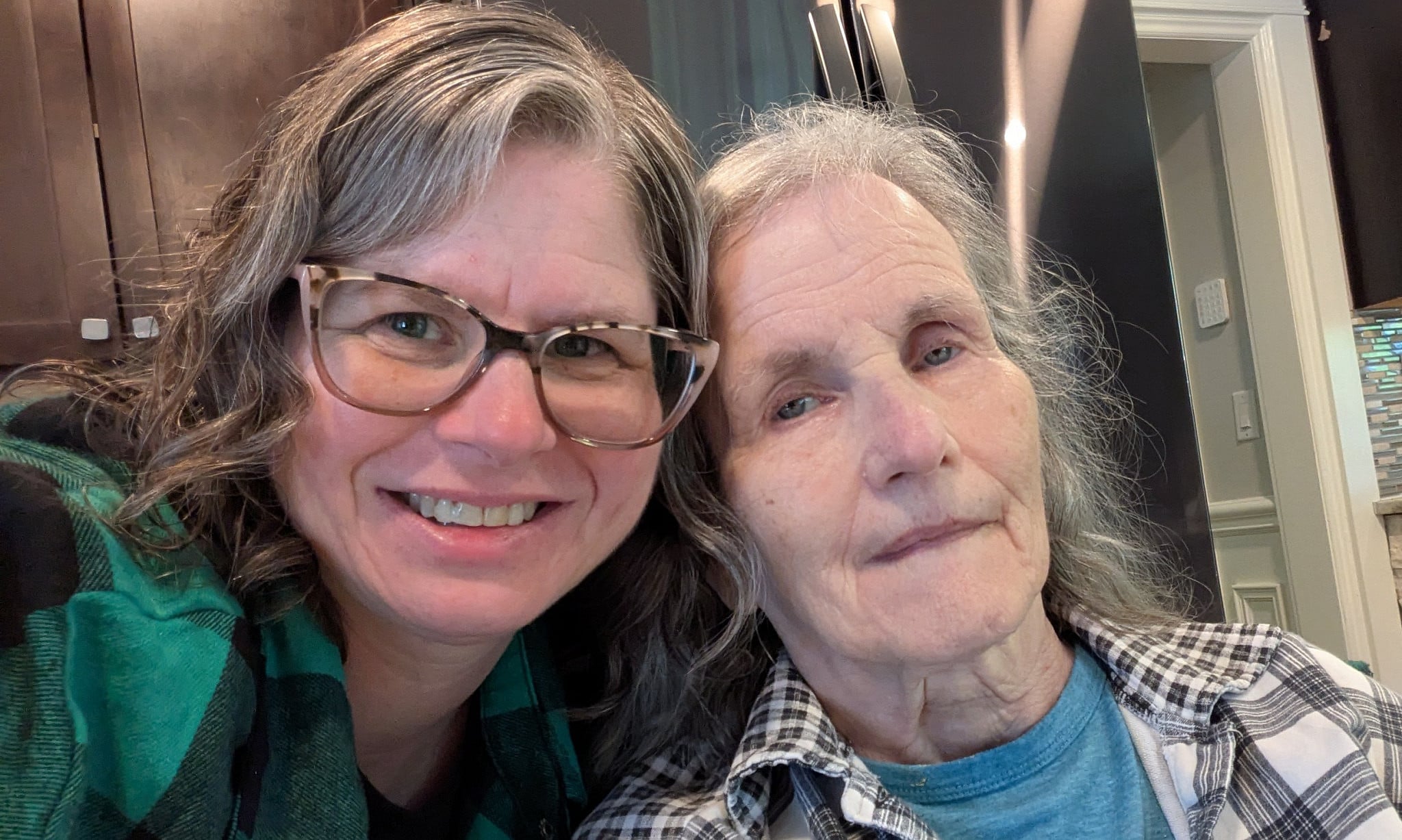
The author and her mom in 2025. Photo courtesy of the author.
Dealing with an Alzheimer’s diagnosis can feel very isolating, and it’s important to know that you are not alone. I’m grateful for this opportunity to share my family’s journey during Alzheimer’s Awareness Month.
My mom, an intelligent and fiercely independent woman, noticed a change in her memory about 10 years ago after she had major surgery. She took it upon herself to see every specialist, take every test and do anything suggested to help with her memory. She was not given a formal diagnosis for a very long time.
The best doctors could say was that my mom was suffering from significant short-term memory impairment, without a reason as to why. Nor was there a really viable treatment option. She took the medications that were available at that time, and perhaps they did slow down the progression a bit, but they couldn’t stop it. For a number of years, my mom continued to have a good life, living with her significant other, going on outings, seeing friends, enjoying vacations and spending time with family, but she was aware that her memory was not what it had been, which was depressing and scary for her.
In June of 2021, I was in Traverse City, Michigan, on vacation with my family, when I got a call informing me that there had been a “situation” with my mom. I spent the rest of my vacation handling things from afar. Needless to say, this was not the vacation that I had planned.
One phone call was all it took to completely shift the paradigm of my life and my relationship with my mom forever. It was like a switch had flipped and I went from being the child to being the parent. It was now officially my responsibility to take care of my mom.
I carried that weight on my shoulders everywhere I went. I was officially part of the “sandwich generation” (typically adults between their 40s and their 60s who are “sandwiched” in between their dependent children and the adults they care for). Caring for my mom while caring for my own kids meant having worry and stress as my constant companions.
I realized very quickly that I needed support on this journey. Of course, I was working with my mom’s significant other and I leaned on friends and family, who have been very supportive, and my husband has been particularly helpful with handling the financial responsibilities.
I have been so grateful for all of this support, but I knew I needed experts in our village too, who could look at the situation without bias, taking feelings out of the equation and just help me determine what was best for my mom and how to proceed.
I started by reaching out to a friend who is a geriatric social worker, a true angel in disguise! Her job is not only to help older adults as they age, but also to help their families through this journey. She truly held my hand and gave me resources, support and permission to take care of my mom in the ways that were necessary, even when it was difficult (which was often).
I don’t know how I could have gotten through this without her! I share this so that if you are in a similar situation, you will know to start building your village by finding a good geriatric social worker.
There is no real handbook, no true norm. So learn what you can and then lean on your village for support and resources! It was a huge comfort for me to realize that I didn’t have to learn everything or know everything, and that I could rely on experts.
I’m not a geriatric social worker, nor a neurologist, geriatric nurse, senior living placement specialist or a neuropsychiatrist, but I found people who are, and that made a world of difference!
I also found a lot of support in online communities, such as the Jewish Moms Facebook group in my area, where I would ask for ideas, support and resources. I found purpose in sharing resources, support and advice to help lighten the burden of other people going through this.
An Alzheimer’s diagnosis for your loved one feels like the end but, in actuality, it is the beginning of a journey that you and your loved one are about to embark on. This complicated and devastating condition has no cure yet and there is no clear path to follow, but, if you know where to look, you can find the people and the resources to give you the support that you need to get through it.
I encourage others on this journey to make the choice to look for the positives, to cling to them to help get you through. My mantra is that my mom is well cared for, feels good, is content most of the time and still remembers me. I find strength in those words and I repeat them often, to myself when I need to, and to others when they ask how my mom is doing.
Over time, my mom’s memory continued to diminish and, ultimately, during the COVID-19 pandemic, it declined significantly. She also began losing her ability to maintain her activities of daily life or “ADLs” as they are commonly referred to. She was still living with her significant other, but I ultimately decided that it was time to hire some help, so we brought in a caregiver. Having a caregiver in the house can be helpful, but it’s also a foreign experience — someone you don’t know is now in your home, helping you through your ADLs, trying to help you maintain your dignity when that is incredibly challenging.
Several months later, I determined that a part-time caregiver was not enough and that it was time to move my mom to a memory care facility where she would have round-the-clock care from people who were trained specifically to help with Alzheimer’s and similar conditions.
It quickly became clear that this was not the right fit for her. She needed to be somewhere with eyes on her at all times, and with more one-on-one and small-group attention. So, I moved her to a small group home with fewer residents that had an excellent reputation in our community.
Each one of these decisions was completely gut-wrenching. I asked myself how I could make these decisions for my mom, who had always been incredibly independent. But I took comfort in leaning on our village and their expert advice.
Besides deciding on her living situation and making medical decisions, I also had to take over all her financial obligations. I became responsible for her monthly finances and accounting, financial planning, insurance and more.
The first hurdle, which seemed insurmountable, was having to prove to all of the financial institutions and insurance companies that I was her legal proxy. This required an unbelievable amount of work, the kind of work that we all hate doing for ourselves, and now I was doing it for myself and for my mom. Even once I proved that I was, in fact, acting on her behalf legally, I frequently still had many hoops to jump through.
The most difficult one was getting her long-term care insurance to begin paying out. Even though she had been paying into it for many, many years, and even though her condition clearly fulfilled the requirements, it took me an unbelievable number of hours making calls and filling out paperwork to get it done.
I learned the importance of preparing myself for the inevitable. Familiarizing myself with the path that Alzheimer’s takes — its various stages and what to expect in each of them — has made each stage of decline a little less difficult. Knowing what to expect took the surprise out of it, but unfortunately nothing can take away the sadness that you feel as you’re watching your loved one decline.
My intelligent, independent and strong-willed mom is no longer able to care for herself, remember any of the knowledge that she gathered throughout her life, or ensure that her needs are being met. But I am here, along with our village, to bring those things back into her life and do them for her. My mom’s significant other visits her nearly every day and her dedicated sisters call her daily — one even visits her frequently from Chicago. We read her poems, tell stories from her life, show her pictures and make sure that she has the care that she needs and deserves.
Working together, my mom’s “village,” her significant other and I fill her days with visits, memories and love. We support each other, we prepare as much as possible for the next stage and then the next and we get through this, day by day — and if you’re in this situation, you will too!
The Hadassah Medical Organization is doing groundbreaking medical research to help prevent and treat Alzheimer’s. This work brings much-needed hope for families struggling with this disease! To learn more, please visit this link.
Related Topics
Related Posts