
Eyes everywhere
Italy’s first car-ramming attack. The DoD security contractor: “It’s terrorism”
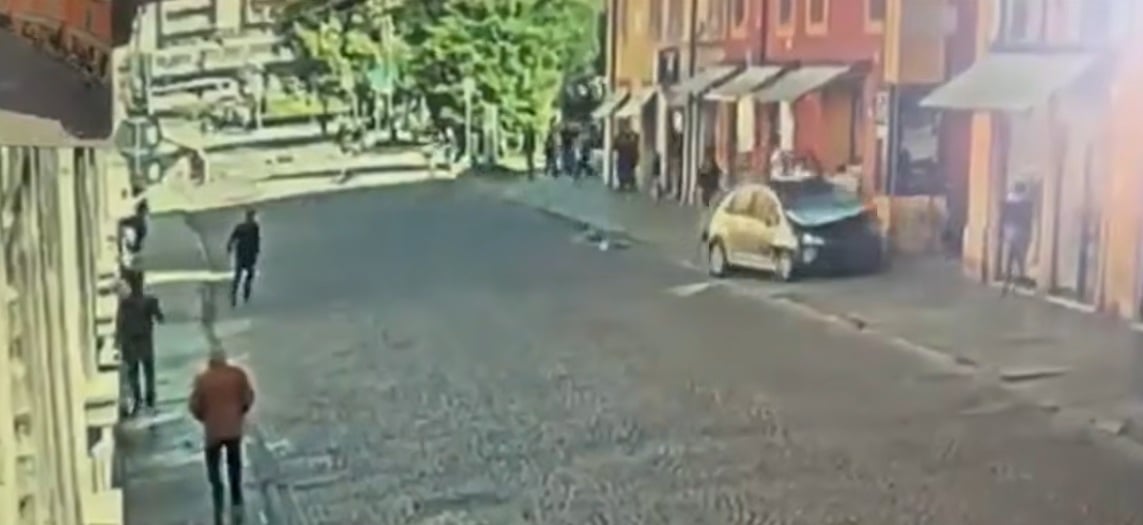
The attacker's car rammed against the sidewalk (YouTube, NBC screenshot; used in accordance with Clause 27a of the Copyright Law)
On Saturday, May 16, at approximately 4:40 p.m., a 31-year-old individual of Moroccan origins, identified as Salim El Koudri, rammed his Citroen C3 at roughly 100 km/h against pedestrians in the northern Italian city of Modena before crashing into a shop window.
The street selected for the attack was a limited traffic zone (ZTL) and the driver proceeded in a zigzag trajectory from one sidewalk to the opposite, trying to hit as many pedestrians as possible. The impact was so violent that people were thrown into the air. In the end, the car crashed into a shop window, crushing a woman who lost both of her legs in the impact.
El Koudri then descended from the vehicle armed with a knife and tried to escape before being blocked by a group of people who chased him. One of them wrestled the attacker to the ground and received two knife wounds before being blocked by other people who rushed to the scene. The final toll was of eight wounded, four of whom were in serious condition.
Less than 24 hours after the attack, numerous Italian media outlets and political figures were already describing the incident as an isolated act committed by a madman, even before the details of the attack had been clarified or any expert assessment of the perpetrator had been conducted. A day after the attack, Minister of the Interior Matteo Piantedosi said that terrorism was ruled out and that the attack happened due to the perpetrator’s psychiatric disorders.
Apparently, El Koudri’s previous temporary treatment at a mental health facility was sufficient to immediately rule out a potential terrorist act. However, mental health issues and terrorism are not mutually exclusive, as noted by well-known experts such as Emily Corner of the Centre for Behaviour Analysis and Paul Gill of University College London. Therefore, insisting on presenting them as incompatible demonstrates a complete misunderstanding of the phenomenon.
In any case, the wet blanket for those who supported this theory came when the preliminary investigations judge validated El Koudri’s arrest, indicating that “there were no elements to believe that the action was a consequence of mental illness.”
Salim El Koudri’s hatred towards Christians had already been documented in a series of emails sent by the individual to his university. The attacker is also reported to have insulted Christianity on social media, Deputy Prime Minister Matteo Salvini told the media. The assailant’s social media accounts were swiftly shut down.
Furthermore, El Koudri utilized the typical ISIS “lone wolf” modus operandi, which aims to inspire individuals potentially susceptible to jihadist propaganda to act independently using readily available tools. In 2014, through an audio message from former spokesman al-Adnani, ISIS encouraged individual supporters of the organization to attack using vehicles and knives. This propaganda resonated widely and directly inspired numerous deadly attacks in Europe and the United States. In 2025, the ISIS newsletter, al-Naba, issued a further appeal inciting followers to carry out attacks using both vehicles and knives in response to the Israeli offensive against Hamas in Gaza, ushering in a “season of terror” against Israel, the United States, and Europe.
It should also be noted that shortly after the attack, the police seized numerous electronic devices from El Koudri’s home, including PCs, cell phones, USB sticks, cryptocurrency passwords, and a PlayStation. These materials clearly require careful examination. So why the rush to declare that “this is not terrorism”?
We decided to talk about the issue with Gianpiero Spinelli, a U.S.DoD Military & Security Contractor (photo below) with previous experience in Iraq and who has also trained civil and military police forces in Brazil. He is also author of the book in Italian “Cosa Fare in Caso di Attacco Terroristico” (What to do in case of a terrorist attack), published in 2016.

Gianpiero, in your view, can the attack perpetrated in Modena be classified as a terrorist action?
“Yes, in my opinion, this is the profile of a terrorist, and here’s why: If we examine the action using an analysis method called TEDD (Time, Environment, Distance, Demeanor) we see that these four elements are identifiable in the action seen in Modena, both in terms of planning and tactics.
If we closely look at the route and timing, El Koudri left his home located outside the city and arrived at the target during peak traffic hours, choosing a traffic-free zone (ZTL) that was packed with people. He was trying to achieve the greatest possible number of victims with a simple action. The time and location chosen were not random but aimed at maximizing the result.
Therefore, the incident cannot have been the result of a sudden impulse. There was nothing random about the sequence of actions, correct?
No. And regarding the environment I also don’t think the choice of a restricted traffic zone was accidental. In that area, his car — used as a weapon — could move without being obstructed by other vehicles. The driver zigzagged through the street, forcing people toward the edges of the road in order to trap and crush them, rather than driving straight at them, which would have made the car’s path easier to anticipate and avoid. The zigzag pattern may also have been intended to reduce the risk of being hit by police gunfire.
Another aspect of interest is the distance, the short trajectory of the car at high speed, as it is intended to maximize the impact force until the vehicle crashes and can no longer be used. By contrast, focusing on a longer route also requires considering the possibility of being stopped by an obstacle or by an armed operator.
In addition, the demeanor – A first phase with the vehicle used as a ram, targeting as many people as possible and a second phase once descended from the car, using a knife. This is a typical tactic incited by ISIS on several occasions.”
What about the second phase of the attack?
Fortunately, the second phase, the one with the knife, did not take place because the attacker was immediately stopped by passers-by. However, this latent second phase is also evident because the attacker had already gotten into the car armed with a knife and used it in an attempt to flee. These, in my view, are all elements that indicate a carefully planned action and not an act linked to the frenzy of a sick mind.
Anything else worth highlighting?
Regarding the post-arrest phase, we saw an initial silence by the attacker followed by the request to have a Bible and see a priest. This, in my point of view, is a form of Taqiyya, dissimulation, to counter the news exposing the emails he sent to his university where he insulted Christians and Christ. This move may very well have been suggested to him by someone. Then there’s the material he used at home: several PCs, cell phones, USB sticks, and a PlayStation, despite the fact that he had no stable employment and was looking for work.
Multiple devices could also mean multiple operating platforms that can operate separately to avoid being intercepted. A “clean” phone could be used, along with others utilized for operational purposes. This is another possibility to consider.
Some say that the terrorist hypothesis can be ruled out because no organization claimed responsibility, nor did the perpetrator. What is your opinion?
Regarding the claim of responsibility, it is certainly an element that is evaluated, but it is not the central aspect. What matters about a terrorist act is the media coverage and the terror it instills in the population after the act has been carried out. Claiming responsibility can occur immediately or later, or it may not occur at all.
Terrorism has changed since the 1990s. Today, the very fact that the event is relaunched on jihadist channels and profiles is already a claim of responsibility in itself. If the individual in question has self-radicalized, claiming responsibility is not necessary to define it as an attack. The act itself, the modus operandi, and the consequences speak clearly; they constitute a claim of responsibility.
The classic modus operandi, invoked on multiple occasions by ISIS, is an irrefutable hallmark. Those who deny this, have not understood what Islamist terrorism is today. I don’t know if they are trying to mitigate the situation out of fear of social tensions towards certain communities, but it’s not credible because the facts speak for themselves.”
Related Posts