It’s Hotter than Hell, But We Don’t Build Cool Cities
It doesn’t take a genius to understand that Israel has a hot climate. It’s the Middle East after all. But extreme heat events are increasing in frequency alongside average temperatures. According to the Israel Meteorological Service, 2025 was 1.1°C (2°F) warmer on average than the 1991–2020 period, with a large number of unusual and extreme weather events. It was also the fifth hottest year since recording began in 1950.
This matches the global trend that extreme heat events are becoming more regular, intense, and longer lasting. The government is aware of this too, and set out a plan for climate adaptation over the coming years. The plan seems to deal with many of the symptoms of a warmer climate, but lacks the teeth to actually address the daily discomfort that citizens experience. Tree planting is one of the only points in the plan that directly confronts the heat that you and I experience on a daily basis going about our lives.
But it didn’t used to be this way, and looking back at the roots of the first Hebrew city, Tel Aviv, can offer us a path to a cooler future.
The Roots of a Garden City
The history of modern Tel Aviv began in Ahuzat Bayit, now Neve Tzedek. In 1909, town planning regulations set out by Arthur Ruppin were adopted, forming the bones of the settlement. It was cutting edge for its day, integrating electricity, sewage and running water to every house. Ruppin took his inspiration from the then popular Garden City movement, which posits that cities should be separated by living and industrial areas, connected by corridors of greenery.
Part of the bylaws set out by Ruppin focused on creating greenery throughout the settlement, with houses separated and set back from the street (not the common practice for the time) and room for gardens in the front and sides of houses. Each house was even required to have a certain number of trees facing the street. This established a city that had shade and respite built into the foundation to protect from the brutal climate.
Tel Aviv received official township status from the British in the early 1920s, meaning it could govern itself. The famed Scottish urban planner Patrick Geddes was contracted to develop a plan for the city’s expansion. He was acutely aware of the climate here and his plan accommodated this in several ways.
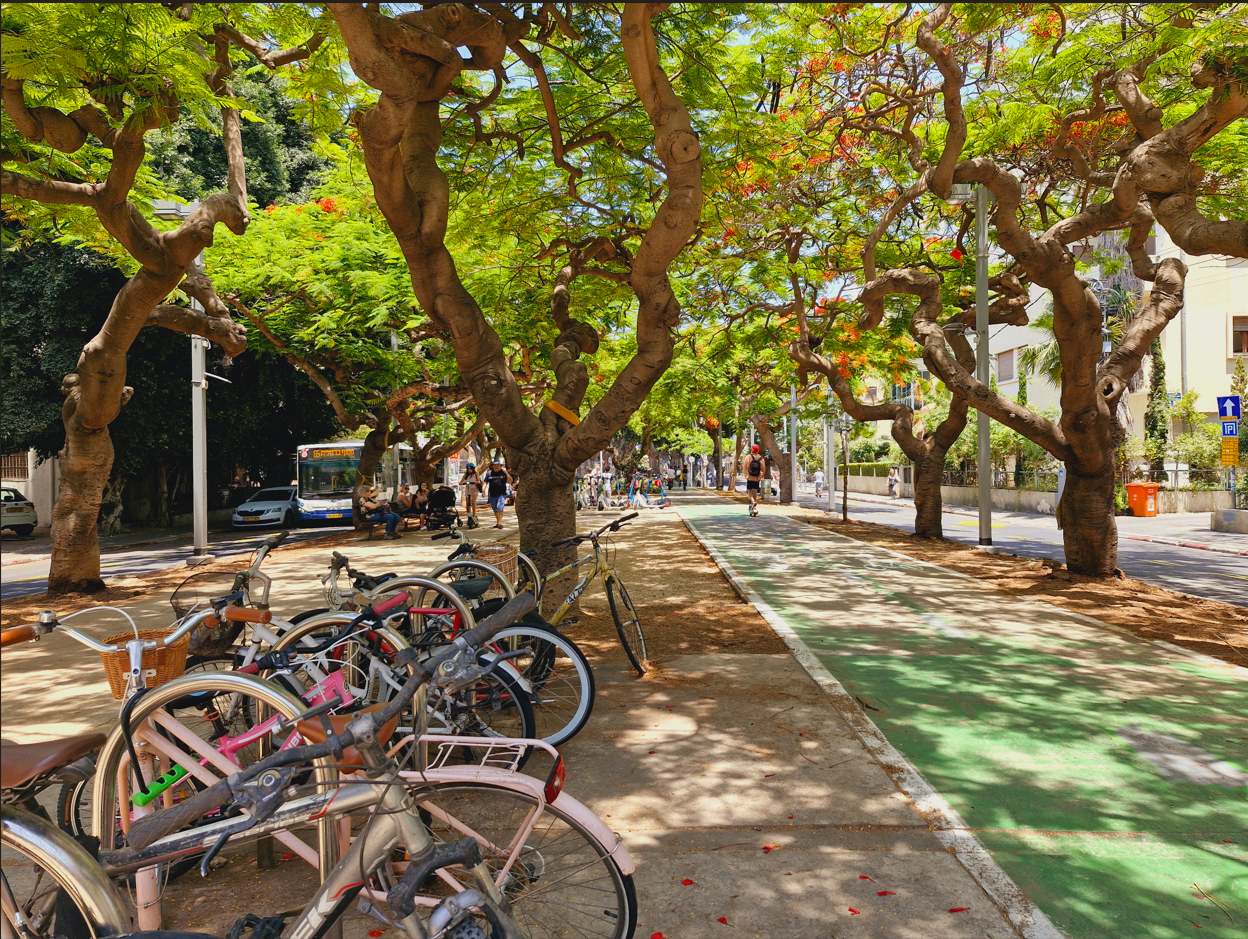
He integrated numerous pocket parks and green public circles; required developers to maintain generous front and side setbacks, so private gardens could flourish on every plot; and, one of the more distinct aspects of his plan, created narrower, tree-lined east-west avenues that would capture the cool breeze from the Mediterranean Sea and channel it inland. This has created the tree dense city that is filled with people walking, biking, and now scootering, in the dead heat of summer and throughout the year.
How Contemporary Israel Gets It Wrong
Unfortunately for Tel Aviv, Geddes’ plan only extended to the north to the Yarkon river, and virtually all of the major expansion being built today is beyond the central city limits. Looking north of the Yarkon, some of the largest housing projects in the country are currently being carried out.
This area, known by local Tel Avivians as the place where rich tech workers go to expand their family and raise kids, was not built with the same vision as Geddes. Looking at a map of Nofei Yam, a neighborhood that was built from nothing in the last 20 years, it’s strikingly obvious what is lacking. Some of the northern city was built with small pocket parks, but Nofei Yam is almost devoid of them. Buildings in this entire area do not have the same setbacks and are barren of trees, offering little to no greenery or shade. Streets themselves are also not planted with trees, instead prioritizing parking. The street grid here is the furthest departure from Geddes’ plan, set up in a wide criss-cross pattern to maximize sea views that bring higher returns on the real estate, essentially blocking the sea breeze by the buildings.
The city is now embarking on one of its largest expansions ever, building out the seafront plot of Sde Dov which sits directly to the west of Nofei Yam. The municipality appears to get some things right, and plans for trees to be planted along the entire length of the streets for shade. It is also planning for bike paths, and other green building requirements. But it has many of the same downfalls that the newer areas of the city have instituted, creating very wide streets measuring around 30 meters across. The plan appears to offer a better street grid than Nofei Yam, avoiding the criss-cross pattern, but doesn’t always provide a straight thoroughfare to the sea.
Other newly planned cities in Israel also get it wrong. Walk around Modiin, a city that was built entirely from scratch beginning in the 1990s, and you will experience the wide street without trees, aside from its central park, which doesn’t make for a cool or walkable urban environment. Look at new tower developments and they essentially all use that same playbook.
Imagine a New, Old City
For the country to truly address the needs of its citizens and the coming generations, we will have to get smarter about building to mitigate the effects of heat. There is a reason that the streets of Tel Aviv become packed with those from outside our borders on nights and weekends. People view a good urban fabric as a destination because they often come from cities and towns that lack it.
Ask people from the northern areas of the city their favorite restaurant, bar, or cafe, and most will name places in the central city. Because who would want to sit on a treeless street in the heat of the day with the sea breeze blocked by towers. We must build better, cooler cities, like the founders of Tel Aviv dreamed of, if we want to create a livable country. All we need to do is take the blueprints that were laid out in the past.