
Ecohasid meets Rambam
It’s now or never: We need to choose life by Rosh Hashanah 5790
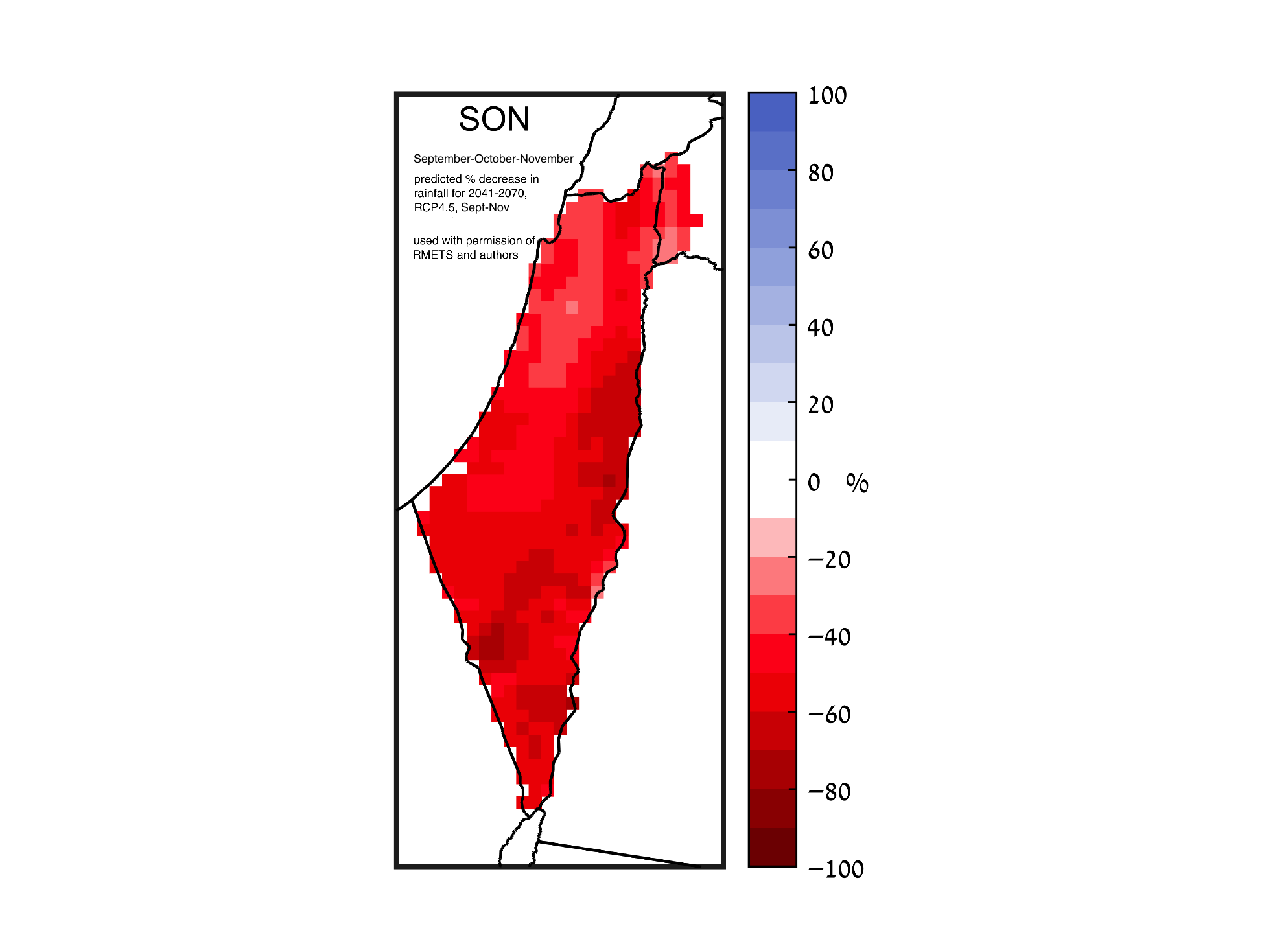
% decrease in rainfall for autumn months 2041-2070, used with permission
Global climate disruption, the subject of this 2019 article, has become a reality, and its effects will only grow as a threat to civilization. The sixth IPCC climate change report, which came out in the beginning of the month of Elul 2021, makes it clear: taking action in the next decade is our only chance to stop the worst of climate disaster. There won’t be another or better chance if we miss this one.
In 2009, I came across a fact about Israel and climate change that shocked me. According to the 2000 Israel National Report produced by Ben Gurion University, “In the Mediterranean basin, a northward shift of 300 to 500 km and an upward shift of 300 to 600 m are projected with 1.5 degrees Centigrade of warming.”
The distance from Beersheva in the Negev to Lebanon border is much less: 215 km. That would mean the Negev would overtake the entire country. Why weren’t people screaming to high heaven save the holy land from ecological ruin?
A decade later, as Rosh Hashanah approached, and I wrote about this again, I wondered if were there more specific predictions, not just for the Mediterranean, but for Israel in particular.
Astonishingly, a more detailed study on Israel was only published one year before, in the International Journal of Climatology.* This was the first study to look at the region with enough resolution to project what would happen differentially in each part of Israel. (The paper, “High-resolution projection of climate change and extremity over Israel using COSMO-CLM,” can be downloaded here.) I spoke with Dr. Pinhas Alpert of Tel Aviv University, one of the authors, over the phone to learn more. Here’s what I found out.
Though the Negev will expand northwards somewhat, it won’t be the major concern people thought it would be. What is most dangerous is that the region of Israel and Palestine is already increasing in temperature by more than half a degree per decade. That’s five times the global average of 1 degree per century. That’s based on data from 1960-2017 of what’s already happening, published only 3 months ago, and more than twice the accelerated rate of change reported in June in Haaretz.
Here are some predictions from the 2018 paper: more consecutive dry days, fewer consecutive wet days, precipitation decreased by 100mm in most places, increased evapotranspiration, flooding and extreme weather. Heat waves will become a big problem, with temperatures remaining much higher than normal for 3-5 days, even for as long as ten days.
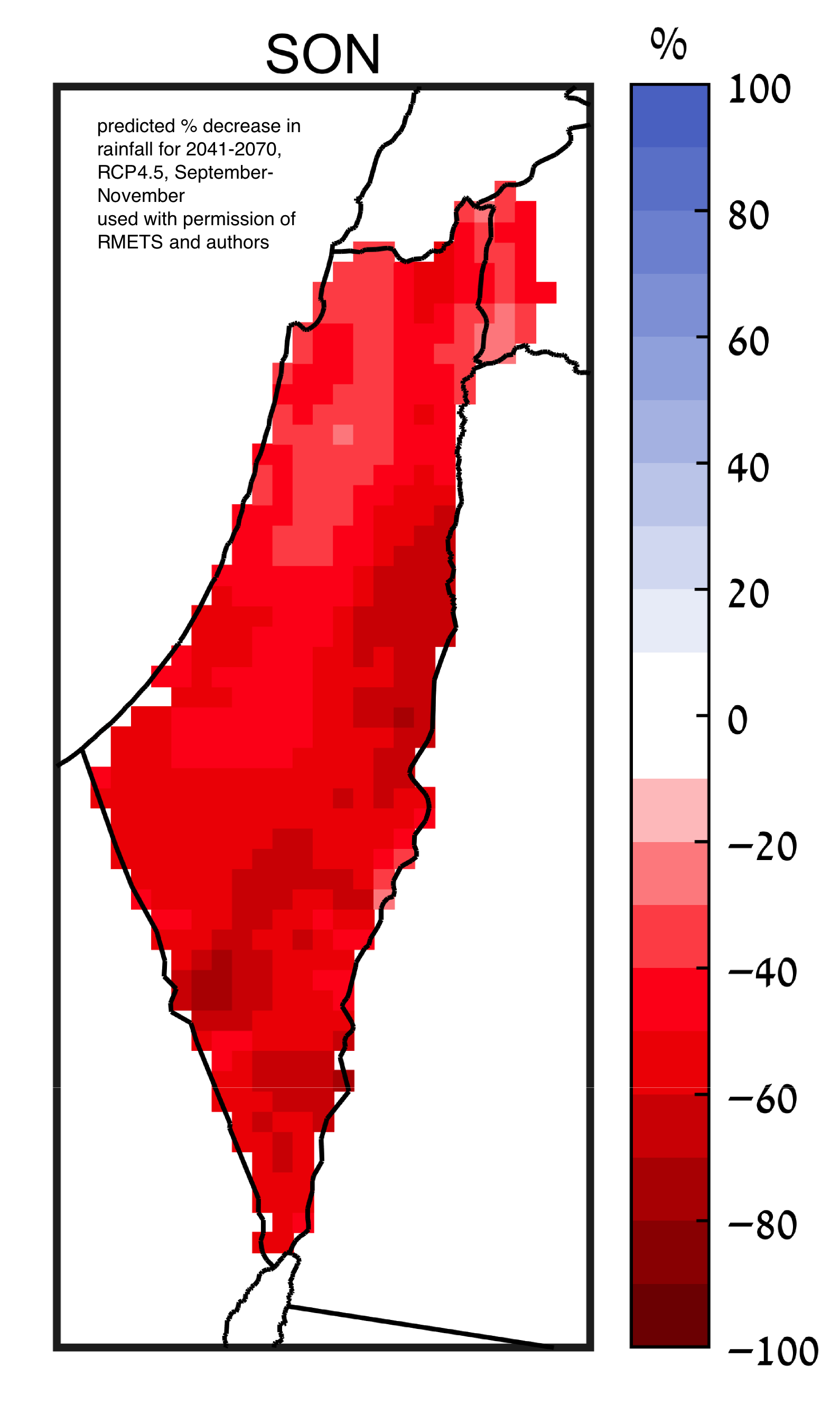
Here’s a sample of the 2018 data, showing percentage decrease in rainfall over Sukkot and the beginning of Israel’s rainy season:
Newer research shows that some aquifers that are already decreasing at an alarming rate will be very hard hit. And even with water from desalination, all the irrigation one can do won’t sustain the greenway that birds migrating between Europe and Africa depend on.
On a continental scale, two other studies, one co-authored by Dr. Alpert, found that the Fertile Crescent, the arc of green going from Israel through Turkey to Iraq/Mesopotamia where agriculture began, will disappear.
Those are the “trees” of the forest, but the forest still looks the same: climate change, which should be called global climate disruption, is an utter disaster for Israel and Palestine.
The scenario used in the 2018 study, called RCP4.5, is what will transpire even if we significantly decrease the carbon we put into the atmosphere starting in 2040. RCP4.5 only gives us about a 50% chance of keeping the Earth from warming less than two degrees over this century, which in our calendar ends in 5860. That means if we want better than even odds, we have to start getting this right long before we reach New Year 5800.
So here we are at the start of 5780. The mainstream of the Jewish community continues obliviously, believing the main threat to Israel is Iran. Its left-wing has so many intersectional fish to fry and social justice causes to champion that climate change is often a caused served by lips rather than action. And its right-wing most often cares about controlling and settling more of that land that could become uninhabitable.
That may in fact be a way to help some Jews survive, but it’s the quickest way to make sure Judaism as a moral value system becomes extinct. That value system teaches that God doesn’t want people to ruin the land. That’s the message of the Noah story and the Torah laws about Sabbatical year and Jubilee. It’s the message one would expect from a Creator who looks at the world and calls it “very good.”
Every year before Rosh Hashanah, the Torah exhorts us: “I have made the heavens and the earth witnesses against you: life and death I set before you… choose life, so that you will live” (Deut. 30:19). In 2019, we have a clearer picture of what that means, and we know our time to choose life is running out. Israel needs to become a moral and technological leader of the changes we need, both for mitigating climate change and for dealing with its consequences. And American Jews have a crucial role to play in getting the U.S. on board, so that Israel and so much else can survive.
If global carbon output starts decreasing by 5790, it’s still a scary picture, but our chances are better than 50%. “Better late than never” may work for some things. But for the planet, and for the holy land – much later equals never.
- For a more detailed look at the science, see my article “Choosing Life by Rosh Hashanah 5790” in Tikkun.
Related Topics
Related Posts