Jackie Robinson, Stamford, and the Jewish Community
My father was a passionate Brooklyn Dodgers fan, and his favorite player of all time was Jackie Robinson. Growing up, I heard endless stories about Jackie’s dynamic baserunning (he stole home 19 times in his career!), his elite plate discipline, defensive versatility, and clutch performance under pressure. Of course, being the first Black baseball player in the Major Leagues took far more than athletic genius—it required extraordinary mental toughness and grace under fire.
I was too young to see Jackie play, but when my wife and I moved to Stamford in 1982, I was thrilled to learn that he and his family had also called our town home. Naturally, it made me wonder: Did this legendary figure have a personal connection with the local Jewish community right here in Stamford?
As it turns out, the history is as rich as it is fascinating.
Jackie Robinson and his family moved to Stamford near the end of 1954, shortly after the Supreme Court’s landmark Brown v. Board of Education decision. They were relocating from the St. Albans neighborhood of Queens, New York, to a home on Cascade Road in North Stamford. But making that move was anything but easy—and if not for the steadfast support of a prominent Jewish family in town, it might not have happened at all.
When the Robinsons first began looking for a house in Connecticut, local real estate agents repeatedly refused to show them properties or claimed homes had suddenly become “unavailable” the moment they expressed interest. After a local newspaper published an article exposing this blatant housing discrimination, a progressive Jewish family in Stamford decided it was time to step up.
Richard and Andrea Heinemann Simon—community leaders and parents of singer-songwriter Carly Simon—actively intervened. Andrea Simon began accompanying Rachel Robinson on home tours to ensure real estate agents couldn’t hide active listings or discriminate behind closed doors. She even escalated matters by threatening local homeowners’ associations and sellers with public pickets alongside local clergy if they continued their exclusionary tactics.
Thanks to the Simons’ resolve, the Robinsons successfully secured a beautiful plot of land at 95 Cascade Road. Because it took roughly 18 months to clear the land and build their house, the Robinson family lived with the Simons during part of the transition.
Jackie’s deep connection with the Jewish community didn’t start or end with housing. He strongly subscribed to what sociologists back then called the “unitary theory of bigotry”—the belief that all forms of prejudice, whether anti-Black racism or antisemitism, were fundamentally connected and had to be fought together. He often spoke of a deeply felt “kinship of hardship” between Black and Jewish Americans.
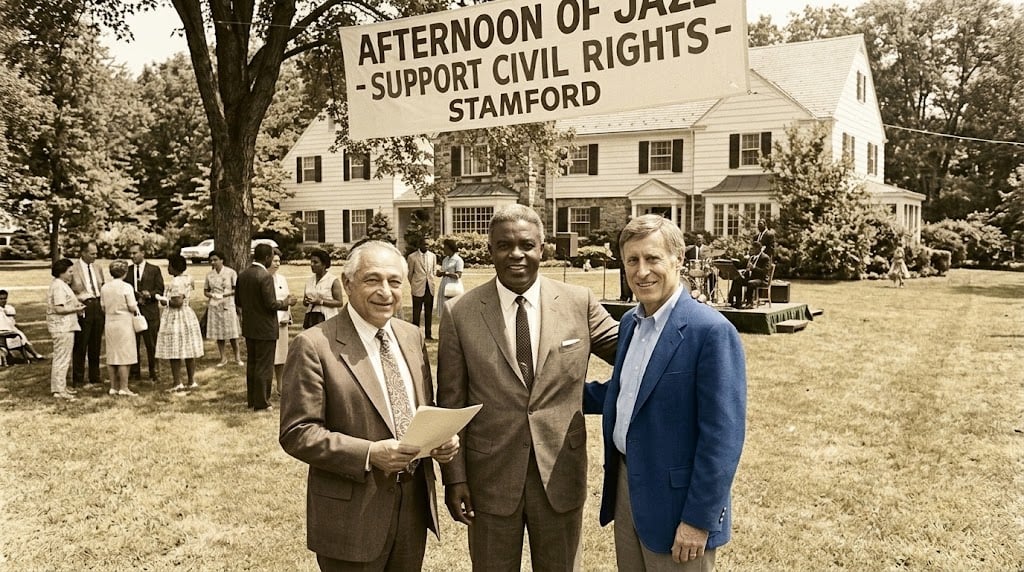
Once settled in Stamford, that philosophy came to life right in his own backyard. Beginning in June 1963, Jackie and Rachel hosted their famous annual “Afternoon of Jazz” concerts on their sprawling lawn on Cascade Road. The primary goal was raising crucial bail money for civil rights activists who were being jailed during peaceful protests across the South.
These concerts quickly became a cornerstone of Stamford’s civic life. Local Jewish residents, activists, and interfaith allies bought tickets en masse, helped coordinate logistics, and poured significant funding into both the Southern Christian Leadership Conference (SCLC) and the NAACP through those afternoon gatherings.
Around that same time, another meaningful connection was taking root through Rabbi Joseph Ehrenkranz, the longtime Orthodox rabbi of Congregation Agudath Sholom in Stamford.
Rabbi Ehrenkranz, who began leading the shul in 1948, built a national reputation for championing racial justice and interfaith dialogue long before those causes were widely embraced. He firmly taught that authentic Judaism demanded active engagement in the civil rights struggle.
While living in the same town during the height of the movement, Rabbi Ehrenkranz also served as a close mentor to a young Stamford teenager named Joe Lieberman (who would later become a U.S. Senator). Inspired by the rabbi’s civil rights focus, young Lieberman befriended Jackie Robinson in Stamford during the mid-1950s, building a direct personal bridge between the local Jewish youth and the baseball icon.
In August 1963, Rabbi Ehrenkranz was one of the very few Orthodox rabbis to attend the historic March on Washington. He later recalled the journey:
“At 3 a.m., the train to Washington D.C. stopped in Stamford. I boarded with many congregants—including young people. I marched in the front row with Martin Luther King, Jr., and then watched him as he delivered his ‘I Have a Dream’ speech. It was an important moment not only in Black and U.S. history, but also in Jewish history. The next year, when Congress passed the Civil Rights Act of 1964, the Jews were beneficiaries of newfound rights, along with African Americans.”
It’s wonderful to imagine that Jackie Robinson and Rabbi Ehrenkranz might very well have been riding on that same 3:00 a.m. train out of Stamford that morning, heading toward history together.
The Robinsons remained in Stamford for the rest of Jackie’s life. After retiring from baseball following the 1956 season, he threw himself into business ventures, social advocacy, and community building. He passed away at his Stamford home on October 24, 1972, at the age of just 53.
Through genuine allyship and a shared commitment to fighting prejudice, the Stamford Jewish community played a proud part in helping Jackie Robinson break down barriers in Connecticut—helping transform a quiet suburban home into a vibrant center for national civil rights support.