
Bridging faith. Defending truth. Confronting hate
JD Vance Just Mainstreamed Tucker Carlson’s Narrative About Israel
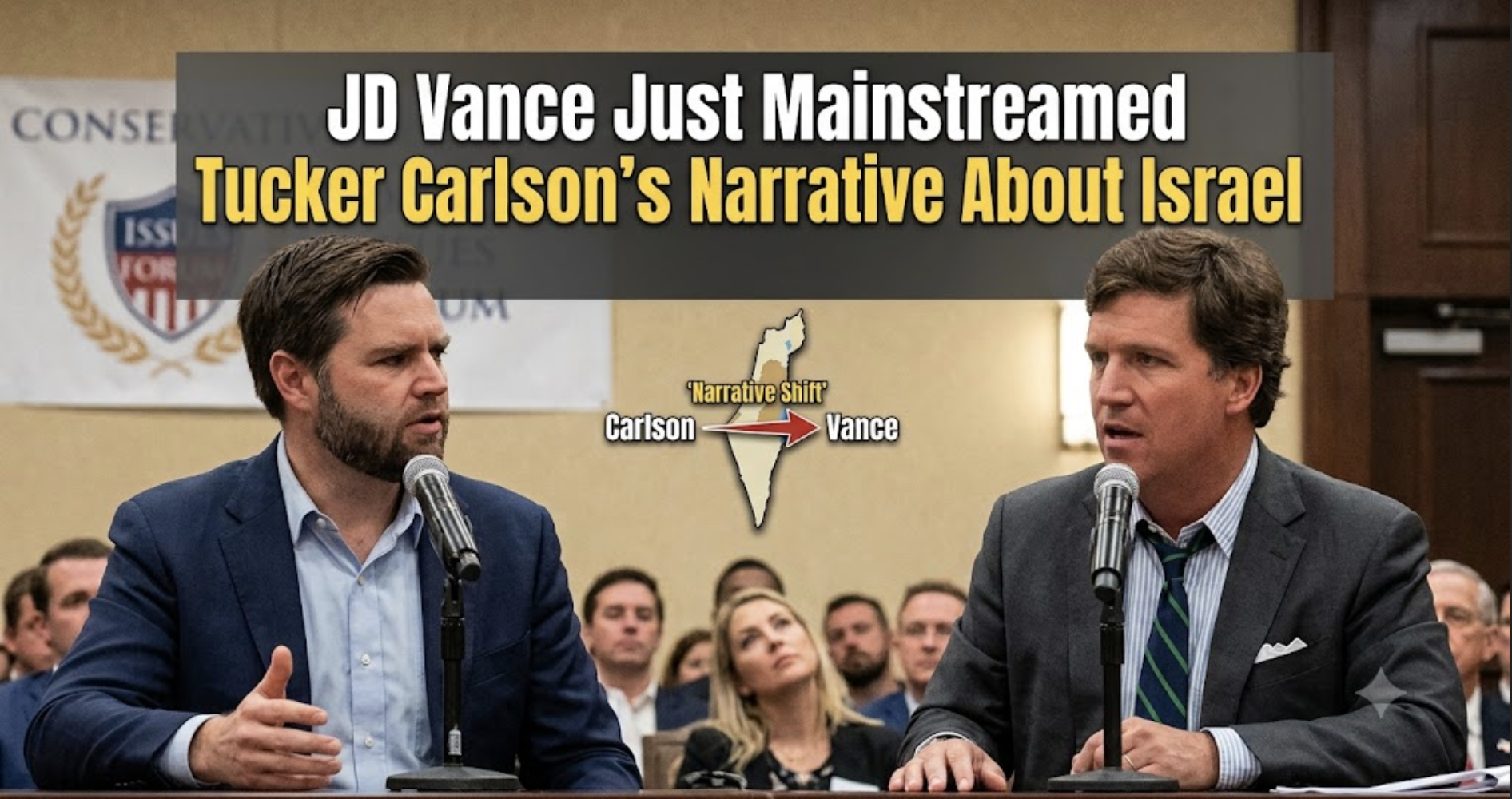
Image created from Google Gemini by Tim Orr
On July 15, Vice President JD Vance advanced a troubling narrative on the Joe Rogan Podcast echoed a rhetorical framework that has become closely associated with Tucker Carlson’s commentary on Israel than Donald Trump, who is the one whose policies he should be defending, not undermining.
The central narrative he constructs in this interview is one that closely resembles Tucker Carlson’s ideas on Israel that has spent the last few years developing. Vance does not repeat Carlson’s language verbatim. Instead, he echoes many of the same assumptions about Israeli influence, American foreign policy, and the motivations of pro-Israel policymakers.
First, Vance advances an all-too-familiar accusation about Israel in that it supposedly possesses extraordinary influence over American politics. This is a source of a conspiracy theory that is often leveled against Israel and distorts what is really going on. According to this narrative, there are pro-Israel advocacy groups, donors, and lobbying organizations that exercise a level of political power that far exceeds that of other interest groups. What he leaves out is that almost every nation invests in efforts to influence public opinion in line with its national interests. The implication that Vance advances is that Israel is especially guilty of influencing our elected officials to prioritize Israel’s preferences because they are unable or unwilling to resist this influence.
Second, certain Israeli officials secretly finance American influencers and media campaigns. Here, the term is “secretly. “This is a conspiratorial accusation that apparently only applies to Israel. That description would be accurate when discussing Qatari, Russian, or Chinese influence on these formats. Applying conspiratorial language selectively to Israel suggests that Israel alone exercises hidden and uniquely sinister control over American public discourse. Here, he advanced a familiar conspiratorial narrative of manipulating American politics through secret influence rather than through the same forms of diplomacy, advocacy, and public engagement practiced by many other states.
These allegations suggest that Israel covertly cultivates journalists, commentators, and online personalities to shape public opinion in its favor. The result is portraying the relationship that America has with Israel as being manufactured rather than reflecting genuine political or moral convictions.
The effect of Vance’s statements is to portray the U.S.-Israel relationship as the product of hidden manipulation rather than the result of genuinely held political judgments, strategic interests, or moral convictions. In this way, he makes support for Israel an illegitimate position to have that well-meaning people can disagree on. Instead, he treats it as evidence that public discourse has been secretly engineered.
Third, those influence campaigns supposedly distort American foreign policy. According to this narrative, U.S. strategic decisions are not primarily driven by American national interests but by narratives deliberately crafted to benefit Israel. This Tucker Carlson-like argument that closely mirrors Tucker Carlson’s repeated claim that Washington’s policies toward the Middle East is a product of manipulation rather than independent judgment. Instead of framing the debate correctly, namely a debate about democracy, shared strategic interests, or sincerely held moral convictions, he frames it as evidence that American policymakers have been misled by Israeli influence.
The danger here is that this statement frames every American decision toward Israel, ranging from military assistance and intelligence cooperation to diplomatic support at the United Nations, as not a product of normal policy deliberation but as proof of hidden Israeli control. Once this assumption is accepted, disagreement with the accusation itself can be dismissed as further evidence of the influence campaign’s success. This is where the Vice President of the United States echoes similar tropes from the podcast sphere, such as those of Tucker Carlson, Candice Owens, and Meghan Kelly. These ideas become accepted norms and are interesting evidence that people’s expressions of support for Israel is treated as confirmation that American policy has been captured rather than freely chosen.
Fourth, pro-Israel politicians become instruments of a foreign government rather than defenders of American interests. One of his statements seems to be directed toward Marco Rubio and possibly even Mike Huckabee. Of the two, I think Rubio is more plausible because of his stated policy positions on Iran and during his tenure as Secretary of State. Vance argued that there are Americans within the administration who oppose negotiations; according to him, some of these hawks have tried to derail them. He charges that those who embrace those policies side with Israel, favoring a continued military campaign “indefinitely.” Of course, the operative word here is indefinitely, and some of the criticism has been amplified by “certain elements within the Israeli government” through influence campaigns. In his telling, their support for Israel is interpreted as evidence of compromised loyalty. In other words, Israel first and not America first. This accusation shifts the debate over policy to suspicion about the motivations and independence of American political leaders.
Vance is creating a deeply asymmetrical standard. After all, have you ever heard him accuse other politicians who favor closer relations with allies of serving those governments merely because they support cooperation with them? He singles out Israel, and any support for Israel is treated as uniquely disqualifying.
Yet support for Israel is treated as a disqualifying act, as though agreement with Israeli policy automatically places an American official under suspicion. The result is that pro-Israel advocacy is no longer seen as a legitimate position within American democratic debate but as evidence of divided allegiance.
Of course, none of these claims is entirely new. What is striking is that they appear together as a coherent interpretive framework, even by the Vice President. Rather than viewing the U.S.-Israel relationship through the traditional lenses of strategic partnership, shared democratic values, or common security interests, he explains the relationship to be primarily one of hidden influence, elite manipulation, and compromised policymakers. That narrative has become a defining feature of Tucker Carlson’s commentary on Israel, and Vance reproduces many of its central assumptions.
Finally, Israel, and not Iran, is presented as the principal obstacle to peace. He presents Israeli policies as the central cause of instability in the Middle East, while Iran’s actions receive comparatively less emphasis or are treated as reactive. The effect is that he reframes the region’s conflict around Israel and not the Iranian revolutionary ambitions or the actions of its proxy groups.
The real danger of Vance’s argument is that it does not merely criticize Israel, but that he encourages Americans to view the U.S.-Israel relationship through a lens of suspicion rather than one of strategic partnership. Through he combination of allegations of hidden influence, his charge of secret media campaigns, compromised policymakers, and Israel being the primary obstacle to peace, he reproduces a framework that has become closely associated with Tucker Carlson and the populist anti-interventionist right. On this framework is accepted, any support for Israel will be received as something sinister. Conservatives should reject such a narrative framing.
Related Topics