Jeffrey Sachs’s Moral Shortcuts in His UN Speech
Principle as branding: a lecture with missing targets
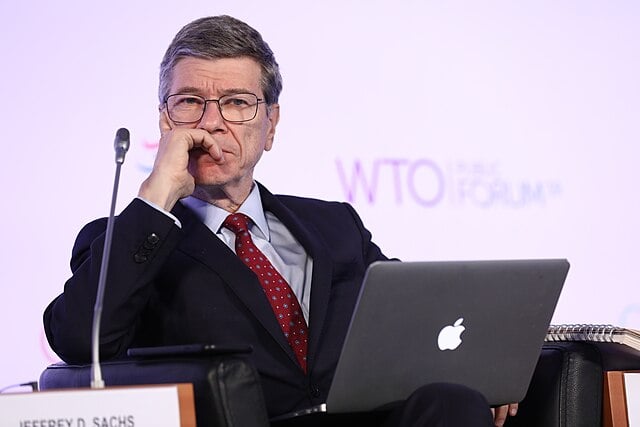
Professor Jeffrey Sachs came to the Security Council with a familiar performance: an oration on the sanctity of the UN Charter, delivered with pious optimism and a practiced air of sanctimony. His central manoeuver is to treat American force as the defining threat to the international order, while speaking as though other great powers merely endure history rather than manufacture it. He lists US bombing operations and threats, calls them unlawful, and then invites the Council to behave as if it is a neutral tribunal that can command the powerful into obedience. Elegant, yet wrong.
The boring part first. Sachs presents a bundle of legal conclusions as settled fact. The honest way to handle claims about strikes and self-defense is to go country by country, with skeptical precision and forensic clarity. Ask if force was conducted with host state consent. Check if Article 51 letters were filed. Compare the legal arguments invoked, and admit where serious lawyers disagree. The task is not to prove Washington right. The task is to show that he has smuggled contested legal territory into moral certainty.
China did not drift into Tibet like fog. The PRC’s takeover was formalized in 1951. Russia did not simply wake up one morning in 2008 to find itself in mortal danger from Georgia. It invaded, and Georgia lost further control of territory around South Ossetia and Abkhazia in the aftermath. I’d guess the Professor can sanctify that too. NATO, for its part, bombed what was then the Federal Republic of Yugoslavia in 1999. That intervention contributed to the conditions that preceded Kosovo’s unilateral declaration of independence.
If the subject is the Charter versus the habits of empire, the cast list cannot be one nation, one alliance, one convenient villain. Great powers do not merely violate norms through bombs. They do it through annexations, proxy armies, the installation and protection of friendly strongmen, forced votes under occupation, economic chokeholds that make sovereignty conditional. The Charter is not threatened by one capital alone. It is threatened whenever any permanent member treats veto privilege as a license for impunity.
Sachs’s selectivity becomes still more revealing when he explains away Russia’s invasion of Ukraine as a strategic security reaction to NATO. He has argued, in his own writings and interviews, that the war was “provoked” by decades of US policy. That logic grants Russia the privilege of motive while shrinking Ukraine into a secondary detail. Yet the same generosity of context rarely appears when he prosecutes Washington. National security is mitigation for Moscow, but mere pretense for America.
Professor Sachs may claim the matter at hand is Venezuela. Then let him prove his principle travels by issuing the same condemnations, with the same moral urgency, on any TV station; I’d recommend Al Jazeera TV (they love him, he persistently defames his country and Israel), or in the podcasts that crown him an ‘expert’, when the aggressor is Moscow or Beijing rather than Washington.
Another problem hides inside his “measures required”. He demands the Council affirm immediate restraints on the United States, including withdrawal of “forward deployed assets”, termination of coercive measures, and the appointment of a special envoy reporting back in fourteen days. One hears the confident voice of law. One also hears an evasion of the institution’s design. The Council is not a court. It is a veto club where the powerful legalize their preferences and block what they dislike.
And then comes the moral question Sachs never seems to consider, even as he claims the mantle of universalism. In the wider UN system, Israel attracts a uniquely concentrated stream of condemnatory resolutions, year after year, a pattern acknowledged even by governments that support scrutiny in principle. A UN Human Rights Council agenda item exists that singles out Israel as a standing, country-specific focus. It does require anyone praising the UN as a moral referee to explain its obsessions, not with tartness alone, but with an account of what that obsession reveals.
Two questions remain, and they are the only ones worth asking at the end of such speeches. If NATO “provocation” can be used to interpret Moscow’s war as a security response, why is a parallel standard treated as illegitimate when applied to Washington’s conduct? And if the UN system repeatedly concentrates its condemnations on one state with such continuity, why accept Sachs’s piety about neutrality when the Council’s first loyalty is to its permanent members’ interests?