Founder & Principal, Line of State
Jerusalem Reads Iran Through Its Constituent Peoples
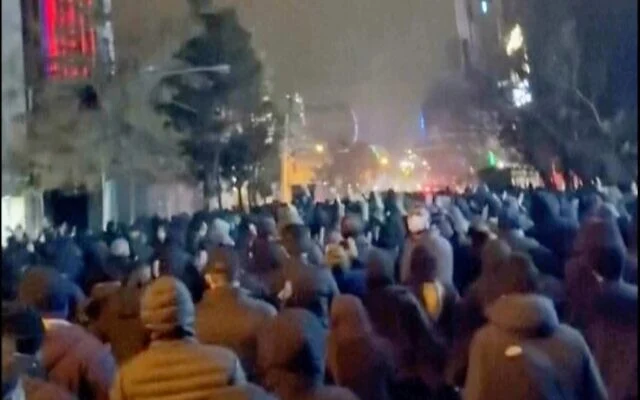
Tehran under tightening control as protests persist, while Iran remains largely cut off from the outside world. Authority is enforced at the centre, but contested beyond it. Tehran, Iran, January 10, 2026. (UGC via AP)
Iran’s struggle is no longer defined solely by Tehran or its ruling elite. Even as the regime attempts to retain control, and while its durability remains uncertain, the decisive dynamics are already unfolding across the country’s peoples, regions and fault lines, terrain that Jerusalem has been reading, mapping and quietly preparing around for years. What comes next will not be settled by succession politics in the capital, but by who understands where power has shifted beyond it and who is positioned to act when the centre can no longer set the terms.
The shutdown of Iran’s communications network marked the moment when the confrontation ceased to be economic and became existential. When “Enemies of God” are measured in gallows, the regime is no longer managing a crisis; it is fighting for its survival. It is too early to determine whether Iran will collapse. But it is already clear that even if the ayatollahs endure, Iran’s future will be written beyond Tehran.
This is not a story of people versus regime. It is the story of a state constructed as a power-centered mosaic: a unifying Shiite authority since the Safavids, borders imposed in the nineteenth century that cut peoples apart along the Aras River, and a century of administrative centralization in Tehran – one language, one bureaucracy, vast regions governed from afar. Persians constitute a majority, but not an exclusive one; alongside them live Azeris, Kurds, Lurs, Arabs and Baloch. The protest movement, which spread across provinces and cities, has struck directly at this fault line: centre versus margins, official identity versus regional identities. Even if control is reasserted, something beyond Tehran has changed irreversibly.
The Azeris are the case that most consistently misleads external observers. They number in the millions, are overwhelmingly Shiite, and are deeply embedded in Iran’s economy and religious-political establishment – up to the very summit of power, including Khamenei himself. Their demands centre on language and culture, not separation. Yet integration is not immunity. When the economy falters and the streets mobilize, Azeri cities move as well, often through Iran’s oldest political instrument: the bazaar. Azeri identity was split in the nineteenth century, when the border imposed between Qajar Persia and the Russian Empire cut it in two and prevented it from becoming a single state. For many, home remains Iran – not Azerbaijan – but an Iran of a different kind. In a post-Tehran collapse scenario, the northwest will not debate annexation but the structure of the state: federal arrangements, autonomy, and the distribution of authority. In Baku, under the Aliyev family, this reality is well understood: millions of Azeris south of the Aras are not a national asset, but a potential threat to internal balance and regime stability.
With the Kurds, there is no ambiguity. Across the western arc, a consolidated national identity exists alongside governing structures and a proven capacity to turn vacuum into fact. The discussion there is not about linguistic rights but about statehood – one that would carve territory from Iran, Iraq, Syria and Turkey. This is not a vision but an operational scenario, one that Jerusalem supports, understands in depth, and knows how to engage across all four arenas. Regional stability is not preserved by maintaining borders at any cost, but by adapting them to realities that have long demanded such solutions and now do so with renewed force.
The Baloch map Iran’s axis of strategic depth: centre to coast, not west to east. Around Zahedan, a cross-border Baloch identity spans Iran, Pakistan and Afghanistan. Here, the question is no longer protest but political configuration. A Baloch state drawing territory from all three would move from theoretical possibility into diplomatic discourse. This is a theatre Jerusalem reads through long historical continuities, soft borders, and communities that operate beyond electoral or regime cycles.
The Arabs of Khuzestan are not a question of identity but of control. This is a hub of oil, water and infrastructure, a mixed region under tight security management since the Iran-Iraq War. Grievances are deep, and protests over water and livelihoods have repeatedly escalated into confrontation with the centre. In the aftermath of any central breakdown, the contest will not begin with flags but with revenue streams and corridors – who controls the fields and the refineries. It is also the westernmost Iranian theatre closest to Israel; in the opening strike of the June 2025 Israel-Iran Twelve-Day War, launch capabilities there were severely degraded and activity was pushed eastward. In Jerusalem, Khuzestan is understood not as a province but as a strategic junction. Ideas of an Arab state circulate in exile; on the ground, outcomes are decided by resources, not sovereignty.
Beyond separatism, peoples who do not seek statehood – Lurs, Gilakis and others – will also shape Iran’s fate. Their alignment will determine whether disruption yields order or chaos, depending on whether governance offers dignity, livelihood and local authority, or attempts to reimpose centralization and coercion.
Even without the collapse of Tehran, every fissure in Iran opens a new arena. Ankara will close windows, Islamabad will draw red lines, Washington will hesitate over maps. Jerusalem, however, reads Iran not only through its centre but through the peoples and fault lines that lie beyond the capital. Those who understand Kurds, Baloch, Azeris and Arabs understand Iran as it truly is. Regimes can shut down networks, but not identities – and the next order will be shaped by those already positioned to act before the arena formally opens.
—
An earlier Hebrew version of this analysis appeared in Maariv. This is a revised English edition by the author.
Related Topics