
Clarity for Leaders in Law, Policy, Finance, and Covenant
Jews and Christians Are Lowering Standards for Political Gain
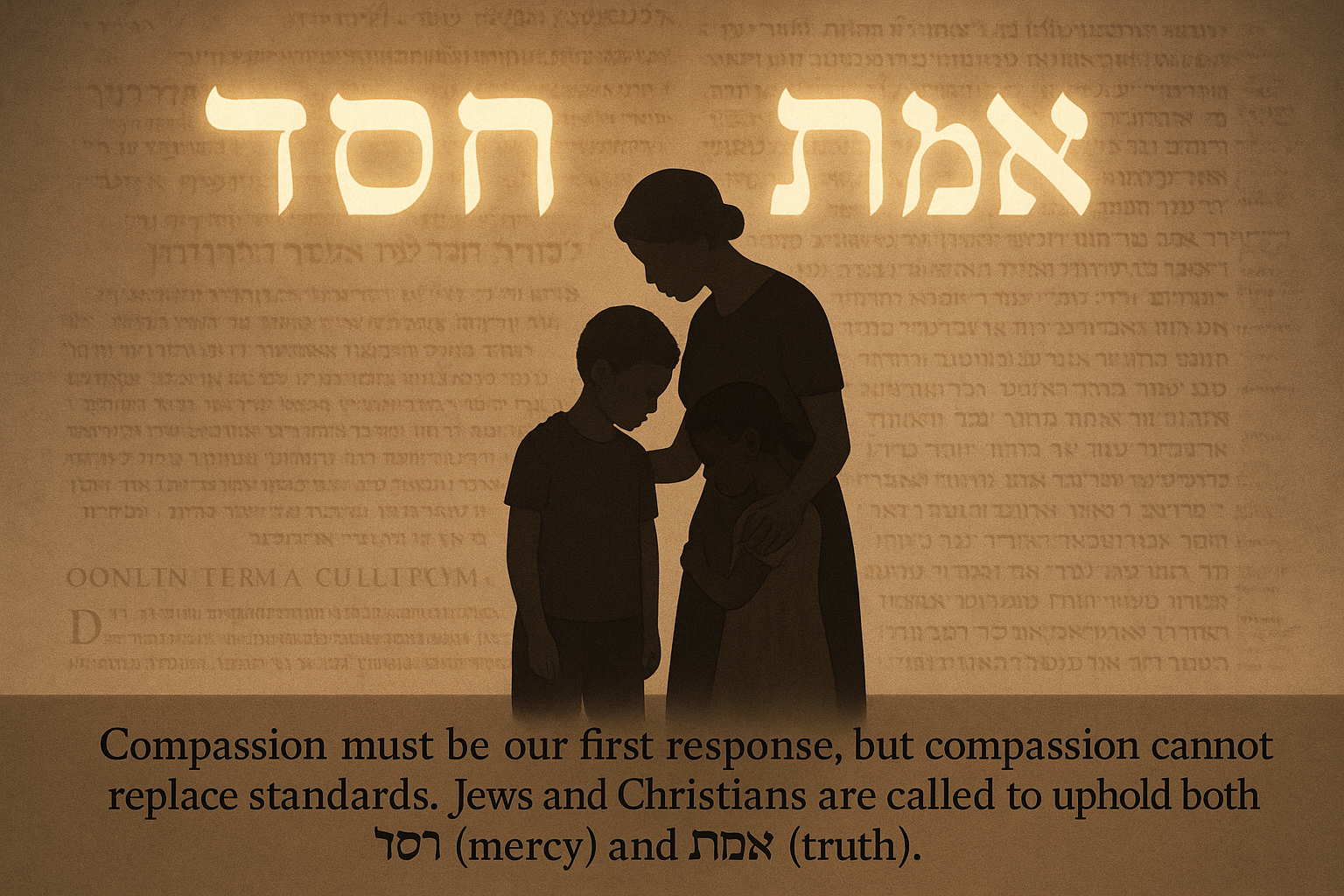
Source Image: The Sovereign Standard. Illustration of a grieving mother with two children in silhouette, framed beneath glowing Hebrew words אמת (truth) and חסד (mercy).
The death of Charlie Kirk is a tragedy. No amount of disagreement with his politics should obscure that fact. He was a young man, a husband, and a father of two children who now face life without him. Murder is not justice. It is not a solution to ideological disputes, nor is it a legitimate expression of democracy. What happened to him was an assassination, not accountability. Any fair society must say this plainly.
Yet the rush in some circles to canonize him as a civil rights saint should give us pause. Honoring a man’s humanity is not the same as elevating him into a symbol of righteousness. Justice requires truth. Jewish tradition has long warned against false weights and measures (Devarim 25:13–16), and Christians are taught not to conform to the pattern of this world but to be transformed by the renewing of the mind. In holding Kirk to his own professed Christian standards (Romans 12:2) becomes a mirror, not a weapon. When conduct forms a repeated pattern that contradicts the principles one claims, accountability is not slander. It is integrity.
Kirk’s record is complex. He spoke in churches across the United States and was welcomed by pastors. He founded Turning Point USA, which drew large numbers of young people into political discourse. He defended Israel at a time when many conservatives sought strong voices on the subject. For these reasons, some in the Jewish community respected him, and many Christians viewed him as a defender of faith and family values. These contributions should be recognized.
But for those who watched his content consistently, troubling behavior also emerged. One public moment stands out. A young woman, barely out of her teens, challenged him during a live event. Rather than respond with patience, he mocked her, watched her falter before a cheering crowd, then had her microphone pulled. As she broke down emotionally, he pointed at her and told the men in the audience that this is the type of woman they should not marry.
Those words humiliated rather than healed. In Jewish scripture, “One who mocks the poor blasphemes his Maker” (Mishlei 17:5), and “A soft answer turns away wrath, but a harsh word stirs up anger” (Mishlei 15:1). Wisdom literature warns that arrogance hardens into oppression (Tehillim 73:8), and blessing rests on those who refuse the counsel of mockers (Tehillim 1:1). Even when wrongdoing appears to thrive, judgment comes. “It shall be well with those who fear God” (Kohelet 8:12).
Because Kirk identified as a Christian and taught from pulpits, it is fair to hold him to his own professed Christian standards. “All Scripture is God-breathed and useful for teaching, rebuking, correcting, and training in righteousness” so that people of faith are equipped for good works (2 Timothy 3:16–17). Rebuke is meant to guide, not crush. Teaching is meant to nurture, not humiliate. In Christian terms, leadership is measured by integrity and gentleness, not applause for belittling opponents.
This raises a deeper question: Where were the elders? A pastor recounted at a vigil that Kirk was in a private group of twelve pastors, men decades older than him. They bore the responsibility to guide him when zeal hardened into arrogance. The Christian epistles state that an elder must be “self-controlled, upright, holy, and disciplined” and “not arrogant or quick-tempered” (Titus 1:7–8). Shepherds are charged to care for the flock without lording it over others (1 Peter 5:2–3), and teachers are warned that “they will be judged more strictly” (James 3:1). If senior leaders saw patterns of harshness and did not intervene, then silence became complicity.
The Jewish community also faces questions. Some praised Kirk simply because he was pro-Israel. Yet Torah demands more. “Execute true justice, show kindness and compassion” (Sefer Zechariah 7:9) and “speak truth to one another, render judgments that make for peace” (Sefer Zechariah 8:16). “Woe to those who call evil good and good evil” (Yeshayahu 5:20). Support for Israel does not cancel behavior that violates the ethics of Torah. To excuse such behavior is partiality, and Jewish law forbids partiality in judgment.
Concerns about Kirk’s rhetoric should not be ignored. In the days following his death, reviewers and monitors identified both exaggerations and real statements that many Jews reasonably heard as echoing familiar tropes. The far-right Groyper movement even targeted him for being “too friendly” toward Jews and Israel, while others criticized his invocation of Jewish influence in negative terms. That tension reveals how volatile the platform had become. In Jewish thought, lashon hara, harmful speech, is condemned regardless of intention. Words that degrade carry weight whether or not the speaker claims to reject extremism.
Journalists like Kyle Spencer documented how Turning Point USA rewarded spectacle over substance and incentivized confrontation. The American Association of University Professors issued a warning about TPUSA’s campus tactics, including watchlists and public shaming. When the culture of a movement prizes humiliation, it abandons the biblical charge to speak truth with peace (Sefer Zechariah 8:16).
Public reactions after his death reflected this tension. Rev. William Barber II denounced the killing as a brutal assassination while warning against “religious nationalism … a kind of national religion that asks God to bless the nation without the nation facing her sins and her violent public policy.” Former Vice President Mike Pence praised Kirk as a defender of free speech but urged the nation to confront political violence. In contrast, faith leaders such as Rev. William Barber II warned against ‘religious nationalism’ and pastors in Houston openly acknowledged that Kirk’s tone was combative and at times inconsistent with the love he professed, underscoring that even within the church, his public witness provoked serious concern. Reuters noted how Kirk inspired both intense support and strong opposition. Pastors in Houston acknowledged his faith but cautioned against martyrizing a figure whose style often targeted dissenters. These critiques were not attacks from enemies. They came from within his own world.
The combined lesson is that grief must not blur standards. Jewish tradition says “seek justice, correct oppression” (Yeshayahu 1:17). And again, Christians are called to teach, rebuke, and correct (2 Timothy 3:16–17), not according to political convenience but to their own scriptures.
The call to action is simple but hard. Jews and Christians must recover their standards together. Elders and rabbis must not withhold rebuke when leaders violate ethical norms. Political allies must not excuse arrogance or cruelty simply because someone is pro-Israel or pro-family. To lower the bar for political gain is to betray both Torah and Gospel. But if we refuse to lower it together, we might yet be the light to the nations we were meant to be.
Let compassion shape the close. Charlie Kirk was not beyond growth. He was still maturing, still learning, still capable of change. That possibility was stolen by violence. Compassion for his family must remain our first response, but compassion must never become an excuse for myth-making. We can mourn without canonizing, and we can honor his life without ignoring his flaws. If Jews and Christians hold to God’s standards rather than political expedience, even in grief, we will remain witnesses of justice, mercy, and truth.
Related Topics
Related Posts