Johanna and Johann: A Hollywood Love Story or Darker Tale?
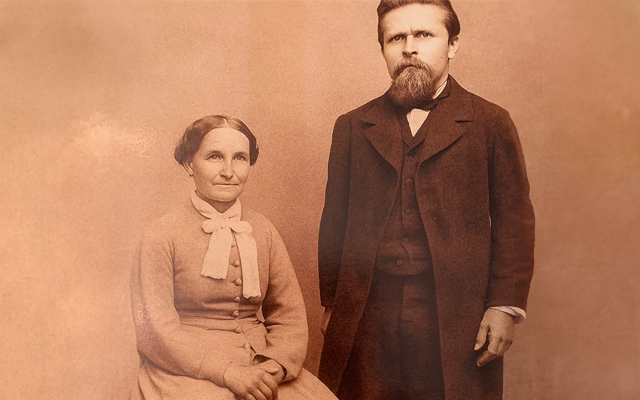
With the approach of the Jewish high holidays and its themes of reflection on the past and hopes for the future, I find myself musing about my husband’s great-great grandparents: Johanna Horn, a Jew, and Johann Hopfengsperger, a seminarian studying to be a Catholic priest.
Based on genealogical research, I know that Johanna and Johann lived in Bavaria, Germany. I don’t know how they met. But I do know, in today’s vernacular, that they were “in a relationship.” It’s a good bet that neither family was delighted.
In fact, Johann’s uncle reportedly gave him a substantial amount of money to break it off with Johanna. In true Hollywood fashion, Johann took the money and fled with Johanna. They boarded a ship, got married at sea and ultimately arrived in Boston, Massachusetts.
The couple later moved to a part of Wisconsin known for farming and cheese making and had eight children and many grandchildren. Both are buried in a Catholic cemetery. Johanna’s Jewish identity seems to have been hidden throughout this time but she may have kept some Jewish traditions.
Growing up in a nearby Wisconsin town, my husband Paul knew nothing about his Jewish ancestry. His parents were devoted members of a Catholic church and his maternal aunt was a nun. Paul attended private Catholic grade school and served as a church altar boy.
Paul often says he became a Zionist in 1967 when he and his college fraternity buddies avidly followed the news about the Six Day War that was thrust on Israel by its Arab neighbors. He was inspired by Israel’s tremendous military skills, courage, and resolve in the aftermath of the Holocaust.
Over the ensuing years, Paul began to read about Israel and the Holocaust, enjoy Israeli music and dance, and participate in Jewish holidays, rituals and traditions. With no idea of his biological connection, and without my knowledge, he took rigorous religion classes, immersed in the mikvah, and converted to Judaism in 1980.
Many years later, I began dabbling in genealogical research, never intending to dig into Paul’s family history. But, when I couldn’t easily find out anything about my family, I switched to Paul’s.
I was amazed at the wealth of information that popped up on his maternal side. Much of what I read was the product of a genealogy assignment given to high school kids, many of whom were connected in some way to the Hopfensperger family tree.
Via their research posted on-line, I learned about Johanna and Johann, including the possibility that Johanna was a rabbi’s daughter, that the ship was delayed, and perhaps rerouted, due to weather or other problems, and that the couple was married on board the ship. Paul and I were astonished by these revelations.
I hungered for more information and later found out the ship’s name, located the ship’s manifest bearing both Johanna’s and Johann’s names, and found out that they departed at one point from the Azores Islands, Portugal.
I also found a box of old photos in our basement. There was one with Johann standing alone. On the back of the photo, my mother-in-law had written “My great-grandfather … supposedly eloped with a Jewish girl Johanna Horn.”
I let myself go down a rabbit hole. Why did she keep her knowledge from Paul even after he shared his conversion and, much later, told his parents that we were getting married? Why did she call Johann her great-grandfather but seemingly didn’t acknowledge the “Jewish girl” as her great-grandmother? Why was the mysterious Johanna missing from the photo?
Adding to the mystery, why did Paul’s mother love matzos and horseradish? And why did his grandmother make a point of buying chametz from a Jewish neighbor every Passover?
Ironically, during this time, I was frequently in Germany in my role as an attorney for a large international German company headquartered in Bavaria. In my spare time there, I visited Jewish cemeteries, museums, sites of Jewish medieval learning and old synagogues that the Nazi’s hadn’t destroyed. But I didn’t delve into Bavarian Jewish history and never made it to where Johanna and Johann lived.
In my current quest for knowledge, I’ve learned that Bavaria has a very long, sordid history of anti-Jewish persecution, including massacres and repeated expulsions. I also found out that, in the 1840’s and 1850’s, Bavarian Jews faced severe ongoing legal discrimination, periodic pogroms and even greater oppression after the 1848 revolution failed. Around that time, there was a significant surge in Jewish emigration.
With this newfound knowledge, I now wonder whether Johanna’s marriage was for love, a means to escape persecution or a combination of both. I also ponder what her life would have been like had she stayed in Bavaria and whether it might have been snuffed out in a pogrom. Would her descendants have been murdered in a Nazi massacre or concentration camp?
Perhaps edging into the realm of Jewish mysticism, Johanna died on January 21, 1884 and Paul was born on January 21, 1948. Is this pure coincidence or are there no coincidences? Did Johanna’s Jewish essence somehow live on through Paul? Can you ever really abandon who you are?
Obviously, there are no answers to these questions.
Paul and I are fortunate to collectively have many photos of long-gone family members on our wall – including our great-great grandparents. But until last month, we only had Johann’s photo. After additional searches of on-line genealogy sites, I found a photo of Johann and Johanna together. Through the miracle of AI, this fuzzy digital photo was sharpened and now hangs prominently in our family photo gallery.
I see the photo of Johanna and Johann daily and feel a satisfying sense of closure. Johanna has taken her proper place, and her existence as a Jew will no longer be hidden or forgotten by our family.
The high holidays are a time for reflection about the past and hope for the future. My search for family history has reinforced that life is complicated and messy, that we can never really put ourselves in others’ shoes and thus can’t judge their actions, and that life is full of mysteries.
In the here and now, our world is filled with senseless violence, tragedy and hate. Against all odds, I hope and pray for the future: that the New Year brings better times for Jews, Israel and all innocents who suffer, and that we will all experience many moments of joy and goodness.