
Judaism Is Fracturing. We Are Doing It to Ourselves.
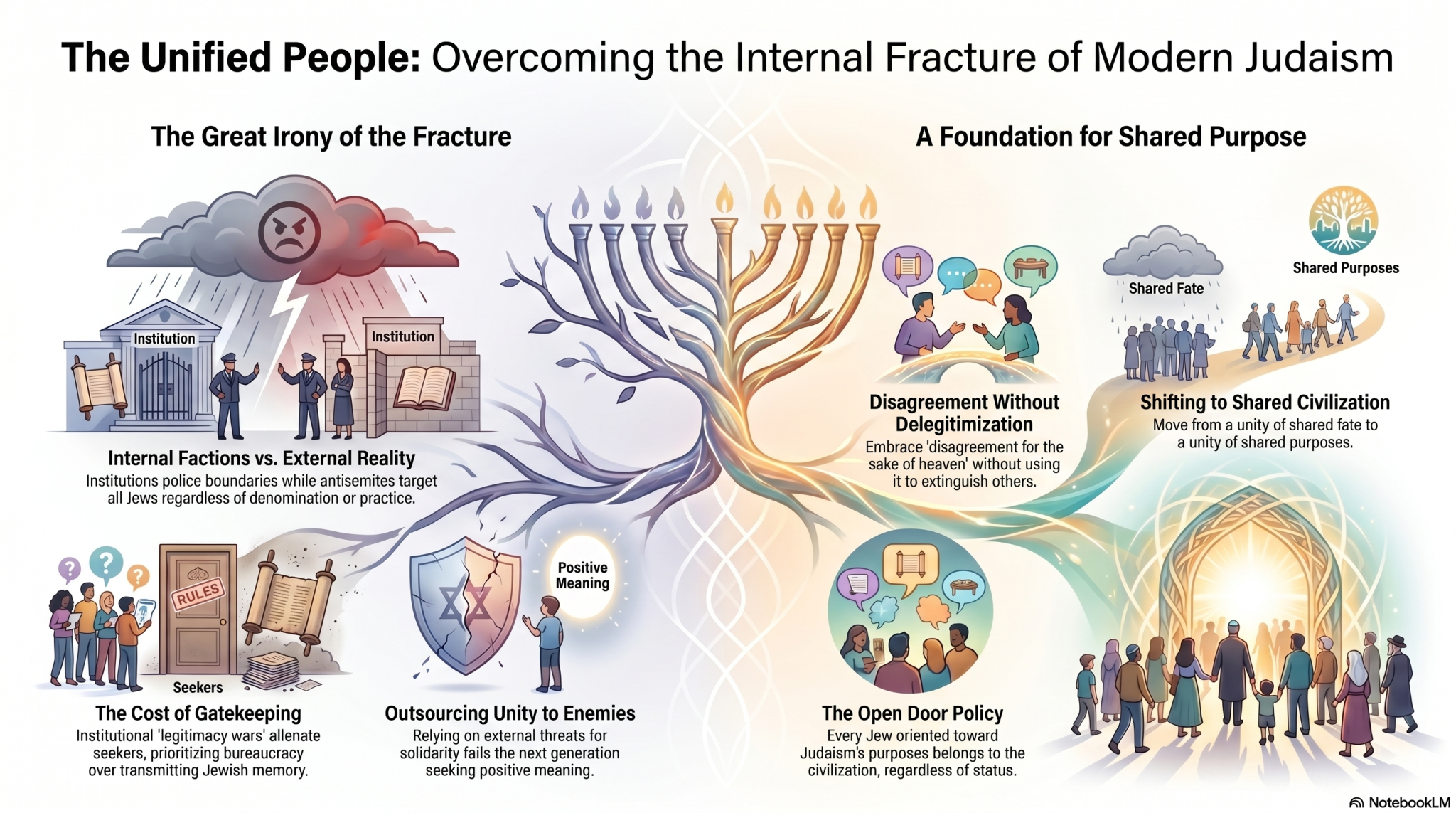
The world’s antisemites see one Jewish people. We need to as well.
Consider two scenes from Jewish life in 2026.
In Jerusalem, a young woman who immigrated to Israel from the former Soviet Union under the Law of Return — who served in the Israeli Defense Forces, paid her taxes, buried her grandfather in Israeli soil — is told by the state rabbinate that she cannot marry in the country she defended. Her Jewish ancestry passes through the wrong grandparent. By the rabbinate’s standards, enforced through the civil law of a Jewish state, she is not Jewish enough to be married as a Jew in the land of the Jewish people.
In a suburb of Chicago, a man in his fifties who grew up Jewish — who had a bar mitzvah, attended Jewish day school, feels his Jewish identity as one of the most significant facts of his life — has quietly stopped attending synagogue. Not because he stopped caring. Because the community he found organized itself primarily around questions he found dispiriting: who counts as a real Jew, which conversions are valid, which denominations deserve recognition. He came looking for meaning. He found a boundary dispute.
These two scenes are not unrelated. They are the same scene at different scales. And they are happening, in variations too numerous to count, across the entire Jewish world right now.
The Terrible Irony
Here is what makes the internal fracturing of Judaism not merely sad but historically grotesque: antisemitism does not recognize any of our internal distinctions.
The Cossack forces that conducted the Chmielnicki Massacres in 1648 did not ask their victims whether they were halakhically observant. The Spanish Inquisition pursued conversos on the theory that Jewish identity was heritable in ways that baptism could not erase. The racial laws of the Third Reich defined Jewishness by grandparentage, making no distinction between the assimilated German Jew who had not set foot in a synagogue in decades and the most devout Hasid in Warsaw. To the perpetrators, the distinctions that consume our communal energy were irrelevant. They were all Jews. They were all targets.
This remains true today. Antisemitism is rising by every measured metric across the political left and the political right, in Europe, in the United States, across the world. Campus incidents, synagogue attacks, social media harassment, political violence — the targets are not sorted by denomination. The Haredi Jew walking to shul in Brooklyn and the secular Israeli studying at an American university and the Reform Jew attending High Holiday services in suburban Atlanta are, to the antisemite, indistinguishable. They are Jews. That is sufficient.
There is a bitter irony in this. The external world imposes on us a unity that we refuse to impose on ourselves. The antisemite sees one Jewish people. We see factions, denominations, movements, and streams, each questioning the authenticity of the others, each conducting legitimacy wars over who truly belongs. The hatred that has pursued us across centuries does not participate in these debates. It does not care which rabbi performed your conversion or whether your mother or your father was Jewish. It finds you anyway.
For much of Jewish history, this external identification — the imposition of a shared fate by shared persecution — has functioned as a powerful, if terrible, form of communal glue. When external threat becomes acute enough, the internal disputes recede. The wars of legitimacy are suspended when survival is genuinely at stake. Israel’s founding, the Six-Day War, moments of acute danger have reliably activated a solidarity across denominational lines that ordinary communal life fails to sustain. Shared threat concentrates what shared purpose has not managed to hold together.
But this is not a foundation. A people who require persecution to feel like a people have outsourced their unity to their enemies. And the generation now coming to adulthood — living with rising antisemitism but without the founding traumas that gave the previous generation its instinctive solidarity — is discovering that threat alone, without positive purpose, is not enough to hold a civilization together.
The Wars We Are Fighting
Judaism is fracturing from within. The fracture is internal, self-administered, and accelerating.
The Israeli rabbinate holds a monopoly over Jewish marriage, divorce, conversion, and burial that no prior Jewish institution in the modern era has possessed. Orthodox parties representing a minority of the Israeli Jewish population have used their indispensability to governing coalitions to entrench that monopoly against the preferences of most Israeli Jews and virtually all diaspora Jewish communities. The result is a state-backed institutional arrangement that imposes one faction’s definition of who is Jewish on everyone — citizens who never accepted that faction’s authority, diaspora communities whose members find their Jewish standing suddenly conditional when they seek to connect with the Jewish state.
The conversion crisis is not theoretical. Hundreds of thousands of Israeli citizens live under the shadow of disputed Jewish status. The Western Wall remains a site of conflict rather than shared Jewish inheritance. Non-Orthodox rabbis — who serve the overwhelming majority of affiliated Jews in North America — see their ordinations, marriages, and conversions unrecognized by the only sovereign Jewish state in existence.
Meanwhile, across the diaspora, something quieter but equally serious is happening. The Pew Research surveys tell part of the story: declining affiliation, rising disidentification, a growing proportion of Jews who describe themselves as Jewish by ancestry but not by religion. But the surveys miss the most important dimension. The crisis is not primarily about intermarriage rates or synagogue membership. It is about alienation and disaffection — about Jews who approached Jewish communal life looking for something serious and found it organized primarily around the question of who doesn’t belong.
The intellectually curious Jew whose questions were met with managed deflection rather than genuine engagement. The gay Jew who spent decades understanding that their full humanity was incompatible with authentic Jewish belonging. The child of a Jewish father who has lived a Jewish life but learns that by Orthodox standards they are not Jewish. The secular Israeli who is Jewish in every meaningful dimension of their existence and finds their standing treated as conditional by institutions that govern them without their consent.
Each of these people was told, by some institutional voice claiming Jewish authority, that they did not fully belong. The antisemite would disagree.
The Pattern Is Not New
What is happening to Judaism now has happened before — in a different tradition, with armies rather than rabbinates as the enforcement mechanism, but with the same structural logic.
The Reformation produced not a reformed Christianity but Christianities plural, each convinced of its own authenticity, each willing to use whatever institutional authority it possessed to suppress the others. The resulting conflicts killed millions and exhausted a civilization across 150 years. The Peace of Westphalia in 1648 did not end the theological disputes — no one changed their minds about doctrine. It ended the wars by changing the architecture: establishing that no single confession was entitled to make its definition of authentic Christianity binding on everyone else.
Judaism’s own legitimacy wars are no less real. The Karaite schism divided Jewish civilization for centuries. The Sabbatean catastrophe shattered communities across the Ottoman world and beyond. The Hasidic-Mitnagdic wars fractured Eastern European Jewry along legitimacy lines that persisted until the Holocaust interrupted the argument by destroying the communities conducting it. The Reform-Orthodox rupture of the nineteenth century produced permanent parallel institutional structures and a legitimacy war that has never ended.
The pattern in each case is identical: theological disagreement is genuine and irresolvable; one faction gains institutional authority; that authority is used to define authentic Judaism exclusively; the excluded communities are delegitimized rather than merely disagreed with; the community fractures; the collective energy that belonged to Judaism’s purposes is consumed by the war over who gets to define them.
We are in that pattern now. The current expression is more dangerous than most of its predecessors because it has state power behind one faction’s definitional authority, and because the generational window for repair is closing faster than we acknowledge.
What Is Being Lost
Every hour that Jewish communal leadership spends fighting about conversion standards is an hour not spent transmitting Jewish memory to the generation that will either carry it forward or let it go. Every meeting devoted to Western Wall access is a meeting not devoted to the question of what Jewish civilization has to say to people who are looking — urgently, seriously looking — for an account of how to live a meaningful life. Every denomination boundary policed as a front in the legitimacy war is a boundary that a Jew who doesn’t fit neatly into any category must navigate rather than simply walking through.
The next generation is watching. And what they are watching is a civilization that has organized its considerable institutional energy primarily around the question of who doesn’t belong. It is not a compelling advertisement for engagement.
The estrangement between Israeli and diaspora Jewry is reaching a generational inflection point. The sense of shared fate that sustained the relationship for seven decades — the conviction that what happened to Jews anywhere was the concern of Jews everywhere — is not equally present in the generation now inheriting Jewish institutional life. When that emotional connection breaks at the generational level, it does not reliably return. We are approaching that threshold. We have not yet crossed it.
And here is the specific danger of that estrangement in an era of rising antisemitism: the solidarity that external threat has historically activated depends on a prior sense of shared civilization. When that sense has eroded — when Israeli Jews and diaspora Jews feel their connection primarily as bureaucratic dispute rather than shared inheritance, when denominational legitimacy wars have convinced significant numbers of Jews that the Jewish community has nothing for them — the threat that once united us produces instead a fragmented collection of communities, each facing external hostility with diminished capacity for collective response.
We cannot afford to outsource our unity to our enemies’ hatred. We need a foundation that holds when the threat recedes — and that is strong enough to face the threat when it does not.
What Is Required
The fracture is not inevitable. It is the product of a specific structural failure: the absence of a framework that prevents any single faction from using institutional authority to make its definition of authentic Judaism binding on everyone else.
This is not a call for Jewish unity in the sense of theological agreement. Unity is neither achievable nor desirable. Judaism’s characteristic mode is argument — machloket l’shem shamayim, disagreement for the sake of heaven — and the tradition has always been richer for the argument than it would have been for enforced agreement. The Orthodox community and the Reform community will not agree about halakha. The secular Israeli and the Haredi scholar will not agree about what Jewish civilization requires. That disagreement is permanent and should be honored.
What is required is a framework that says: you may disagree about everything Judaism contains, and the disagreement is honored, and none of you may use that disagreement as a weapon against the standing of the others. You may define your own community’s membership as rigorously as your theology requires. You may not define the whole of Jewish civilization by your own community’s standards. The antisemite who makes no distinction among us has, in this one respect, grasped something we have not: we are one people. Not one theology, not one practice, not one denomination — one people, constituted by shared purposes and shared history and shared exposure to shared threat.
A framework for that people — not imposed from above, not requiring institutional ratification, but derived from Judaism’s own four-thousand-year record of what it has been trying to do — is available. It identifies eight purposes recoverable from that record: survival, memory, the rejection of false ultimacy, ethical witness, the pursuit of understanding, repair, the sanctification of ordinary life, and inclusion. It derives five structural prohibitions from the tradition’s own documented failure modes. It requires no governing machinery. The Declaration of Independence had no enforcement machinery either. It changed the world anyway, by articulating a standard against which existing arrangements could be measured and found wanting.
The fracturing of Judaism can be addressed the same way. Not by resolving the theological disputes that divide us — they are not resolvable and should not be forced. But by establishing clearly, on the basis of what Judaism’s own tradition requires, that no faction’s definition of authentic Judaism is entitled to extinguish the others, and that every Jew oriented toward Judaism’s purposes belongs to Jewish civilization regardless of what any institution has told them about their standing.
The Door Was Always Open
The young woman in Jerusalem who cannot marry in the country she defended is not less Jewish than the rabbinate that denied her. The man in Chicago who stopped coming because the community had nothing for him was not wrong about the community. He was wrong to conclude that the community was Judaism.
The antisemite who would target both of them without distinction has understood something that our institutional architecture has not: they are both Jews. They belong to the same civilization. The same history claims them. The same purposes are available to them. The same tradition — demanding, serious, four thousand years deep — is theirs to inhabit.
The institutions that have communicated to generations of Jews that their belonging is conditional have not been enforcing Judaism’s standard. They have been enforcing a faction’s standard and calling it Judaism. The external world — which has never accepted our internal distinctions as grounds for differential treatment — implicitly knew better all along.
The door to Jewish civilization was always open. The framework that makes that claim explicit, that builds Jewish unity on the foundation of shared purpose rather than shared persecution, that claims every Jew the antisemite would target — in language precise enough to be useful and on grounds strong enough to be honest — is now available, but is too big for an oped.