Documenting Hidden Jewish Histories and Legacies
Judaism Was Never Meant to Be a Fortress
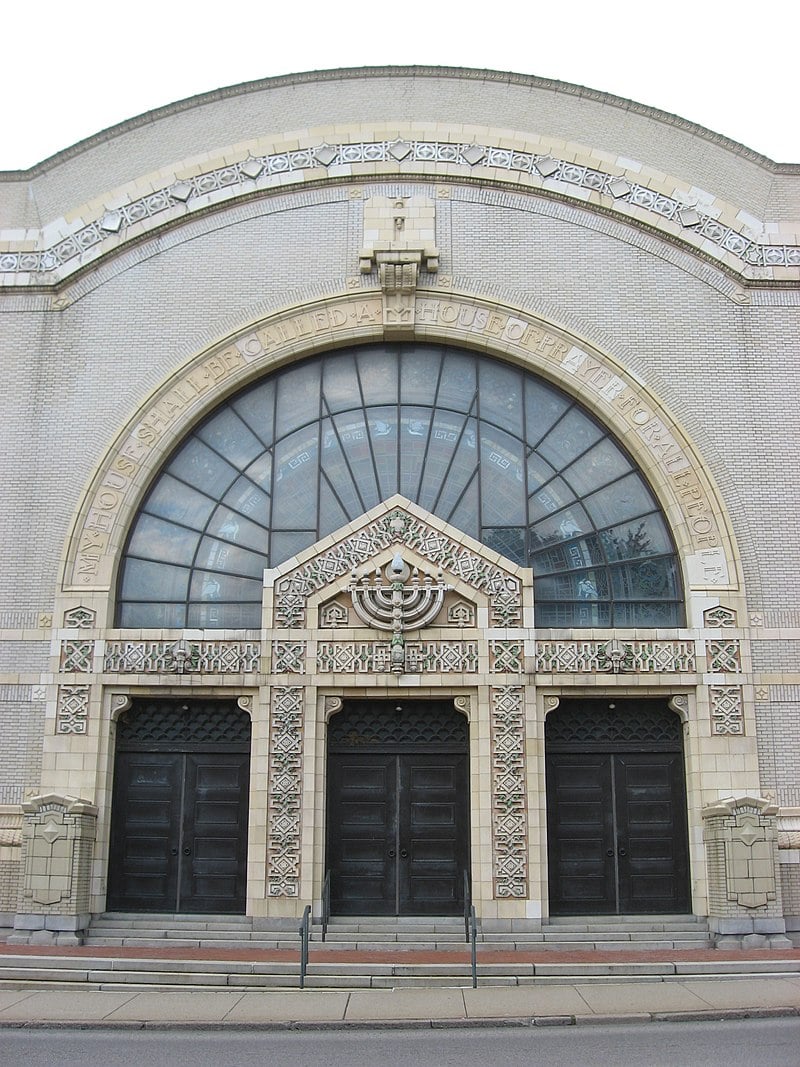
The façade of Rodef Shalom Congregation in Pittsburgh, engraved with Isaiah 56:7: “My house shall be a house of prayer for all peoples.” (Photo: Daderot / Wikimedia Commons)
When I wrote recently about the open-hearted voice of American Judaism in the late 19th century—especially its embrace of converts and civic pluralism—I expected disagreement. That’s part of writing publicly. But I wasn’t prepared for the string of emails that followed: a barrage of theological absolutism, identity policing, and thinly veiled ethnic condescension.
The messages came in response to a blog I published last week for Shavuot, where I traced how rabbis once proclaimed Judaism’s universal values in public—and how many American Jewish communities carved Isaiah’s verse, “My house shall be a house of prayer for all peoples,” into their synagogue walls. It was a piece about memory and welcome—and some replies I received over email only underscored how urgently that message is still needed.
The writer, who signed his name as Tzvi-Gad, didn’t engage with the sources I quoted. Instead, he attacked my credentials, mocked my name, rejected Reform Judaism as Judaism, and insisted that Moses and David were free from “any flaws”.
I won’t quote the full exchange. But I will say this: it revealed a strain of Jewish fundamentalism that has grown louder in recent years—a strain that sees many Jews as imposters, pluralism as heresy, history itself as a threat, and even attacks places of worship that express differing views, as we saw recently in Ra’anana. And it reminded me who I write for.
Fundamentalism does not fear lies. It fears truth. And it especially fears truths that come wrapped in love, learning, and lived experience—because those are harder to dismiss.
That’s why, for some, converts like me are threatening.
I converted to Judaism not to marry in or reclaim distant ancestry, but because I saw in it a faith worth choosing and a tradition worth carrying. For much of the past decade, I’ve worked or volunteered with Jewish nonprofits—as an educator, advocate, and community builder. And still, I’m often asked questions meant to locate my legitimacy: “What is someone with the last name Reid doing at Hillel?” “Are you really Jewish?”
These aren’t just awkward moments. They reflect a deeper discomfort—one that surfaces whenever Judaism’s boundaries are even gently questioned. Converts reveal that Jewishness is not just inherited—it can also be chosen. And that challenges centuries of survival anxiety shaped by persecution and assimilation.
But here’s the truth: those of us who weren’t born Jewish have always been part of this story. From Ruth to Onkelos, from medieval proselytes to modern seekers, Judaism has welcomed the stranger not only in word but in deed. In fact, many of today’s most active Jewish communities—across denominations—include a quiet, steady presence of people who found their way in. They serve on boards. They lead seders. They raise Jewish children. And yet too often, they are still asked to prove themselves.
In my previous work with Jewish students, I saw something remarkable: seekers often felt more comfortable approaching someone who had chosen Judaism. They sensed we understood the terrain. Converts often become translators—guides for those navigating interfaith families, personal doubt, or late-in-life returns to Jewish practice. Our backgrounds aren’t liabilities. They’re bridges.
That’s what makes us unsettling to fundamentalists. Not because we dilute Judaism—but because we deepen it. Because our very presence affirms that Torah can speak across cultures, across languages, across generations. Because we are proof that Judaism is not only inherited—it is chosen, too.
Jewish history offers no shortage of warnings about what happens when faith hardens into fear and power is confused with purpose.
One of the clearest examples is the Bar Kokhba revolt—a second-century uprising that began with hope and ended in devastation. Fueled by militant zeal and messianic fervor, the rebellion left Judea in ruins and led to mass executions, expulsions, and the banning of Torah study itself. The Talmud doesn’t praise the revolt; it mourns its consequences. Yet modern fundamentalists often invoke the zeal of Bar Kokhba’s supporters while forgetting the lessons their failure taught.
Generations earlier, during the Hasmonean period, Jewish history took another dark turn. John Hyrcanus—descended from the Maccabees, the very heroes we celebrate on Hanukkah—used political power to forcibly convert an entire population, the Idumeans. A movement that began as resistance to assimilation ended in coerced assimilation of others. It’s an uncomfortable truth: Jewish leaders have sometimes imposed beliefs on non-Jews.
Even the joyous holiday of Purim contains this shadow. The Book of Esther ends not just with celebration, but with violence and a chilling line: “And many of the peoples of the land became Jews, for the fear of the Jews fell upon them.” (Esther 8:17). While modern Judaism emphasizes voluntary conversion, this verse reveals an ancient ambiguity: sometimes, joining the Jewish people was about safety, not spirituality. And when modern Purim celebrations gloss over that violence with silence, we miss an opportunity to reflect on this complicated aspect of our history.
These stories are not just historical curiosities. Today, people still face barriers when trying to join the Jewish people. In Israel, some Jews-by-choice struggle for recognition as Jews, even after completing rigorous conversion processes and serving in the IDF. In America, converts are routinely questioned, excluded, or treated with suspicion—especially if they don’t look or sound the part. I’ve experienced this firsthand: comments like “My Jewdar didn’t go off” or “You don’t look Jewish” are so common that I’ve had to rehearse how to respond.
These moments aren’t just microaggressions. They reveal how lashon hara—speaking ill of others—can become a tool of gatekeeping, contrary to a tradition that was never monolithic. Labels like “not really Jewish” or “just converted” diminish and exclude—ignoring that every stream of Judaism today would be scarcely recognizable to a Jew of the first century.
And yet, there is another side to our story—one reflected in the thoughtful responses I also received: words of support, shared stories, and hopes for a more open Jewish future.
In the early Roman period, long before Christianity emerged, Judaism actively welcomed seekers. Rabbinic literature and Christian texts alike refer to “God-fearers”—non-Jews drawn to Jewish teachings, who sometimes became full converts. Converts like Aquila of Sinope and Queen Helena of Adiabene became part of Jewish communal life, not despite their outsider status, but as testaments to Judaism’s spiritual magnetism.
That tradition re-emerged in 19th-century America, especially through the vision of Reform Judaism. Leaders like Rabbi Isaac Mayer Wise saw Judaism as a faith for the world—not in the missionary sense, but in the ethical and covenantal sense. They welcomed seekers and made space for them celebrating those who chose to convert openly.
These moments of welcome still exist. I’ve known Orthodox rabbis who supported my work in towns with no active congregation. I’ve received blessings from Chabad rabbis, affirmation from lay leaders, and warmth from teachers across denominations who never questioned my place.
But these moments must become the norm, not the exception. Because fundamentalism is loud. It is certain. It is seductive in its simplicity. And if we don’t push back with confidence, compassion, and memory, it will define Judaism not by the God who welcomes—but by the gatekeepers who guard.
Maimonides taught that righteousness is found not in stringency, but in balance. This “golden mean” embodied wisdom, humility, and moderation. In an age when religious certainty so often hardens into cruelty, his voice is worth hearing again.
So too are the voices of our ancestors—not angelic saints, but flawed human beings. Moses committed murder and struggled with anger. King David committed grave sins and was still called “a man after God’s own heart.” These figures are not spiritual gatekeepers; they are reminders that Judaism is not about perfection—it’s about commitment.
In 1880s America, rabbis like Solomon Sonneschein understood this. They spoke not of a Judaism obsessed with boundary, but of a Judaism brimming with purpose—eager to share its ethical teachings with a hurting world. They believed Judaism had something to offer all people. And when some congregations carved Isaiah’s verse onto their synagogue walls—“My house shall be a house of prayer for all peoples”—they weren’t being poetic. They were being prophetic.
That same vision still calls to us. We don’t need to reinvent it. We only need to remember it—and live it with the confidence it deserves.
The emails I received after my last essay didn’t shake me. They clarified me.
I don’t write to win arguments. I write to remember. I write to extend the same welcome I was once shown—to preserve the memory of a Judaism that proudly spoke to the world, not only to itself.
The voices that lash out against that vision are not new. They’ve taken many forms throughout our history—zealots, excommunicators, censors, gatekeepers. But they’ve always feared the same thing: a Judaism big enough for imperfection, strong enough for love, and open enough to be chosen.
That’s the Judaism I joined. That’s the Judaism I work to build.
I believe we are living in a moment of decision. Fear is loud. Extremism is fast. But truth—real truth, grounded in tradition and sacred text—is steady. It unfolds across generations. It welcomes the stranger. It leaves gleanings in the field. It remembers that our ancestors were wanderers, too.
We can build a Jewish future that closes in on itself. Or we can build a Jewish future that makes room. I’ve made my choice. And I’ll keep writing—not to defend my place, but to make sure others know there’s a place for them too.
Related Topics