NAnews - Nikk.Agency Israel News
“Katyusha” in Jericho: Who Is Russia Training for the Palestinian Authority?
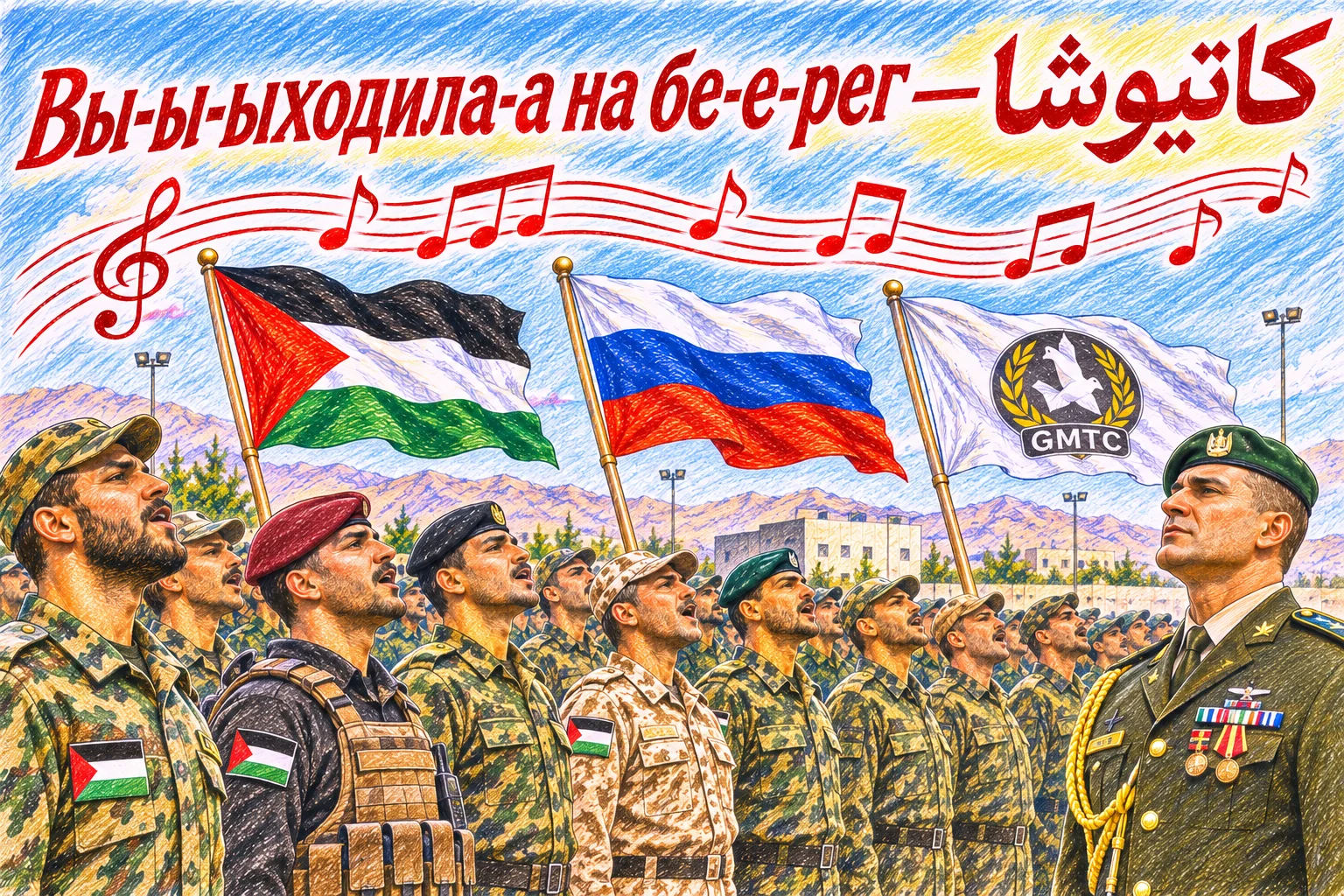
"Katyusha" in Jericho: Who Is Russia Training for the Palestinian Authority? The image was created using AI.
Russian officers are teaching Palestinian security personnel about the war in Ukraine. But under the Oslo Accords, the Palestinian Authority is not supposed to have an independent army.
The ceremony ended with a Soviet song.
On November 17, 2026, Palestinian candidates preparing to enter Russian military academies completed a preliminary training course organized by the Palestinian General Military Training Commission (GMTC). They had studied Russian, military terminology, parade-ground drills, and Russian culture. At the graduation ceremony, attended by a Russian Defense Ministry colonel and senior Palestinian officials, the graduates reportedly sang Katyusha together.
There is an almost surreal detail here: the music of this famous Soviet wartime song was written in 1938 by Matvey Blanter, a Jewish composer.
But the song is not the story.
The real story is what Russia is teaching Palestinian security personnel, who will receive that training, and what Israel knows about it.
Even more strikingly, Moscow is not concealing the cooperation. Russia’s diplomatic mission in Ramallah described the ceremony in an official Facebook post.
Yes, Facebook — the very platform Russia blocked in March 2022, while declaring its parent company, Meta, an extremist organization.
Russian citizens face restrictions on accessing Facebook. Russian diplomats abroad use it to publicize military educational cooperation.
And they appear quite comfortable doing so.
The Palestinian Army That Officially Does Not Exist
To understand why this matters to Israel, one has to return to September 28, 1995.
On that date, Israel and the Palestine Liberation Organization signed the Oslo II Interim Agreement. Article XIV established that, apart from the Palestinian Police and Israeli military forces, no other armed forces were to be established or operate in the West Bank and Gaza Strip.
In other words, the agreement provided for Palestinian internal security forces, not an independent Palestinian army.
Yet the Palestinian Authority operates a sophisticated network of security institutions. Its personnel wear military uniforms, hold ranks ranging from lieutenant to general, attend military colleges, and undergo officer training.
The GMTC is one of the institutions responsible for that system.
Palestinian legislation adopted in 2005 established a military-style framework for the security services. A 2007 decree signed by Mahmoud Abbas created a formal mechanism for military and security training, including the selection of personnel for education abroad.
This distinction is important. Foreign military education for a member of an authorized security service does not automatically violate Oslo. A military doctor, for example, can serve legitimate security and humanitarian functions.
But what happens when the education involves artillery, battlefield command, or technologies developed during a major European war?
At what point does training a security officer become preparing the officer corps of a future army?
These are questions the public deserves to see answered.
Jericho, Area A — and Russian Military Instructors
The Palestinian Central Training Institute is located in Jericho, one of the earliest cities transferred to Palestinian self-government under the Oslo process.
Jericho’s urban area belongs to Area A, where the Palestinian Authority exercises civil responsibilities and internal security powers, while Israel retains important responsibilities under the agreements.
The exact venue of the November 17 graduation ceremony has not been independently established. However, Palestinian reporting confirms that a Russian delegation visited the Central Training Institute and addressed senior officers there that day.
The delegation included Colonel Maxim Misin, a representative of Russia’s Defense Ministry, and Russian diplomat I. A. Arishin. Brigadier General Ashraf Abu Sultan, head of the Palestinian Central Training Institute, took part in the graduation ceremony.
According to the Russian account, the preliminary course was designed to prepare future cadets for studying at Russian military institutions.
How many candidates completed it? Which academies will receive them? Who will pay for their education? What specializations will they pursue?
The diplomatic announcement provides no answers.
But another event reported on the same day reveals that Moscow’s involvement goes well beyond introductory language instruction.
Russian Lessons From the War in Ukraine
On November 17, the Palestinian news agency Shfa reported that the Russian delegation had met GMTC chief Major General Mahmoud Haroun and addressed participants in the 24th course for senior Palestinian officers.
The subject was the war in the Middle East and Russia’s role in the region.
According to the Palestinian report, Arishin discussed regional developments, while Colonel Misin presented aspects of Russia’s war against Ukraine, including the use of modern technologies and changes in methods of military operations.
These were not prospective students preparing for their first semester abroad. They were serving officers undergoing advanced professional training.
Nor was this an isolated event.
On August 24, 2026, the GMTC reported another lecture delivered by Misin, this time to participants in its 30th course for mid-level commanders. The subjects included the Russian war against Ukraine, unmanned aerial vehicles, operational planning, and intelligence collection.
Russia is therefore doing two different things.
It is educating future Palestinian security personnel in its military institutions. It is also bringing representatives of its Defense Ministry to the West Bank to discuss contemporary warfare with serving Palestinian commanders.
The available evidence does not demonstrate that these lectures involved transferring weapons, classified technologies, or instructions for attacking Israel. But the military character of the educational cooperation is not in doubt.
Seventeen Graduates — and a Longer Soviet History
This cooperation did not begin in November 2026.
During the 1970s, the Soviet Union provided military training to members of the Palestine Liberation Organization and associated armed factions. In February 1981, a PLO representative in Moscow publicly claimed that hundreds of Palestinian officers had already graduated from Soviet military academies.
The Soviet Union disappeared in 1991. The training relationships did not disappear with it.
After the creation of the Palestinian Authority, Russia continued cooperating with Palestinian security institutions, although the political and organizational circumstances were different.
The modern program has produced documented graduates. The chronology of this training relationship, including the Russian military education programs and the November 17 ceremony, is examined in NAnews’s original investigation into Russia’s training of Palestinian military personnel.
On June 29, 2025, the GMTC announced that 17 Palestinians had completed military and academic studies at Russian military institutions, receiving the rank of first lieutenant. Four were recognized for outstanding academic performance.
On June 21, 2026, the commission announced that two more Palestinians had completed seven years of study at the Military Medical Academy in St. Petersburg. It explicitly described plans to assist their return and integration into Palestinian security institutions.
So this is not merely an exchange of ceremonial visits.
Russia has been educating personnel who are expected to serve in the Palestinian security system.
The Same Russian Mission Was Picking Olives With Israel’s Russian Ambassador
There is another connection that deserves attention.
The Russian Representative Office in Ramallah is a separate diplomatic mission under the Russian Foreign Ministry, not a department of the Russian Embassy in Tel Aviv. The two institutions nevertheless cooperate.
On October 24, Russian Ambassador to Israel Anatoly Viktorov joined employees of his embassy and representatives of the Russian mission to the Palestinian Authority in an olive harvest at the Gornensky Convent in Ein Kerem, West Jerusalem.
Another olive-harvesting event, also attended by Viktorov and members of the Ramallah mission, took place on October 31 at the Russian Orthodox Ascension Convent on the Mount of Olives.
These religious and agricultural activities should not be confused with military cooperation. There is no evidence that the same individuals attended the olive harvests and the military training ceremony, or that the events were operationally connected.
Their significance is diplomatic.
The same Russian mission appears in official events alongside Moscow’s ambassador to Israel and in public reporting on Russian military educational cooperation with the Palestinian Authority.
Russia maintains relationships on both sides — and makes no particular effort to hide that fact.
What Does Israel Know?
It is essential to distinguish the Palestinian Authority’s security forces from Hamas.
The Palestinian Authority maintains official security institutions in the West Bank. Hamas seized control of Gaza in 2007. Training Palestinian Authority personnel does not, by itself, establish that Russia is preparing Hamas fighters or planning operations against Israel.
That distinction matters.
But it does not resolve the questions raised by Russia’s activities.
What military specializations are Palestinian cadets acquiring? Which units receive them when they return? Are Israeli authorities informed about the nature of their education? Does that training remain within the permitted functions of Palestinian security forces under the Oslo framework?
And what assessment have Israel’s military and intelligence services made of Russian Defense Ministry representatives teaching Palestinian officers about the war in Ukraine?
A public Israeli assessment of the particular November 17 ceremony has not been established.
The images of Palestinian military formations carrying Russian and Palestinian flags, alongside the GMTC banner, provide a striking visual illustration of these relationships. They should not, however, be treated as proof that a particular military formation was singing Katyusha at that precise moment: the dates and contexts of the photographs require independent confirmation.
The evidence that matters most comes from the institutions themselves.
Russia’s diplomatic mission described the graduation. Palestinian officials reported the visits and lectures. The GMTC published the numbers of graduates from Russian military schools.
This is not a story built around an anonymous intelligence leak. It is a story assembled from what Moscow and the Palestinian authorities have chosen to announce publicly.
And that may be its most remarkable feature.
While the world focuses on Russia’s continuing war against Ukraine, Russian military officials are also helping educate Palestinian security personnel and discussing lessons from that war with Palestinian commanders.
The Oslo Accords do not authorize an independent Palestinian army. They do permit Palestinian security institutions, whose training and responsibilities must remain within the agreed framework.
Whether the Russian programs comply with those limitations is an important question — and one that cannot be answered by the performance of a Soviet song.
Katyusha was the soundtrack.
The real question is who is being trained, for what purpose, and whether Israel is adequately informed.
Related Topics