
Keeping hope alive after October 7th
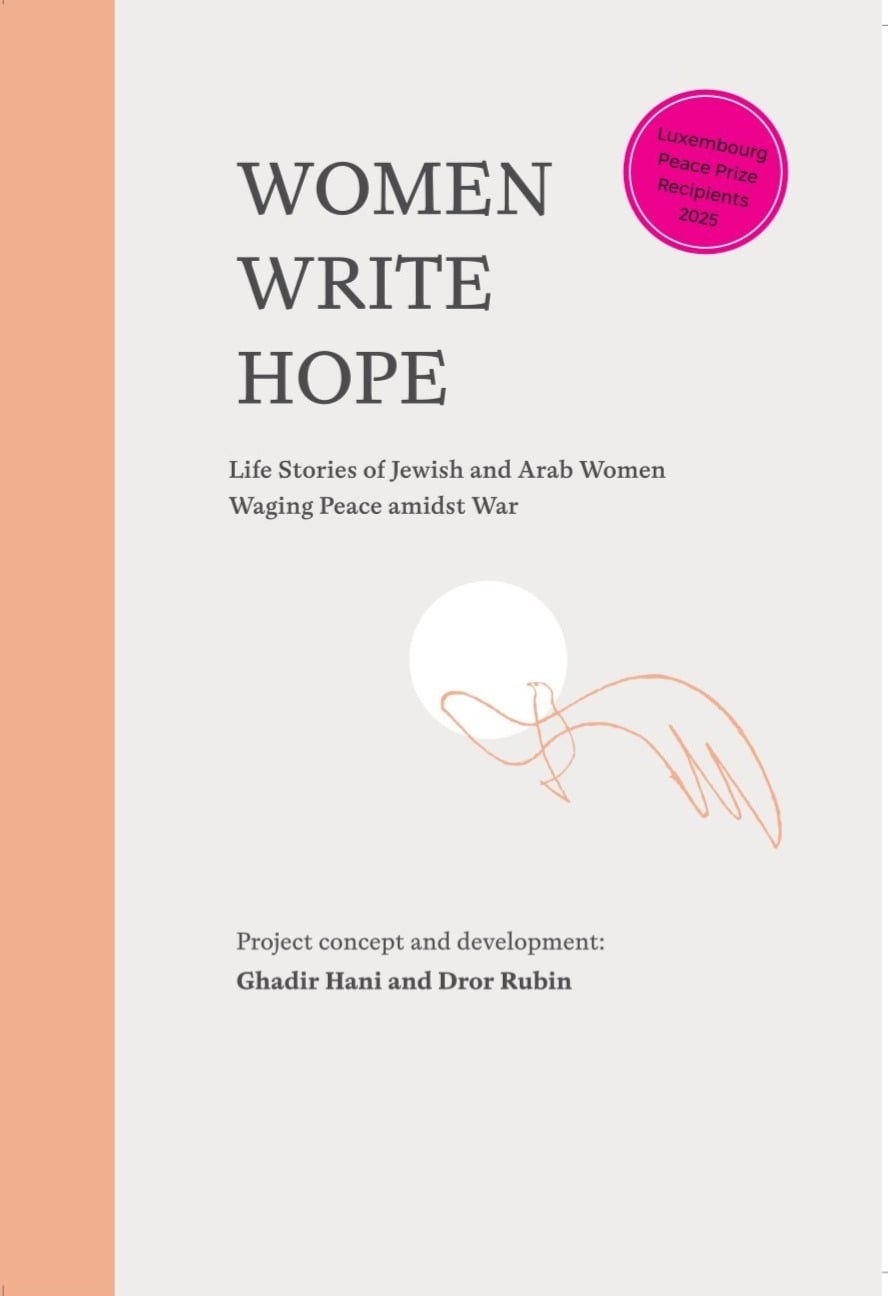
Book review: WOMEN WRITE HOPE: Life Stories of Jewish and Arab Women Waging Peace amidst War. Project Concept and Development: Ghadir Hani and Dror Rubin. Editor: Dror Rubin. 2025
Keeping hope alive is very difficult these days in Israel and Palestine, since we are still in the midst of a horrible war, which has been going on for two years. Indeed, it has been very rare to find anyone talking about hope until lately, when President Trump announced a “peace plan” to end the war and bring the hostages home. This is now being negotiated with the help of mediators between the warring parties, and we can only hope that the negotiations succeed. However, there remains great skepticism since the devil is in the details and that the negotiations might get bogged down once again, with no resolution to come quickly.
It seems that despondency and despair may return to all of us who hoped that this nightmare would finally end soon. As of this writing, the fact that the war persists and that the politicians on both sides are stuck in their obstinate ways and are not budging from their rejectionism does not portend well for a quick resolution and the return of the hostages.
However, a new book, which was recently published in Israel in Hebrew and in English, reveals the stories of 21 Jewish and Arab women who are succeeding in keeping hope alive by their personal stories of persistent activism and their refusal to give up on peace. WOMEN WRITE HOPE: Life Stories of Jewish and Arab Women Waging Peace amidst War offers us both inspiration and information about people who speak and act for peace in very difficult times.
This book is dedicated to Vivian Silver, a wonderful woman and peace activist, who was killed in her home at Kibbutz Beeri by Hamas militants as part of their horrific massacres and kidnappings on that horrific day of October 7th, 2023. The project directors dedicate this book to her . In their introduction, they say:
We are sure that Vivian would not have wanted us to sink into pain and despair. As a beacon of justice, compassion and hope, she would have demanded that we continue our work of healing and trust-building. As we promised at Vivian’s grave [I was at her funeral and I heard Ghadir Hani say this], we will not stop our work and we will continue to believe in a life of peace for us all.
The preparation for this unique book underwent a special process. With the assistance of Professor Amia Lieblich, 12 women from a wide range of backgrounds—Jewish and Arab, religious and secular, from the north and south of the country—underwent training in conducting interviews, building trust and addressing complex issues. These 12 women then wrote up their interviews, which are the essence of this book.
The women interviewed for this book include women from the south of Israel known as the Gaza Envelope, women living and working in mixed Arab-Jewish cities or regions, and women working as directors of founders with non-profit organizations in Israel. According to Hani and Rubin,
These women continue to believe in shared humanity, to create trust, to inspire others and to build peace at a period of almost unimaginable animosity, brutality and suffering.
I was particularly interested in the story of Ghadir Hani, whom I heard speak at Vivian Silver’s funeral and on other occasions, and was very impressed with what she said and how she said it. She was born and raised in Akka/Acco, in the north of Israel. At a young age, she moved to the Negev, where she worked in the field of women’s empowerment with Vivian Silver. She is also one of the leading members of the Arab-Jewish activist group called Standing Together and of another significant organization called Women Wage Peace, as well as being a partner in many interfaith initiatives. In addition, she writes opinion pieces in the Israeli media and on social media platform. The interviewer asked her how she became more involved with peace activism, and she replied:
In 2015, as part of an initiative of AJEEC (the organization in the Negev founded and led by Vivian Silver and a Bedouin colleague), I came with a group of Israeli and Palestinian women for a visit to Jerusalem, at an event organized by Women Wage Peace (more about this organization below). They called the event “Protective Fast”, echoing the name of Israel’s Operation Protective Edge, which had just ended. Then, as now, it was important to deal with the risk that the conflict could continue to shape public discourse. Vivian Silver was also at the event. Today, it’s heartbreaking to recall that Vivian always said: “If we don’t take the initiative and resolved the conflict, it will eventually drown us all in blood.”
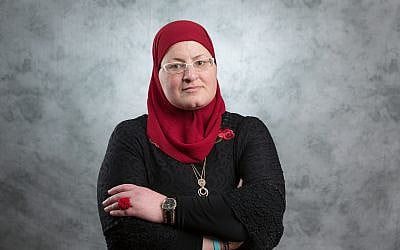
Hani was undoubtedly seriously influenced by Vivian Silver and other Jewish peacebuilders whom she met along the way, including Rabbi Amirit Rosen, whom she befriended when she worked in the Negev. She has clearly come to know many Israeli Jews well on her journey as a peacebuilder in Israel.
The interviewer also noticed that Hani was wearing a pin with the number 1325 on it and asked her what is means. She responded:
1325 is the number of the U.N. Security council resolution that emphasized the importance of integrating women into decision-making processes, negotiations, and security issues. Here, in this region, and around the world, it is clear that war is mainly men’s business….I believe that women must be part of the decision-making processes—this isn’t only a matter of gender but of a different approach and discourse.
Indeed, many of the women interviewed for this book have an alternative form of discourse than the mean macho men who are leading Israel and Palestinian to more violence and war all the time. I actually wish that they were in charge of the peace process in this region. If so, the conflict would have been resolved a long time ago.
One of the most outstanding Jewish women interviewed for this book is Yael Admi, one of the founders of the Women Wage Peace movement. I was interested in reading her story since I heard her speak very passionately at a large peace rally in Jerusalem a few months ago/ Among other things, she is a partner in dialogue between polarized groups in Israeli society and she serves as chairperson of the Parents Circle Families Forum
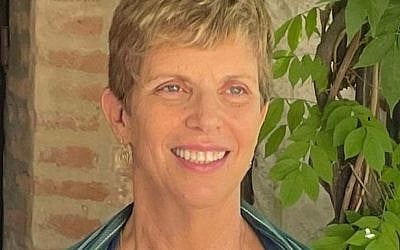
Admi’s encounter with the price of war came at a young age when her elder brother, Yishai, was killed during the War of Attrition with Egypt (1967-1970) when she was only 12 years old. This was a pivotal time in her life:
After my brother was killed, I promised my parents that I would give them lots of grandchildren and make peace. I felt that this was the only thing that could comfort them following our disaster. But unfortunately, I failed. My mother never got to see my children and grandchildren. After she passed away, we found a brown envelope containing poems she had written. She had written ‘Hopes and Heartbreaks’ on the envelope, but later she changed the order of the words in the title to ‘Heartbreaks and Hopes.’ This is her legacy to me: to try to find hope from within the heartbreak, and not to sink into despair.
As a grandfather, I find it fascinating and life-affirming that her grandchildren give her the inspiration to keep going:
My grandchildren give me strength. I feel grateful and fortunate that I can enjoy them: they are my remedy for this terrible period… We have not succeeded in bringing peace. But we must continue—this is our responsibility for them and for us [I very much agree with this!].
Admi and the thousands of women involved with her in Women Wage Peace all over Israel have been trying their best to resist despair, despite everything that has happened here during the past decade since the movement was founded in 2014 after one of the many mini-wars with Hamas, (Operation Protective Edge) before the current big one:
For 10 years, I have done everything I can to promote the voices of women and mothers, out of a deep belief that this voice can influence reality. We have learned from other conflicts about the critical role of women in ending conflict. We work hard in every corner of the country.
It is certainly the case that women in many other conflicts in the world have played prominent roles in bringing peace to their countries and regions, and it is admirable that Admi and thousands of other women—including Palestinian women in their partner movement, Women of the Sun—are endeavoring in very serious and sustained ways to bring peace here and to end the Israeli-Palestinian conflict. Would that they would succeed!
The women whose stories appear in this beautiful book are not only persistent peace activists, each one in her own way, but they inspire us with their lives and their actions for peace and thereby help us to keep a flicker of hope alive in a very dark situation in Israel/Palestine.