Strategist and Diplomat Analyzing Somaliland and Horn Affairs
Khadar’s 01:30 Interview: Media Distortion Exposed
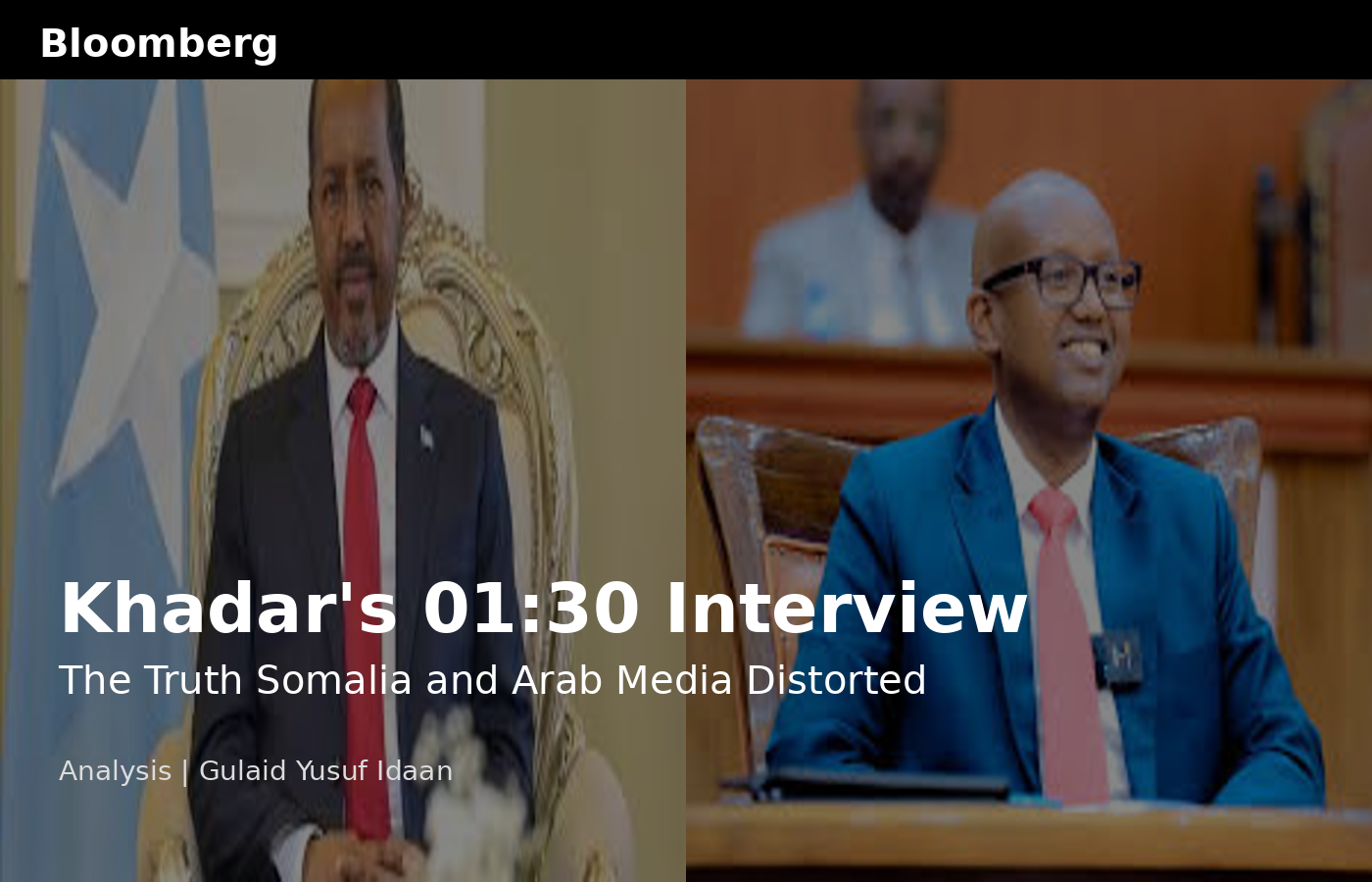
Khadar Hussein Abdi (right) during an official appearance in Somaliland, and Hassan Sheikh Mohamud, president of Somalia, pictured in separate events.
On December 26, 2025, Israel’s recognition of Somaliland represented a historic diplomatic achievement for a nation that had waited three decades for international legitimacy. Yet this breakthrough has been systematically distorted by the failed Federal Government of Somalia and a complicit Arab media sphere into a manufactured crisis over an alleged Israeli military base—claims that collapse under scrutiny of the actual statements by Somaliland officials.
This article centers the precise words of Somaliland Minister of the Presidency Khadar Hussein Abdi demonstrating that at no point did he admit to discussing Israeli military bases; that his statements to AFP and Bloomberg have been deliberately misrepresented; and that Somalia and Arab media have constructed a narrative of “violation” and “destabilization” to serve their own political agendas. Through this analysis, we examine: (1) the actual content of Abdi’s statements versus their media portrayal; (2) how diplomatic language was misleadingly interpreted; (3) the political motivations behind Mogadishu’s fabrication of base negotiations; (4) the Arab media’s role in amplifying disinformation; (5) the asymmetry between Somaliland’s transparent diplomacy and Somalia’s obstructionism; and (6) the dangerous implications of allowing a failed state’s media manipulation to derail a legitimate nation’s path to recognition.
The February 2026 AFP Interview: “Could Not Rule Out”
When Agence France-Presse asked Somaliland Minister of the Presidency Khadar Hussein Abdi about potential security cooperation with Israel, he employed standard diplomatic language: Somaliland “could not rule out” future possibilities. He explicitly framed this within the nation’s intention “to contribute to peace in the region.”
How It Was Distorted: Somalia and Arab media immediately seized “could not rule out” as confirmation of active Israeli military base negotiations in Berbera. They conflated hypothetical future considerations with present commitments, treating strategic ambiguity as admission of intent. In diplomacy, the phrase explicitly indicates the absence of a current commitment—yet media presented it as proof that Somaliland had already negotiated what it had merely declined to forbid in the future.
The March 2026 Bloomberg Interview: Explicit Denial
When international attention focused on Red Sea security, Mr Khadar provided direct clarification to Bloomberg: “We haven’t discussed with them if the security partnership becomes a military base.” This was unambiguous denial—no negotiations or planning had occurred. He added that “there will be an analysis at some point,” reflecting responsible state practice: governments must evaluate possible partnerships before making decisions.
How It Was Distorted: Media deliberately portrayed the February and March statements as contradictory. In reality, February referred to hypothetical future possibilities, while March clarified present facts. The temporal confusion served political agendas rather than journalistic accuracy.
The Mechanism of Distortion
Mr Khadar’s statement that Somaliland “could not rule out” future possibilities was misrepresented in the media as proof that active negotiations for an Israeli military base were already taking place. This reflects a technique of conflation, where a hypothetical possibility is presented as an established fact.
His remark that any engagement should “contribute to peace in the region” was completely omitted in many reports, illustrating selective omission intended to remove the broader diplomatic context of the statement.
Similarly, his clarification that “we haven’t discussed a military base” was portrayed by some outlets as a contradiction or an attempt to evade the issue, demonstrating a technique of temporal confusion that ignores the clear distinction between present discussions and hypothetical future considerations.
Finally, his comment that “there will be an analysis at some point” was framed by critics as evidence of secret planning, an example of hostile framing designed to portray normal diplomatic deliberation as covert strategic activity.
The “Strategic Relationship” Misrepresentation
Mr Khadar described Somaliland’s relationship with Israel as “strategic”—standard terminology encompassing trade, technology, agriculture, and security. Hostile media framed this as evidence of hidden military agendas.
Rebutting the Misrepresentation: Mr Khadar simultaneously stated Somaliland was open to offering military bases to the United States, alongside mineral cooperation. If Somaliland were secretly negotiating Israeli bases, such public transparency about American cooperation would be illogical. The structure indicates diversification of partnerships rather than secrecy.
President Mohamud’s Escalation: From Distortion to Fabrication
When distortion of Mr Khadar’s actual statements proved insufficient, President Hassan Sheikh Mohamud manufactured entirely false claims. In multiple interviews with Arab outlets including Al Jazeera and Al Arabiya, Mohamud claimed Somaliland and Israel had agreed to relocate Palestinians to Somaliland—categorically denied by both Somaliland and Israel.
This fabrication exploits what Mohamud understands: Palestinian displacement resonates strongly in Muslim societies. By presenting Somaliland’s recognition as religious betrayal, Mogadishu attempted to mobilize opposition based on cultural and religious sensitivities. This was not misunderstanding but calculated incitement.
Arab Media Complicity: Amplification Without Verification
Networks such as Al Jazeera and Al Arabiya broadcast Mohamud’s claims widely while giving far less attention to the categorical denials issued by Somaliland and Israel. The imbalance suggests narrative construction rather than neutral reporting—repeating unverified claims because they served broader anti-Israel narratives regardless of factual accuracy.
By reframing Somaliland’s recognition as moral wrongdoing rather than diplomatic achievement, these outlets amplified disinformation that risks transforming diplomatic progress into geopolitical tension.
Somalia’s Failed State Narrative vs. Empirical Reality
The Federal Government presents itself as defender of sovereignty despite controlling limited territory and relying heavily on foreign security support. Somaliland, by contrast, has maintained stable governance, democratic transitions, and territorial control for more than three decades.
The Contradiction: Mogadishu claims exclusive authority over Somaliland’s foreign relations while simultaneously offering ports such as Berbera to external partners—including a 2025 letter proposing strategic access to the United States. This reflects political competition rather than legal principle.
The Danger: From Media Narratives to Security Threats
Media narratives linking Somaliland’s recognition to regional military tensions have contributed to escalating rhetoric, including threats from Houthi actors declaring Berbera a “legitimate target.” The combination of distorted statements, fabricated allegations, and hostile framing creates justification structures for political or military pressure against Somaliland.
Conclusion: Transparency Punished, Fabrication Rewarded
Mr Khadar’s diplomatic record demonstrates open engagement: public interviews, explicit offers to Washington, clear distinction between present reality and hypothetical futures. Yet Somalia and Arab media transformed this transparency into alleged secrecy through conflation, temporal confusion, selective quotation, and hostile framing.
The Palestinian relocation allegation—denied by all parties involved—illustrates how false narratives can be weaponized to undermine legitimate diplomacy. If recognition achieved through legitimate diplomacy can be undermined by fabricated narratives and media amplification, the precedent becomes troubling: disinformation overrides empirical realities such as Somaliland’s stable governance and democratic institutions.
The broader question is whether international observers will rely on factual evidence—Somaliland’s record of stability and its officials’ actual statements—or accept politically constructed narratives designed to obstruct recognition. The answer will shape not only Somaliland’s future but also the credibility of diplomatic transparency in an era increasingly defined by disinformation.
Related Topics
Related Posts