Strategist and Diplomat Analyzing Somaliland and Horn Affairs
A Dream Realized After 34 Years
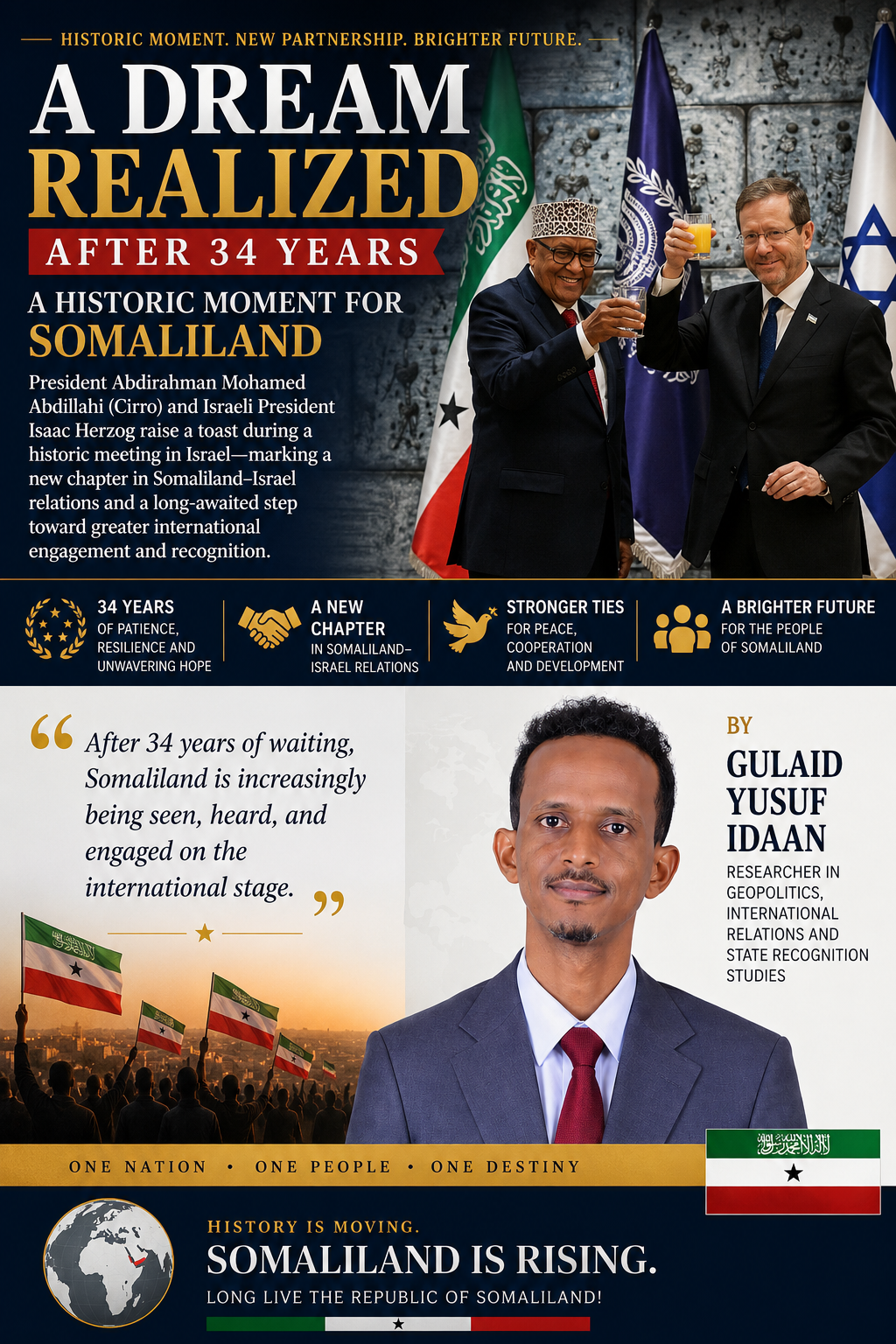
"After 34 years of patience and perseverance, Somaliland stands increasingly visible on the international stage. A historic moment of hope, dignity, and engagement."
A Dream Realized After 34 Years: A Historic Moment for Somaliland
From Isolation to International Engagement: Why President Cirro’s Reception in Israel Resonates Deeply with Somalilanders
There are moments in life that stop time itself.
Moments that make your heart swell until you can barely breathe.
Moments that remind you why hope is worth holding onto, even when the world tells you — over and over, in a thousand different ways — to let go.
Today was one of those moments.
After 34 years — thirty-four long, aching, bone-deep years of waiting, praying, and believing against every odd, every dismissal, every closed door — I watched something I had only dared to dream of in the quietest hours of the night:
The President of the Republic of Somaliland, Abdirahman Mohamed Abdillahi (Cirro), standing on foreign soil, receiving a welcome not as a supplicant, not as a beggar, not as someone who needs to explain himself — but as a leader. A welcome in Israel.
And I wept.
Not tears of sadness. Not even tears of joy, exactly.
Tears that had been gathering for three decades — three decades of carrying a weight so heavy that you forget you’re carrying it until someone finally lifts it off your shoulders.
Tears of a people who have whispered their story into a world that too often refused to listen. Who have knocked on doors that never opened. Who have stood in rooms where their name was not spoken, where their flag was not flown, where their very existence was treated as an inconvenience.
Tears of mothers who buried their sons for this dream — sons who died believing in something they would never live to see. Who held their children’s bodies and wondered if the world would ever know their names, ever acknowledge that they died for a country that the world pretended didn’t exist.
Tears of fathers who worked barren lands with hands cracked and bleeding, believing — against all evidence, against all reason — that one day, the world would see what they saw. That one day, someone would look at this land and see not a ‘breakaway region,’ not a ‘self-declared state,’ but a nation. A people. A heartbeat.
Tears of a generation that grew up hearing ‘you don’t exist’ — at airports, at embassies, at border crossings, in classrooms where teachers marked their maps with a single Somalia and no room for Somaliland — yet never stopped existing. Never stopped believing. Never stopped being.
The Weight of 34 Years
1991.
Do you remember what 1991 felt like?
I do. I remember it in my bones, even though I was just a child.
I remember the smell of burning. I remember the sound of my mother’s voice, raw and terrified, telling us to get under the bed. I remember the silence that came after the guns — a silence so heavy it felt like drowning.
I remember the earth. Still wet. Still warm. Still holding everything we had lost.
And yet — and this is the miracle, the thing that still makes me weep when I think about it — in the ashes of our own destruction, we chose something so radical that the world still doesn’t know how to process it:
Peace.
Not because someone offered it to us. Not because the international community brokered it. Not because we had any reason to believe it would be rewarded.
We chose peace because it was who we are. Because we had seen the alternative, and we had buried it. Because there was a moment — a single, fragile moment — when we looked at each other across the rubble and decided: Not again. Never again.
While the world looked away, we built.
While they called us ‘the region that doesn’t matter,’ we mattered — to ourselves, to each other, to the future we refused to surrender.
We built democratic institutions when no one demanded them of us. When there was no one watching, no one grading our homework, no one who would have noticed if we had chosen the easier path of strongmen and silence.
We held elections that the world ignored — elections that were freer and fairer than many ‘recognized’ nations could claim — yet we celebrated as if the whole earth was watching. Because for us, it wasn’t about the world. It was about us. It was about proving to ourselves that we could do this. That we were worthy of our own dreams.
We maintained stability in a neighborhood where stability is a foreign language. While the world watched other conflicts with horror and fascination, our peace was invisible. Our quiet determination was unnewsworthy. Our refusal to become what they expected us to become — a failed fragment of a failed state — was treated as an anomaly, not an achievement.
We did this not for recognition.
We did this because it was who we are.
But oh.
Oh, how we longed to be seen.
How many nights did Somalilanders stare at maps of the world, tracing borders that were drawn by colonial hands, by war, by politics — wondering why our border, drawn in the blood and sacrifice of our own people, meant so little? Why our line on the map was invisible while others, drawn with the same violence, were sacred?
How many young people — bright, ambitious, full of potential — packed their dreams into suitcases and left? Not because they didn’t love this land. Not because they didn’t believe in it. But because they feared it would never love them back on the world stage. Because they couldn’t bear to spend their lives in a country that the world refused to name.
I know them. I am one of them. I left. And I carried Somaliland in my chest like a secret, like a wound that never healed, like a love I could never fully explain to anyone who hadn’t felt it.
The Moment That Changed Everything
And then, today.
I watched President Cirro — this man who carries not just the title of president, but the unspoken prayers of millions, the hopes of a diaspora scattered across the globe like seeds in the wind — walk into a room in Israel and be greeted with respect.
Not pity. Not the condescending smile of someone who thinks they’re doing you a favor. Not curiosity, the way you might look at a rare animal in a zoo. Not the nod reserved for those who ‘almost matter.’
Respect.
The kind of respect you give to someone who has earned their place at the table. The kind of respect that says: We see you. We know what you have done. We know what you have survived. And we are willing to sit with you as an equal.
Do you understand what that means?
It means that somewhere, in the corridors of power where decisions are made by people who have never set foot in Hargeisa, never smelled the dust of our roads, never heard the call to prayer echoing across our hills — someone finally looked at Somaliland and saw what we have always known:
A nation that has earned its place.
A nation that has paid its dues not in violence, not in threats, not in the currency that the world too often trades in — but in patience. In proof. In persistent, quiet, unglamorous excellence.
This is not about one visit.
This is not about one handshake.
This is not about one photograph that will circulate on social media and then be forgotten.
This is about the arc of history finally — finally — bending toward justice for a people who have waited so long that waiting became a way of life. A people who learned to hope in whispers, to dream in shadows, to believe in the dark.
For Those Who Didn’t Live to See This
I want to pause here. Because this moment is not just for us who are alive to witness it.
This is for the ones who didn’t make it.
For the freedom fighters of the SNM who fell in the struggle — whose names we sing in songs that grow fainter with each generation, whose faces grow dim in memory, whose sacrifices built the foundation we stand on today. This welcome is for you. You did not die in vain. You did not bleed for nothing. The world is beginning to know what you knew: that Somaliland is real, that Somaliland is worthy, that Somaliland is here.
For the elders who died believing — who sat under acacia trees and told their grandchildren, with voices rough with certainty and eyes that had seen too much, ‘One day, they will know us. The world is slow, but it is not blind forever.’ This is your day. Your faith was not foolish. Your hope was not naive. You saw what the world could not see, and you held that vision until your last breath.
For the refugees who perished in foreign lands — in the waters of the Mediterranean, in the deserts of Libya, in the detention centers of Europe — clutching passports that called them ‘stateless’ when they were anything but. We see you. We remember you. This moment belongs to you. You carried our name into the world, even when the world would not carry you.
I think of my own grandfather.
He used to sit under the acacia tree behind our house — the same tree that had been there before the war, that had watched everything, that had survived when so much did not — and speak of Somaliland as if it were a person he loved. Not a place. A person. Someone he had known his whole life, someone he had fought for, someone he had mourned for, someone he refused to abandon.
‘They will come around,’ he would say, his voice rough with certainty, his eyes fixed on a horizon I couldn’t see. ‘The world is slow. Oh, it is so slow. But it is not blind forever.’
He did not live to see this.
But I feel him here, in this moment, smiling that quiet smile of his — the one that said he knew something the rest of us were still learning. The one that said patience is not weakness. The one that said faith is not foolishness.
I feel him. And I weep again.
What This Means
This welcome in Israel is more than diplomacy.
It is validation — the kind that seeps into your bones and changes how you stand, how you speak, how you breathe.
It is the world beginning to whisper what we have shouted for 34 years, what we have whispered in the dark, what we have carried in our chests like a second heartbeat:
Somaliland is here.
Somaliland has always been here.
And Somaliland is not going anywhere.
It means hope — real, tangible, hold-it-in-your-hands hope — for the child in Hargeisa who dreams of being a diplomat, not in spite of where she comes from, but because of it. Because she has seen her president welcomed as a leader, and she knows — she knows — that her dreams are not foolish. That her country is not a fantasy. That she belongs to a nation that the world is beginning to see.
It means hope for the entrepreneur in Berbera who has built something beautiful with his own hands, who has created jobs and futures and possibilities in a place where possibility was supposed to die — and who now sees a world that might finally trade with him as an equal. Not as charity. Not as aid. But as a partner.
It means hope for the student in Burao who studies international law late into the night, believing — against every textbook that erases his country, against every map that draws him out of existence — that one day, his nation will have a seat where laws are made. That one day, he will stand in a room and say, ‘I am from Somaliland,’ and the world will nod and say, ‘We know. We see you.’
It means that our voice — this voice that has been hoarse from shouting into a wind that never seemed to carry our words anywhere — is finally being heard.
Not by everyone. Not yet. But by someone. And someone is how everything begins.
The Road Ahead
I will not pretend that one welcome solves everything.
The journey is not over. The road is still long, still hard, still full of obstacles that would break a lesser people.
There will still be days when we feel invisible. When doors close in our faces. When the word ‘unrecognized’ stings like a fresh wound, like a slap, like a reminder that the world has not fully caught up to the truth we have known for 34 years.
But today reminds us of something essential — something we must hold onto when the darkness returns:
History moves.
Slowly. Painfully. Unpredictably. Sometimes so slowly that you wonder if it moves at all.
But it moves.
And we have moved it.
Not with violence. Not with demands. Not with the tactics that the world too often rewards. But with the quiet, stubborn, beautiful persistence of a people who refused to become what the world expected them to become.
A failed fragment of a failed state.
That is what they expected. That is what they were prepared for. That is the narrative that would have been so easy to fulfill.
Instead, we became something the world did not expect:
A success story without a title page.
A nation that built peace when no one was watching. That held elections when no one was counting. That maintained stability when no one was measuring. That proved, over and over, that we were worthy of a place at the table — even when the table had no chair for us.
Until today.
Today, someone turned the page.
And on that page, for the first time in 34 years, the title is beginning to appear.
To Every Somalilander, Everywhere
Wherever you are — in Hargeisa, in London, in Minneapolis, in Dubai, in a refugee camp, in a university dorm, in a hospital ward, in a taxi driving through streets that don’t know your name — feel this in your bones:
You are seen today.
You are not a statistic.
You are not a footnote.
You are not ‘the northern region of Somalia.’
You are not a problem to be solved, an anomaly to be explained, a curiosity to be catalogued.
You are a citizen of a nation that has defied every prediction of its demise. A nation that rose from its own ashes and chose light over darkness, again and again, when no one would have blamed it for choosing otherwise.
You are the inheritor of a legacy of resilience that would break lesser peoples. A resilience forged not in comfort, not in privilege, but in the fire of survival. In the choice, made every single day for 34 years, to believe in something the world refused to name.
You are part of a story that is still being written. And today — today — the ink ran a little brighter. The page turned a little easier. The words came a little clearer.
This welcome is for you.
For your patience. For your pride. For the way you have carried this identity like a secret treasure, showing it only to those worthy of its weight, protecting it from those who would diminish it, nurturing it in the dark when no one else would.
Today, we show it to the world.
And the world — finally, beautifully, tearfully, gratefully — is beginning to look.
Long Live Somaliland
After 34 years of waiting, today feels like a dream realized.
But it is not just a dream.
It is the harvest of seeds planted in tears, watered with faith, and tended by generations who refused to abandon the field even when the harvest seemed impossible.
It is a reminder that persistence is not futile. That the quiet work of building, believing, and waiting matters — even when no one sees it, even when no one rewards it, even when the world tells you that you are wasting your time.
It is a reminder that history bends toward those who refuse to break. That the arc of justice is long, but it is real. That the truth, spoken softly and consistently for 34 years, eventually finds ears willing to hear it.
It is a reminder that the aspirations of a determined people — a people who have known the darkest nights, who have buried their dead, who have watched their children leave, who have carried an invisible nation in their chests for three decades — cannot be ignored forever.
Today, Somalilanders everywhere have reason to feel proud.
This is not simply a welcome for a president.
It is a welcome that reflects the hopes, the heartaches, the sacrifices, the quiet triumphs, and the soaring aspirations of an entire nation.
It is a welcome that says: You exist. You matter. You have always mattered.
Long live the Republic of Somaliland.
(The Somaliland flag: green for prosperity, white for peace, red for the blood of martyrs, and the black star of unity — a symbol of our faith, our resilience, and our unbreakable African identity.)
Related Topics
Related Posts