Ki-Tavo: Rav Amram HaGaon and Four Verses
When I sat down to think about who could be the Role Model for this week’s parshah, I never imagined I would end up writing about a ninth-century spiritual leader from Babylonia.
In truth, until a few days ago, I had never heard of Rav Amram HaGaon. At least, not that I remembered.
Yet millions of Jews still benefit from a decision he made more than eleven hundred years ago.
Rav Amram served as head of the Academy of Sura, one of the great centres of Jewish learning in the world. A Jewish community in Spain wrote to him with a straightforward question:
How should we pray?
It was the kind of question that invited a conventional answer. Rav Amram could have sent a collection of sources. He could have quoted relevant passages of Talmud, offered rulings and references, and left the community to assemble the rest.
Instead, he answered completely.
His response became what we know as Seder Rav Amram, probably the earliest surviving comprehensive order of Jewish prayer and one of the foundations on which the Siddurim we use today developed. (see page 14 for further reference)
Daily prayers. Shabbat prayers. Festival prayers. Blessings. Customs. Explanations.
A community asked a question. Rav Amram answered with a book.
Of course, the Jews of Spain were not waiting for Rav Amram in order to begin praying. They already possessed prayers, customs and traditions inherited over centuries. The challenge was different. Their knowledge was scattered across memory, local practice, Talmudic discussion and earlier rulings. Rav Amram did not invent Jewish prayer; he organised it. He transformed inherited tradition into a framework that communities could readily follow.
What struck me most, however, was something buried inside it. Seder Rav Amram contains an extraordinarily early version of the Haggadah, preserved as part of Rav Amram’s broader order of prayer.
And at the heart of the Haggadah are four verses from this week’s parshah, Ki Tavo.
Four verses.
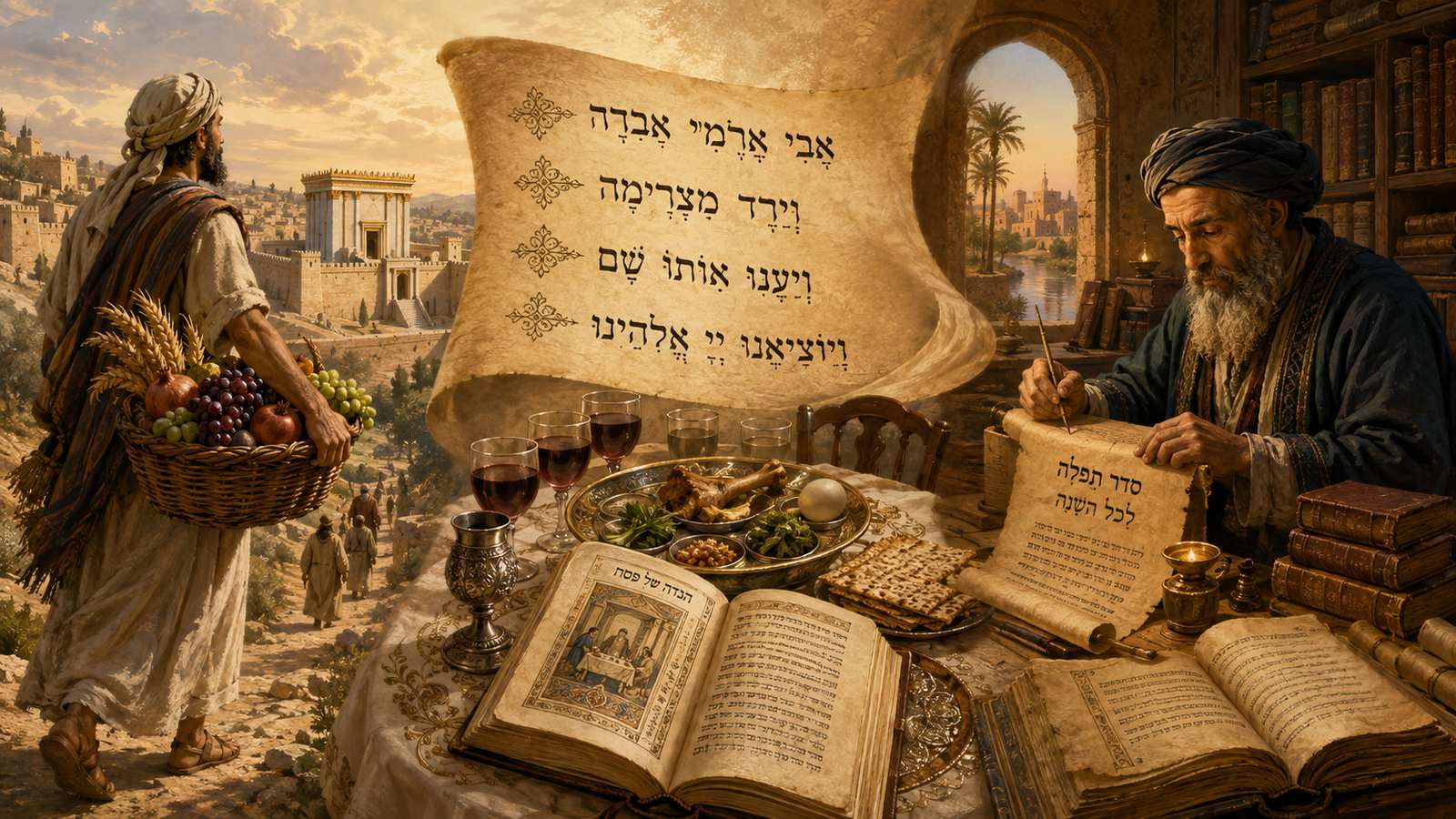
וְעָנִ֨יתָ וְאָמַרְתָּ֜ לִפְנֵ֣י ׀ ה’ אֱלֹהֶ֗יךָ אֲרַמִּי֙ אֹבֵ֣ד אָבִ֔י וַיֵּ֣רֶד מִצְרַ֔יְמָה וַיָּ֥גׇר שָׁ֖ם בִּמְתֵ֣י מְעָ֑ט וַֽיְהִי־שָׁ֕ם לְג֥וֹי גָּד֖וֹל עָצ֥וּם וָרָֽב׃
וַיָּרֵ֧עוּ אֹתָ֛נוּ הַמִּצְרִ֖ים וַיְעַנּ֑וּנוּ וַיִּתְּנ֥וּ עָלֵ֖ינוּ עֲבֹדָ֥ה קָשָֽׁה׃
וַנִּצְעַ֕ק אֶל־ה’ אֱלֹהֵ֣י אֲבֹתֵ֑ינוּ וַיִּשְׁמַ֤ע ה’ אֶת־קֹלֵ֔נוּ וַיַּ֧רְא אֶת־עׇנְיֵ֛נוּ וְאֶת־עֲמָלֵ֖נוּ וְאֶת־לַחֲצֵֽנוּ׃
וַיּוֹצִאֵ֤נוּ ה’ מִמִּצְרַ֔יִם בְּיָ֤ד חֲזָקָה֙ וּבִזְרֹ֣עַ נְטוּיָ֔ה וּבְמֹרָ֖א גָּדֹ֑ל וּבְאֹת֖וֹת וּבְמֹפְתִֽים׃
“My father was a fugitive Aramean. He went down to Egypt with meagre numbers and sojourned there; but there he became a great and very populous nation. The Egyptians dealt harshly with us and oppressed us; they imposed heavy labour upon us. We cried to the Eternal, the God of our ancestors, and the Eternal heard our plea and saw our plight, our misery and our oppression. God freed us from Egypt by a mighty hand, by an outstretched arm and awesome power, and by signs and portents.”
That fascinates me.
Of all the passages in the Torah, why should four verses spoken by farmers become the centrepiece of one of the most widely observed evenings in Jewish life?
Every year, Jews gather around Seder tables across the world. We argue over meanings. We spill wine. We ask questions. We tell stories. We sing songs our grandparents sang and hope our grandchildren will sing them too.
We even debate the opening words, perhaps appropriately for a Haggadah built around questions.
“Arami oved avi…”
The Haggadah and Rashi understand the Aramean as Lavan, who sought to destroy Jacob. Other commentators read the words very differently. Ibn Ezra understands the description as referring to Jacob, while Rashbam understands it as referring to Abraham.
The words originate in the mitzvah of bikkurim in Parshat Ki Tavo. A farmer brings the first fruits of the season to the Beit HaMikdash and recites a declaration.
On the surface, it seems strange. The farmer is holding a basket full of produce. One might expect a prayer about agriculture, rainfall or harvest.
Instead, the Torah instructs him to tell a story. A story about ancestors. A story about Egypt. A story about suffering. A story about redemption.
The farmer is forced to remember that the fruit in his basket did not begin with him.
Before there was fruit, there was a field. Before there was a field, there was a land. Before there was a land, there was redemption. Before there was redemption, there was slavery. Before there was slavery, there was exile. And before there was exile, there were our ancestors, long before Egypt.
Success can be spiritually dangerous. The moment we achieve something, we begin to imagine that we accomplished it alone. The farmer arrives at the Temple carrying the evidence of his success and is immediately told to remember that he is part of a story much larger than himself.
The basket is not the story. The basket is simply the latest chapter in the story.
Perhaps that is why the Rabbis placed these four verses at the heart of the Haggadah.
The Seder is not merely about leaving Egypt. It is about remembering how we arrived where we are.
Just like the farmer. The farmer looks at his basket and asks: How did I get here? The Jew at the Seder table looks at freedom, family, tradition and continuity and asks exactly the same question.
And both begin with the same answer:
“Arami oved avi.”
The story started before me.
Perhaps there is an even deeper connection to Rav Amram.
In Ki Tavo, the Torah does not merely tell the farmer what to do. It tells him what to say. It gives him a set text. Those words, originally prescribed for a farmer standing before God with his first fruits, were later taken by the Rabbis and used as the framework for something far broader: the Haggadah’s telling of the Jewish journey from slavery to freedom.
Rav Amram’s contribution has a striking echo of that.
He did not invent Jewish prayer. The prayers and traditions already existed. But he gathered them, organised them and transmitted them in a form that communities could use. The Siddur, today one of the most universal features of Orthodox Jewish life, owes an enormous debt to the tradition that Rav Amram helped preserve and organise.
In one case, a set text spoken by a farmer became the framework through which generations tell the story of Jewish freedom.
In the other, inherited words of prayer were gathered into a framework through which generations of Jews could speak to God.
Two things about Rav Amram particularly struck me which make him Role Model material:
First, he was willing to do the hard work.
The Jews of Spain needed information, but information alone was not enough. They needed clarity. They needed structure. They needed somebody willing to turn knowledge into something usable.
Rav Amram could have given a partial answer and nobody would have blamed him.
Instead, he gave them a framework. They asked for directions. He gave them a map. They asked how to pray. He gave them an entire order of Jewish prayer.
That willingness to go beyond has borne fruit for well over 1,000 years.
The second quality I admire is his humility. Rav Amram’s greatest achievement largely carries other people’s words. He did not write the declaration of bikkurim. He did not invent the Haggadah. He did not invent Jewish prayer. He inherited traditions, organised them and transmitted them.
There is something profoundly humble about dedicating your life not to making yourself the story, but to ensuring that the story survives.
And there is another wonderful irony. Rav Amram’s own text did not remain frozen.
Later generations adapted it. Communities developed different customs. Siddurim evolved. The prayer books we use today are not identical to the text Rav Amram sent more than a millennium ago.
Yet perhaps that is precisely the point. He created something strong enough to evolve without losing its essence. His work became everyone’s work.
More than a thousand years after Rav Amram sent his famous response to Spain, a printed edition of Seder Rav Amram belonged to the Chafetz Chaim, complete with an ownership inscription and his signature.
Think about that journey. A farmer stands in Jerusalem and recites four verses. The Rabbis place those words at the heart of the Haggadah. Rav Amram preserves that tradition within one of the earliest great orders of Jewish prayer. More than a thousand years later, his work belongs to one of the greatest rabbis of modern times.
And today, I open a Siddur and rely on a framework shaped in part by Rav Amram without ever having known his name.
Perhaps that is the final connection.
The four verses teach the farmer that the fruit in his basket did not begin with him. Rav Amram seems to have understood exactly the same thing. He inherited something precious, added his contribution and passed it forward.
The fact that his work still accompanies Jewish life more than eleven hundred years later, while so many of us barely know his name, is not a weakness in his legacy.
It may be the greatest evidence of it.
And that is why Rav Amram HaGaon is my Role Model for Parshat Ki Tavo.