King Mohammed VI, Moroccan Jewry, and the Road to September 16
In the preamble of the constitution Morocco adopted in 2011, one sentence carries more weight than most diplomatic accords. The kingdom’s unity, it declares, is forged by the convergence of its Arab, Islamic, Amazigh and Saharan components and enriched by its African, Andalusian, Hebraic and Mediterranean influences. The word Hebraic is easy to glide past. It should not be. Morocco was not inventing a minority to please a foreign audience; it was writing down something older than the state itself. Jews had lived in these lands since antiquity, and after 1492 the Atlantic ports absorbed whole communities expelled from Spain, among them the traders who turned Mogador, later Essaouira, into one of the busiest harbors on the Moroccan seaboard and home to one of the most prosperous Jewish communities in the Islamic world.
The monarchy’s relationship with that inheritance has never been merely administrative. Moroccan kings present themselves as protectors of a plural nation, and the title they prize most, Commander of the Faithful, carries an obligation that the present King has articulated without ambiguity: guardianship of the believers of all the revealed religions, Judaism included. When Mohammed VI acceded to the throne in July 1999, that idea was already encoded in his family’s self-understanding. What he added was an unusual willingness to turn memory into policy.
Consider the record. In 2013, when the seventeenth-century synagogue Slat al-Fassiyine reopened in Fez after restoration, the King sent a message read out by his prime minister. His patronage, he wrote, attested to “the importance I attach to the preservation of the spiritual and cultural heritage of the Jewish community,” a community “held in high esteem by my venerable ancestors.” He went further, tying the older heritage to the new constitution: “the Jewish legacy, with its rituals and specific features, has been an intrinsic part of our country’s heritage for more than three thousand years.” Then came the instruction that mattered most, a call to restore the synagogues of Morocco’s other cities so that they might serve not only as places of worship but as forums for dialogue. Speaking as Commander of the Faithful, he promised to uphold “freedom of religion for all believers in the revealed religions, including Judaism, whose followers are loyal citizens for whom I deeply care.”
The program that followed was patient and unglamorous. A restoration of Jewish cemeteries begun in 2010 eventually reached more than a hundred and sixty sites across the kingdom, from the Atlantic coast to the interior: walls rebuilt, gates reset, graves and mausoleums tended, a whole vocabulary of memory rescued from neglect. The historic cemetery of the mellah of Meknès was reopened in 2022 after a decade of work. In Marrakech, the old Jewish quarter recovered its name, El Mellah. Casablanca had held the only Jewish museum in the Arab world since 1997, and in December 2016 the King attended the rededication of its synagogue and galleries himself. Nothing in that sequence owed anything to Washington, to normalization, or to the diplomatic weather of the moment.
Which is precisely why the January morning of 2020 deserves its place in the story. On the fifteenth, Mohammed VI walked into the mellah of Essaouira and through the door of Bayt Dakira, the House of Memory, a small museum built around the restored Simon Attias Synagogue and the Haim and Célia Zafrani research center on the shared history of Judaism and Islam. The project had been driven by André Azoulay, an Essaouira native who advises the King and who was called to the palace by Hassan II in 1991, and it was financed largely by the Moroccan state. The entrance greets visitors in two languages at once, Shalom Aleykoum and Salam Lekoulam. Inside, a Torah and a Quran rest side by side. Azoulay described the building as testimony to a period when the two faiths enjoyed “an exceptional closeness, complicity and intimacy.” The King examined the artifacts, heard the Chief Rabbi of Morocco, David Pinto, offer a prayer for his well-being, and that evening hosted a dinner for the Jewish community. It was not a diplomatic event. It was a monarch regarding his own inheritance in a city where his forebears once protected a people who are now mostly gone, and the year had barely begun.
Ten months later came the diplomacy. In December 2020, in a deal brokered by Washington, Morocco restored official relations with Israel, providing for the reopening of the liaison offices it had closed in 2000, while the United States recognized Moroccan sovereignty over Western Sahara. The three governments signed a joint declaration on December 22 that looked toward full diplomatic relations and set out cooperation in aviation, tourism, water, agriculture, energy and technology. In July 2023, Israel went further and recognized Moroccan sovereignty over the disputed territory in a letter from its prime minister to the King. Anyone watching closely understood the order of events. The heritage work came first. The diplomacy came after, and it built on a foundation that was already generations deep.
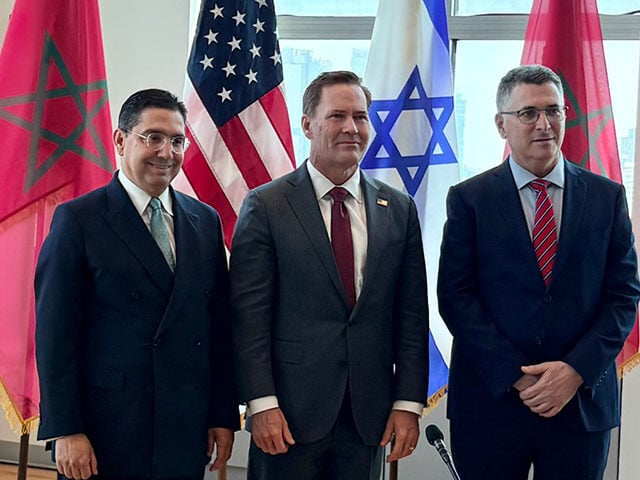
That is the light in which September 16, 2026, should be read. In New York, on the margins of the United Nations General Assembly and a day after Washington marked the sixth anniversary of the Abraham Accords, the American ambassador to the United Nations, Mike Waltz, brought together Morocco’s foreign minister, Nasser Bourita, and Israel’s foreign minister, Gideon Sa’ar. Their joint statement confirmed the elevation of the two liaison missions to full embassies and an exchange of ambassadors, the first in the history of the relationship, together with the prompt reinstatement of direct flights by Moroccan and Israeli carriers before the end of the year, agreements on investment protection and the avoidance of double taxation by the end of 2026, and reciprocal high-level visits in the months ahead. Read casually, this is another normalization communiqué. Read carefully, it is something sturdier: the conversion of a political decision into institutional fact. Embassies, ambassadors, route networks, tax treaties and standing channels of cooperation do not depend on the mood of a single government. They are the architecture of a relationship that intends to remain standing.
The deeper force, though, is human, and it lives far from the negotiating rooms. Close to a million Israelis trace their origins to Morocco, and they have not left the country behind. They carry its Arabic in the home, its piyyutim in the synagogue, its Andalusian orchestrations in the concert hall, its cumin and preserved lemons on the table, its saints in their pilgrimage calendars. They name children after grandparents who never saw Israel and return, often in their thousands each year, to the mellahs and cemeteries their families left. This is the current that runs beneath the treaty language, and it is why the Moroccan-Israeli bond has never been a purely transactional arrangement. Other normalization agreements were signed between states with little memory of one another. Morocco and Israel share a memory, and the Moroccan half of it was kept alive by a throne that refused to let it disappear.
When Mohammed VI entered Bayt Dakira, he was not announcing a foreign policy. He was visiting a house of memory in a kingdom that chose to remember a community most of which now lives elsewhere. September 16 is the latest stage of that choice, an old attachment translated into embassies and ambassadors. The roots reach back centuries, past the accords and the headlines, to a coast where a Torah and a Quran once sat quietly in the same room. A relationship so rooted is not easily uprooted.