Know thy enemy. My second shift of protective presence
I cannot sleep the night before my second shift. I throw up around midnight. Nerves, and too much vodka. Why does it fill me with horror to go back? Most of the time I am filming kids younger than my own. Statistically, I’m more likely to be killed driving to the West Bank, than in it. But on my first day, a senior activist and a Palestinian drove me to a lookout point to see the new outposts, sprinkled like salt over the imposing mountains around Mukhmas. “I was picking olives in the Valley when a group of settlers beat me up,” the Palestinian said. “Then they burnt six homes. Nobody lives there now. Their violence escalates until they achieve their goal and drive us from our homes.”
The violence escalates. So far in Taybeh, where I work, they’ve been sending teenagers to cut fences and drive their flocks up to the houses. They try to cut water and electricity lines. They come every day, twice a day. The Palestinian children leave home at 6 a.m. so they can get to school before the settlers arrive. The families lock themselves in their houses. They barely leave their compounds. But despite the misery of their lives, they aren’t leaving their homes. “I was born here, and my father before me,” my host Husni says. “I will never leave.”
But the violence escalates. In the end, won’t they leave? When lives are threatened. To save their children. At some point the settlers will decide: “OK, this isn’t working. Time to go to the next level of terror!” My role is passive, limited to unviolent reaction. They call the shots. Their goal is to expel the Palestinians and I am an obstacle. How long until I have to place my body between them and the children I am growing fond of, instead of a fence? How long until they beat me up?
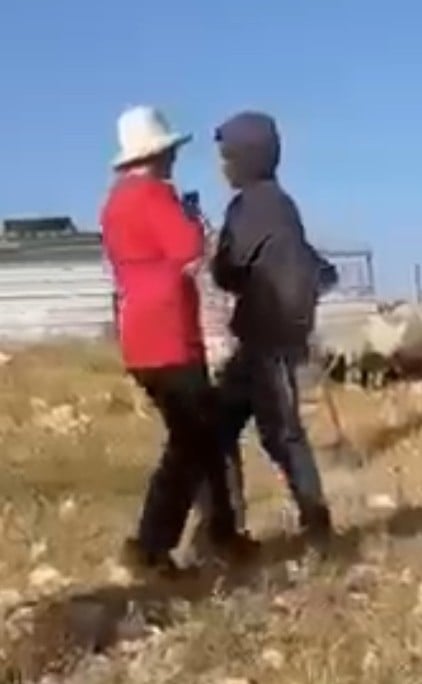
I and my partner Shai are outside Husni and Fatima’s house; two teenagers and a tiny kid push their herd of goats and camels smack-dab against the fence. We shake rocks in plastic bottles to try to move the herd away from the fence. The goats don’t like the noise, but the camels don’t care. The settlers get mad. “Don’t touch our animals!” they repeat, thrusting their phones in our faces. The tiny boy sucks his thumb as he kicks Shai. Then he turns to me, his cherubic face grinning. “Why are you cursing me?” he asks, sweetly.
“Sweetheart, I would never curse you,” I reply, shocked. Later I learn the purpose of such talk. Just like we film them constantly so they won’t cut fences or throw rocks, they also film us. At first I didn’t understand why they came so close to me, nose-to-nose, as I stumbled backwards over the rocky terrain. “Don’t come near me. Don’t come near me,” they repeat over and over.
“What do you mean? You’re the one in my face. Are you filming my blackheads?”
“Don’t come near me. Don’t come near me.”
Later I learn that they post snippets of their videos in an attempt to show we are the aggressors. Who the hell is going to believe that? Are we coming to their compound to bother them? Don’t answer; it’s a rhetorical question. People believe what they want.
Still, they’re just kids. They’ve been brought up in a cult that teaches them all Palestinians want to kill us. That the Arabs have lots of other lands and Israel is ours. That God commands: “And you shall take possession of the land and settle in it, for I have given you the land to possess.” They’re just re-taking their own land, like God wants, FFS.
Shai has taken me, the newbie, under his wing. “You shouldn’t speak to them at all,” he informs me. There’s no point. They’re part of a cult; they’re all brainwashed.”
A rock sails between us and we snap back to attention, phones up. The kids zip around the fence in different directions, trying to lose us so they can cut it. We split and I focus on keeping up, sweating like a Canadian in the boiling heat. “I can see you, I’m filming!” I yell, pointing my phone in the right direction even though I have no idea what I’m filming. It takes all my focus to run over the rocks without falling. Luckily, they get sick of the game before I keel over.
The teenagers roll cigarettes. I sink onto a stone in relief. Shai tells me how the kids hit and kick if they outnumber us. Or when they get us alone. “In February the Palestinians asked us to come to Qursa because settlers were attacking them,” Shai says. “So we went. A group of masked settlers ran towards us with clubs. They started beating my partners—one of them was a woman in her 70s. Then they came for me. They broke bones all over my body. We were airlifted to hospital and I spent months recovering; my partner even longer.”
The violence escalates… “Are the Palestinians who called you still…”
“No. They abandoned their homes.” …until they achieve their goal…
For a moment I can’t speak. Finally, I whisper, “But the attackers weren’t kids?”
Shai nods towards the thumb-sucker. “That’ll be him in a few years.”
Labelling groups of people is what racism is. Americans enslaved Black people because they believed that “all” blacks were inferior. Nazis killed Jews because they believed “all” Jews were parasites. Settlers persecute Palestinians because they believe “all” Palestinians want to slaughter us. A lot of Israelis think this too, and our sad history over the past 78 years doesn’t reflect a strong desire for peace. But the Arabs I’m living with would do anything to end their miserable lives. Anything for peace. When you live with the humans, instead of reading about our awful governments in the newspaper, you begin to glimpse the immense complexity. “All” these kids are irredeemable?
I get up to talk to them, but Shai pulls me back. “Are you crazy? I’ve been doing this for years and you don’t have a clue what you’re doing.”
I wish Shai would bugger off, but I am a newbie and I don’t want to antagonize my seniors. I subside back onto my rock. But I’m curious. Most humans see themselves as good, and I want to know how the settlers can define themselves as good.
Now I have a new goal: Know My Enemy. Learn just how unilateral violence can escalate.