
Author and Global Affairs Commentator
Kushner’s Gaza Opening Is a Chance for Peace
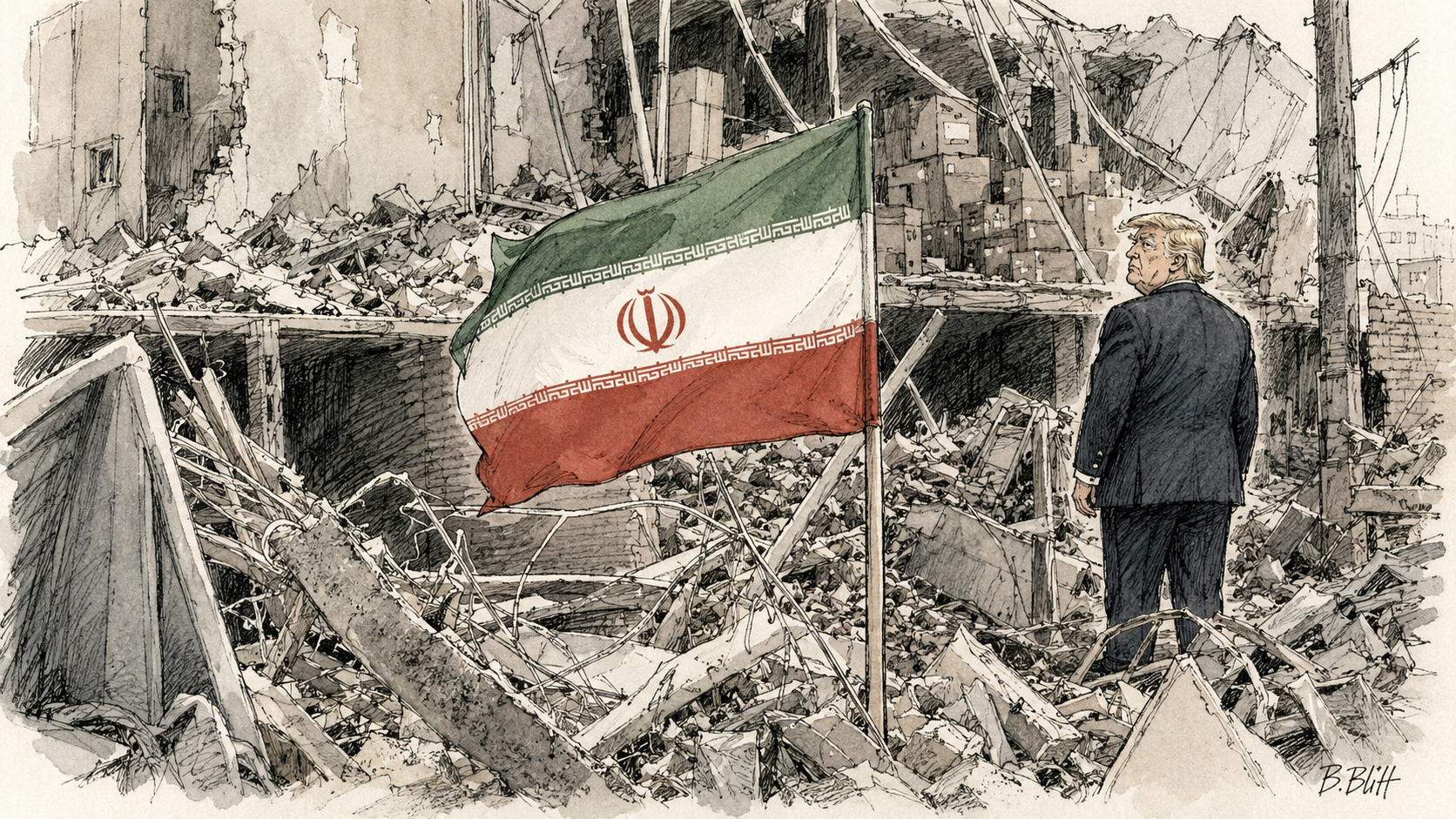
Washington must demonstrate that economic pressure is intended to produce a political outcome rather than become an end in itself. (ChatGPT AI generated image of Donald Trump looking back at the flag of Iran amidst rubble in Tehran. Trump is moving beyond degrading Iran's nuclear ambitions or targeting the IRGC. The emerging objective is to weaken the regime's capacity to govern.)
Could Jared Kushner’s direct talks with Hamas create the opening Israel and the Palestinians need to escape another cycle of war? The answer depends on whether Hamas is prepared to give up its weapons, whether Israel receives credible security guarantees, and whether President Donald Trump can turn diplomacy into a workable path toward reconstruction and political change.
Something potentially historic happened in Egypt this week.
Hamas leaders met directly with Jared Kushner, the US special envoy for peace, in a meeting that could become an important turning point in the Gaza war. Kushner reportedly made the central US position clear: Hamas cannot remain an armed force in Gaza. Promises will not be enough. Weapons must be surrendered, military infrastructure dismantled and governing authority transferred to a Palestinian technocratic administration.
For Israel, that distinction matters enormously.
Israel has lived with the consequences of October 7, 2023: the massacre of civilians, the hostage crisis and the fear that another heavily armed Hamas could eventually rebuild and launch another attack. Any lasting political settlement therefore has to begin with Israeli security.
For Palestinians, the stakes are equally profound. More than two million people in Gaza have endured death, displacement, hunger and the destruction of homes and infrastructure. Demilitarization could provide the foundation for reconstruction, functioning government and a return to ordinary life.
That is where Kushner’s diplomacy matters.
A different kind of diplomacy
The Trump administration has shown a willingness to engage directly with difficult actors while keeping clear conditions on the table. Kushner’s reported approach follows that model: talk directly, demand concrete action and offer a practical path forward if those demands are met.
The message to Hamas is straightforward. Disarm, surrender military control and accept a political future without an armed wing, and a different future for Gaza becomes possible.
That could include greater humanitarian assistance, reconstruction, an international stabilization force and, eventually, Israeli troop withdrawals tied to verifiable progress.
For Israel, this offers something previous diplomatic formulas often failed to provide: the possibility of security being built into the process rather than treated as an afterthought.
For the Palestinians, it offers something equally important: a chance to rebuild without Hamas’s military infrastructure continually pulling Gaza back toward war.
This is the central logic of President Trump’s approach. Peace cannot rest on declarations alone. It requires leverage, verification and reciprocal steps.
Hamas faces a defining choice
Hamas now faces a difficult decision.
Its armed campaign has brought enormous destruction to Gaza while failing to deliver the political achievements it promised. Preserving its weapons may allow Hamas to retain its military identity, but it could also prevent Gaza from moving toward reconstruction and normal government.
Giving up its military structure would be a historic transformation.
Hamas could instead seek to become a political organization operating under one legitimate authority and one national political system. If it genuinely abandons violence, accepts the authority of a future Palestinian government and meets the necessary legal conditions, Palestinians could ultimately judge its political programme at the ballot box.
That is what democracy requires.
Palestinian elections should not be engineered to produce a predetermined outcome. Nor should Israeli voters be asked to accept another open-ended cycle of war simply because diplomacy is difficult.
Both peoples deserve a genuine political choice.
Israel’s security comes first
For Israelis, however, the lesson of recent years is unmistakable: promises must be backed by evidence.
The initial Hamas statement following the meeting reportedly focused on a permanent ceasefire, an Israeli withdrawal, humanitarian assistance and reconstruction. It did not explicitly spell out disarmament.
That makes implementation the real test.
Weapons must be removed. Military infrastructure must be dismantled. Armed groups must be prevented from rebuilding. Political authority must pass to a legitimate civilian administration.
Only then can Israel reasonably be expected to take corresponding steps.
Reciprocity does not mean treating the two sides as morally identical. It means establishing a process in which verified progress produces further progress and obstruction carries a cost.
Trump’s opening
The larger opportunity comes from the political space created by Trump’s diplomacy.
For years, the region has been trapped between maximalist demands and repeated wars. Trump’s willingness to pursue a direct, transactional approach has created a different possibility: security for Israel, reconstruction for Gaza and a broader regional framework in which cooperation becomes more valuable than confrontation.
Kushner’s meeting with Hamas should therefore be judged by what follows it, not simply by the symbolism of the encounter.
The door may be open. But Hamas has to walk through it.
Israel, too, will eventually face choices. If demilitarization genuinely begins, a future Israeli government could inherit a process already moving toward new security arrangements, reconstruction and greater regional cooperation rather than another war beginning from scratch.
That would represent a genuine change.
Approximately 14 million Israelis and Palestinians share the same land. Their futures cannot ultimately be separated by rockets, checkpoints, walls or political slogans.
The coming Israeli and Palestinian elections could therefore become more than contests between parties. They could offer voters a choice between continuing the familiar cycle of fear and conflict or supporting a political path built around security, reconstruction, accountability and dialogue.
Kushner has helped create the opening. President Trump has provided the diplomatic weight behind it.
Now the hardest part begins.
The Palestinians must decide whether Hamas’s future lies in continued armed struggle or legitimate politics. Israelis must decide whether credible security can make a different political future possible.
The opportunity is there. Turning it into lasting peace will require something neither side has had enough of for far too long: the courage to change course.
Related Topics
Related Posts