

NAnews - Nikk.Agency Israel News
Kyiv Prison Honors Rabbi Levi Yitzchak Schneerson, Persecuted by NKVD
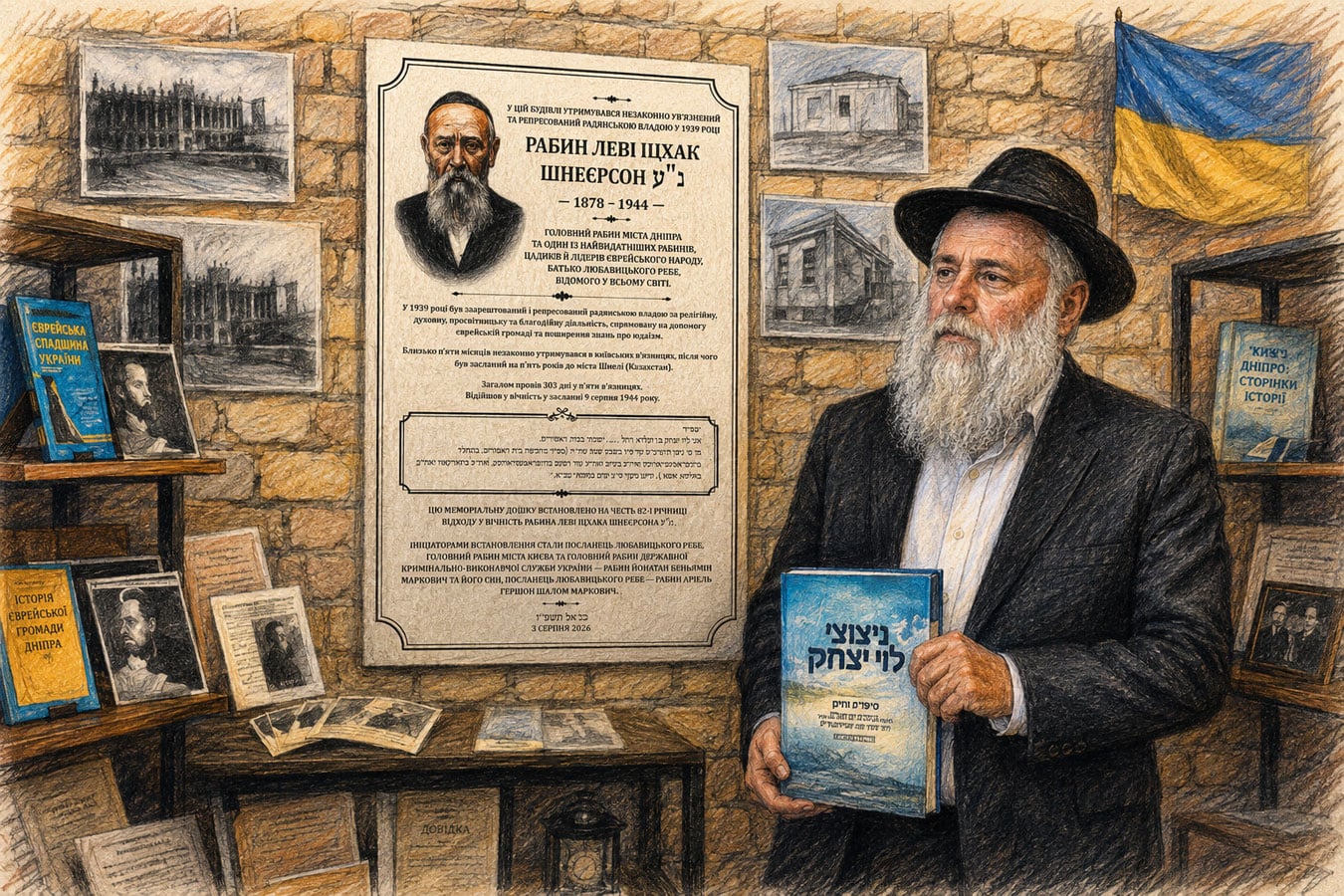
Kyiv Prison Honors Rabbi Levi Yitzchak Schneerson, Persecuted by the NKVD. The image was created using AI
A memorial plaque inside Kyiv’s Lukyanivska Detention Center restores the name of Rabbi Levi Yitzchak Schneerson — and reveals how Jewish life continues to endure in wartime Ukraine.
Memorial plaques are usually placed on the walls of homes, universities, synagogues or museums. In Kyiv, however, a new plaque has appeared in a far darker place: inside the still-operational Lukyanivska pre-trial detention center.
It was there, in the spring of 1939, that the NKVD — Stalin’s secret police — imprisoned Rabbi Levi Yitzchak Schneerson, the chief rabbi of Yekaterinoslav-Dnipropetrovsk, a renowned scholar of Torah and Kabbalah, and the father of the future Seventh Lubavitcher Rebbe, Rabbi Menachem Mendel Schneerson.
The plaque was unveiled on August 3, 2026, corresponding to the 20th of Av, 5786 — Rabbi Levi Yitzchak’s yahrzeit. Eighty-two years after his death in Soviet exile, the institution in which he was once treated as a criminal now publicly acknowledges what he truly was: a Jewish leader persecuted for serving his community and refusing to abandon his faith.
Not merely guests at a ceremony
The memorial did not appear through a routine administrative decision.
Kyiv’s Chief Rabbi Yonatan Markovich and his son, Rabbi Ariel Markovich, who coordinates assistance for Jews in Ukrainian correctional institutions, spent several months seeking permission to install a permanent plaque inside an active, high-security facility.
The ceremony was attended by the head of the Lukyanivska detention center and his deputy, together with both rabbis. The prison administration publicly acknowledged that Rabbi Levi Yitzchak had not been imprisoned for an actual crime. He had become a victim of a Soviet campaign aimed at destroying independent Jewish religious life.
The memorial was accompanied by another deeply symbolic gesture. A copy of Nitzotzei Levi Yitzchak, a collection based on the rabbi’s Torah teachings, was donated to the detention center’s library so that Jewish inmates could read it.
The same institution that once tried to silence him now holds a book containing his words.
That is more than commemorative symbolism. It is a reversal of history.
What the plaque says
The Ukrainian inscription states that Rabbi Levi Yitzchak Schneerson was illegally imprisoned and repressed by the Soviet authorities in 1939.
It identifies him as one of the outstanding rabbis, tzaddikim and leaders of the Jewish people, as well as the father of the world-renowned Lubavitcher Rebbe.
The plaque explains that he was persecuted for religious, spiritual, educational and charitable work directed toward supporting the Jewish community and spreading knowledge of Judaism.
It also records the brutal arithmetic of his imprisonment: approximately five months in Kyiv prisons, 303 days spent in five detention facilities, followed by five years of internal exile in Shieli, Kazakhstan. He died in exile on August 9, 1944.
At its center is a Hebrew passage based on Rabbi Levi Yitzchak’s own account of his imprisonment. The lower section names Rabbis Yonatan and Ariel Markovich as the initiators of the memorial.
Arrested at three in the morning
NKVD officers arrested Rabbi Levi Yitzchak at approximately three in the morning on March 28, 1939, at his home in Dnipropetrovsk. By the following morning, he had been transferred to Kyiv and placed in the Lukyanivska detention center.
His arrest was part of a broader operation. At least twelve Hasidim were detained in Kyiv, Kharkiv and Dnipropetrovsk. Soviet authorities may initially have intended to stage a public trial against the Jewish religious underground before separating Rabbi Levi Yitzchak’s case from the others.
The accusations followed the familiar logic of Stalinist repression. He was charged with anti-Soviet agitation, creating an illegal religious network and maintaining links with foreign intelligence.
NKVD documents even claimed that his son was the chief rabbi of Warsaw and an agent of Polish intelligence.
Neither claim was true.
The future Lubavitcher Rebbe held no such position and was not a Polish agent. But Soviet investigators did not require credible evidence. An influential rabbi who defended Jewish law, supported the families of arrested Jews and helped preserve religious institutions was already considered dangerous.
His real “crime” was that other Jews listened to him.
The matzah he refused to certify
One of the best-known episodes preceding his arrest concerned the production of matzah.
Soviet factories produced matzah and expected the chief rabbi to certify it as kosher. Rabbi Levi Yitzchak refused to sign such a declaration until the production process genuinely met the requirements of Jewish law.
He would not attach his name to a false certificate, even under pressure. Eventually, he succeeded in forcing the authorities to observe the necessary religious standards.
Yet it would be misleading to say that he was arrested over matzah alone.
The dispute was merely one episode in a much longer confrontation. Rabbi Levi Yitzchak organized assistance for the families of imprisoned Jews, helped maintain the distribution of kosher matzah, supported the construction of a clandestine mikvah and continued teaching Torah in a state that had declared religion a relic of the past.
For the NKVD, the problem was not one ritual or one disagreement. The problem was the existence of a leader capable of holding a community together and persuading Jews not to surrender their identity.
Five prisons, sixteen-hour interrogations and exile
Over the following months, Rabbi Levi Yitzchak was transferred between five Soviet prisons. Some interrogations reportedly lasted fifteen or sixteen hours.
On October 4, 1939, he was sentenced to five years of internal exile and sent to Chiili — today known as Shieli — in the Kazakh steppe.
His wife, Rebbetzin Chana Schneerson, voluntarily joined him. Their conditions were severe. They faced illness, hunger and shortages of the most basic necessities.
Even in exile, Rabbi Levi Yitzchak continued writing commentaries on Jewish texts. Because ordinary ink was unavailable, Rebbetzin Chana produced it from herbs, roots and local plants. Her husband wrote his thoughts in the margins of the few sacred books they possessed.
After his death, she preserved those volumes.
The manuscripts eventually reached the United States and were published with the involvement of their son, the Lubavitcher Rebbe. The writings that Stalin’s system tried to extinguish became part of the intellectual inheritance of the worldwide Chabad movement.
Seriously ill, Rabbi Levi Yitzchak was eventually permitted to move to Alma-Ata, today Almaty. He died there on August 9, 1944 — the 20th of Av, 5704 — at the age of 66.
In 2020, Kazakhstan recognized his burial site as a national heritage monument.
A Jewish map of memory across Ukraine
Rabbi Levi Yitzchak’s story is not connected to Kyiv alone.
For nearly three decades, he served as chief rabbi of Yekaterinoslav, later renamed Dnipropetrovsk and now known as Dnipro. He led its Jewish community through World War I, revolution, Bolshevik rule and the systematic destruction of independent religious institutions.
Commemorative farbrengens have continued in Dnipro, including separate gatherings for men and women. Participants study his teachings, sing Hasidic nigunim and discuss how his spiritual principles can be translated into action.
Mykolaiv also holds a special place in the family’s history. Rabbi Levi Yitzchak and Rebbetzin Chana lived there after their marriage, and their eldest son, Menachem Mendel Schneerson, was born there in 1902.
In Kamianske, members of the “Golden Age” community program have also gathered in his memory. These smaller meetings matter. Jewish history survives not only through international conferences and major institutions, but also through local communities in which one generation tells the next what happened.
Together, these cities form a geography of memory: Dnipro, where Rabbi Levi Yitzchak served; Mykolaiv, where the future Rebbe was born; Kyiv, where his father was imprisoned; Kamianske, where his legacy remains part of community life; and Almaty, where exile ended in death.
An archive establishes the facts; a plaque returns the person
The Soviet state did not acknowledge responsibility for Rabbi Levi Yitzchak’s persecution for decades.
Only in August 1991, during the final months of the Soviet Union, did the Ukrainian branch of the KGB formally recognize the illegality of the actions taken by its predecessors. Documents from the case were handed to Chabad representatives and later delivered to Rabbi Menachem Mendel Schneerson in New York.
Ukraine transferred additional records in 1993, followed by Kazakhstan in 1999.
But archival recognition and a memorial plaque serve different purposes.
An archive establishes the facts.
A plaque returns a human being to the physical place from which the authorities tried to erase him.
That is why the Lukyanivska memorial matters beyond the history of Chabad. State institutions do more than preserve documents. They also determine which names remain visible and which language society uses to describe past repression.
Why Israelis should care
For many Israelis, the name Schneerson is primarily associated with the Seventh Lubavitcher Rebbe and the worldwide network of Chabad emissaries, synagogues, schools and community centers that developed under his leadership.
But that global Jewish movement did not emerge from a historical vacuum.
Behind it stands a family that endured Soviet prohibitions, fabricated charges, imprisonment, exile and forced emigration. Ukraine is not a distant background to this story. The Rebbe’s father served there. The Rebbe himself was born there. The Soviet state tried there to destroy the religious world from which one of modern Judaism’s most recognizable movements later emerged.
The plaque in Kyiv therefore belongs not only to Ukrainian history. It is also part of Israeli and global Jewish memory.
It reminds us that the institutions of Jewish life visible today were often built upon acts of resistance carried out by people who had no guarantee that their work would survive them.
Jewish life continues under Russian missiles
The memorial also carries a contemporary meaning.
Ukraine remains under Russian attack. Air-raid sirens, missiles and drones are part of daily life. Homes, hospitals, schools and religious buildings have been destroyed. Millions of people have been displaced.
Yet Jewish life in Ukraine has not disappeared.
Synagogues remain active. Communities continue to pray and study. Rabbis, educators, volunteers and military chaplains continue their work. In Dnipro, farbrengens are held. In Mykolaiv, Jews study Rabbi Levi Yitzchak’s commentaries on Torah and the Zohar. In smaller communities, Jewish history is still being passed to another generation.
Ukrainian Jews are not merely observing the war from the sidelines. They serve in the Ukrainian Defense Forces, work as chaplains, provide vehicles and equipment to military units, support hospitals, help the wounded and assist displaced civilians.
The unveiling of the plaque does not prove that every problem has been solved. Antisemitism must still be confronted. Jewish cemeteries and synagogues still require protection and restoration. Historical memory still demands constant work.
But the ceremony shows a direction.
The Soviet authorities treated independent Jewish life as a threat and sent rabbis to prison. Modern Ukraine, while resisting a new Russian assault, has permitted a memorial to one of those rabbis to be installed inside the very institution where he was held.
Jewish history is being treated not as a foreign appendix to Ukraine’s past, but as part of the country’s own story.
Ukrainian Jews are not guests in that story. They are part of Ukrainian society, its history and its defense.
Memory has returned to the prison
In 1939, the Soviet system tried to replace Rabbi Levi Yitzchak Schneerson’s name with a case number. It recast religious leadership as anti-Soviet activity and transformed his relationship with his own son into a fabricated espionage accusation.
In 2026, a plaque bearing his name was placed inside the same detention center, while a book of his teachings was added to its library.
The NKVD had prison cells, interrogators, exile and the machinery of a state.
Rabbi Levi Yitzchak had a few books, homemade ink and the conviction that abandoning his faith would be a greater defeat than imprisonment.
Eighty-seven years after his arrest, the verdict of history is clear.
The Soviet system succeeded in taking away his freedom, his health and his ability to return home.
It did not succeed in destroying the Jewish life for which it persecuted him.
Related Topics
Related Posts