
I tell startup stories
Learning Hebrew, with my little friend
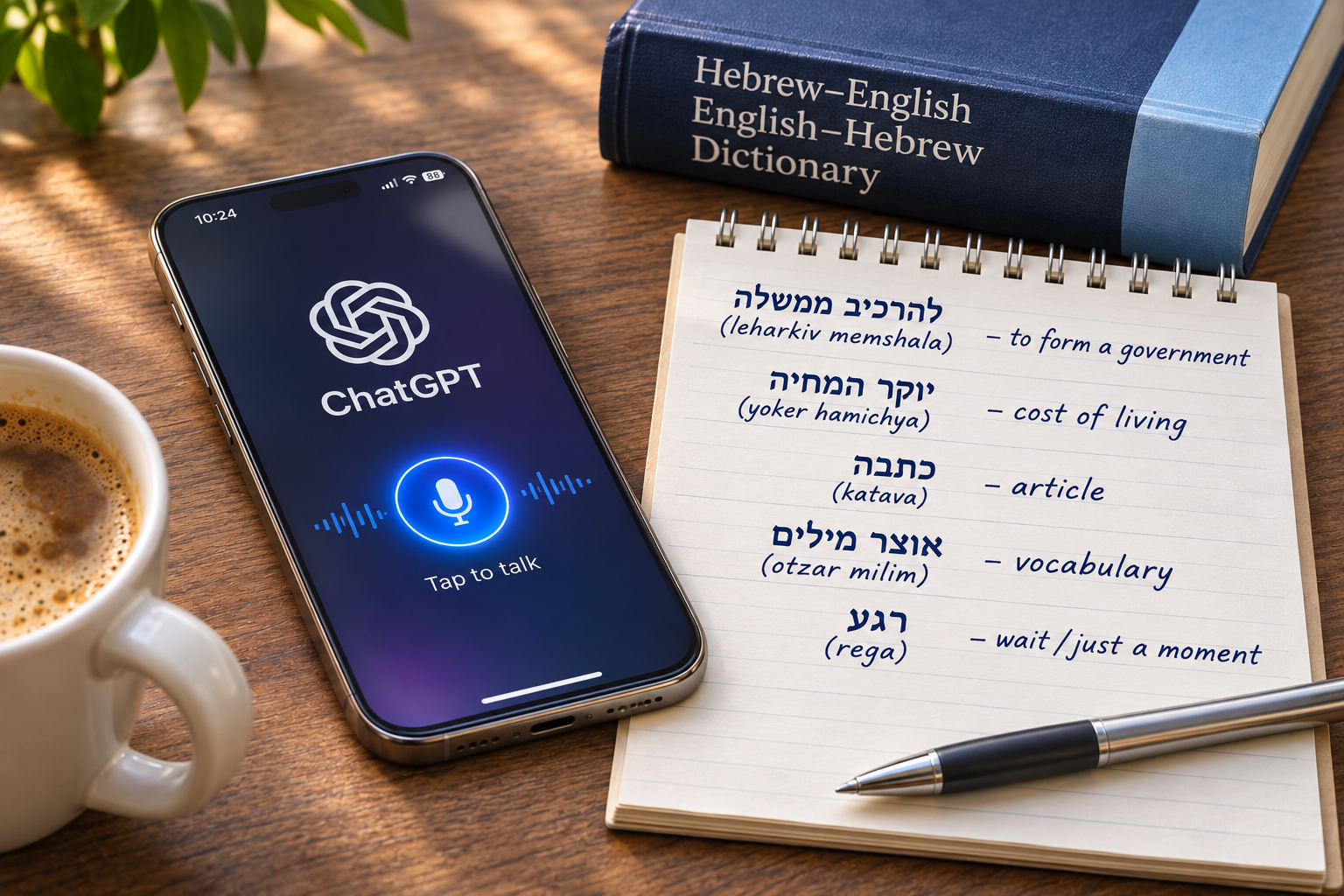
Pic credit: My little friend
I’m learning Hebrew with my little friend. ChatGPT.
People are surprised when I tell them. And I’m surprised that they’re surprised.
It seems to me such an obvious way to make the most of AI.
It’s always available, endlessly patient, obedient, adaptable and resourceful. It never shouts, and it never gets tired.
Those are the pluses. And compared to a paid teacher or an ulpan (virtual or face-to-face), they’re pretty big pluses.
The minuses are that it can be as stupid as it is brilliant. And that its accent is so terrible I sometimes wonder what language it is actually speaking.
Besach hakol (all in all), though, it is an amazing resource. Press the round blue button labelled “voice” and just start talking. It needs no introduction or instruction, it’s ready to roll.
My little friend and I started, at my suggestion, with straightforward stuff – the Israeli elections. I learned how to say “forming a coalition” (leharkiv koalitsia) and “cost of living” (yoker hamichya).
We’ve since moved on to public transport, coffee machines, the weather, international shoe sizes, falafel, techniques in Photoshop, right angled triangles, you name it.
I’ve learned that one of the best ways to use AI is to ask it to find a katava (article) that’s relevant to your chosen topic.
Tell your little friend to stop when there’s a word you don’t understand, and to translate it. Or ask it to work milah b’milah (word by word), Hebrew, then English.
It will compile a list of vocabulary (otzar milim) and test you on new words for as long as you can stay awake.
Yes, it might make mistakes. It’s only AI. But the vast majority of its conversation will be correct. And if the vast majority of my Hebrew was correct, I’d be delighted.
Be aware, though, that AI doesn’t actually know anything. It constantly refers to the entire internet for answers, but it retains no knowledge of its own.
I’ll ask my little friend what’s the Hebrew word for hypotenuse (yeter) and he tells me ani tzarich livdok (I need to check).
I wouldn’t be impressed if an ulpan teacher kept consulting a Hebrew/English dictionary for mathematical terms.
Or if she kept talking over me, as my little friend does, causing me to lose my composure and shout: “Rega, rega, rega. For ****’s sake, will you let me speak?” (Rega means wait).
But I’m more forgiving with AI. And I think you will also be, if you’re ready to give it a go.
I talk to my little friend while I’m out and about, when I’m walking around Ra’anana, when I’m driving to the super (supermarket), pushing my trolley around my favourite branch of Yochanananananof, queueing at the kupah (checkout) in the supermarket, and showing my receipt to the man on the door at the supermarket.
I know my little friend isn’t a replacement for “real” people. I know that.
I know that the best way to learn the language would be to get a Hebrew-speaking girlfriend (not an option).
So I’m happy. We have our ups and downs, my little friend and I. But we’re happy together. And we have a bright future. Together.
And once I’ve mastered this Hebrew malarkey, my patient and obedient little friend is going to teach me to play the saxophone.
Related Topics
Related Posts