Learning to sustain what has been achieved
KI TAVO- LEARNING TO SUSTAIN WHAT HAS BEEN ACHIEVED
The danger of arriving
I do not read Ki Tavo as a parashah about gratitude. Or, more precisely, gratitude is there, but it does not seem to me to be the central problem.
The problem begins when Israel arrives.
For a long time, everything had been about arriving: leaving Egypt, surviving the wilderness, walking, crossing, entering. Ki Tavo begins precisely when that long tension seems about to resolve:
“When you enter the land…”
And then another danger appears.
As long as something is missing, we know it is missing. Hunger does not need to remind us that food exists. Exile does not need to explain what it means to have no land. Slavery remembers itself; the body takes care of that.
Possession is different.
When what was missing is finally before us, it begins to seem natural. The land no longer feels like a promise. It is land. Freedom no longer feels like liberation. It is everyday life. The fruit ceases to be the improbable ending of a very long story and becomes, simply, this year’s harvest.
And that is where Ki Tavo begins.
Not because abundance is bad.
Because it is good.
So good that it can erase the road that led to it.
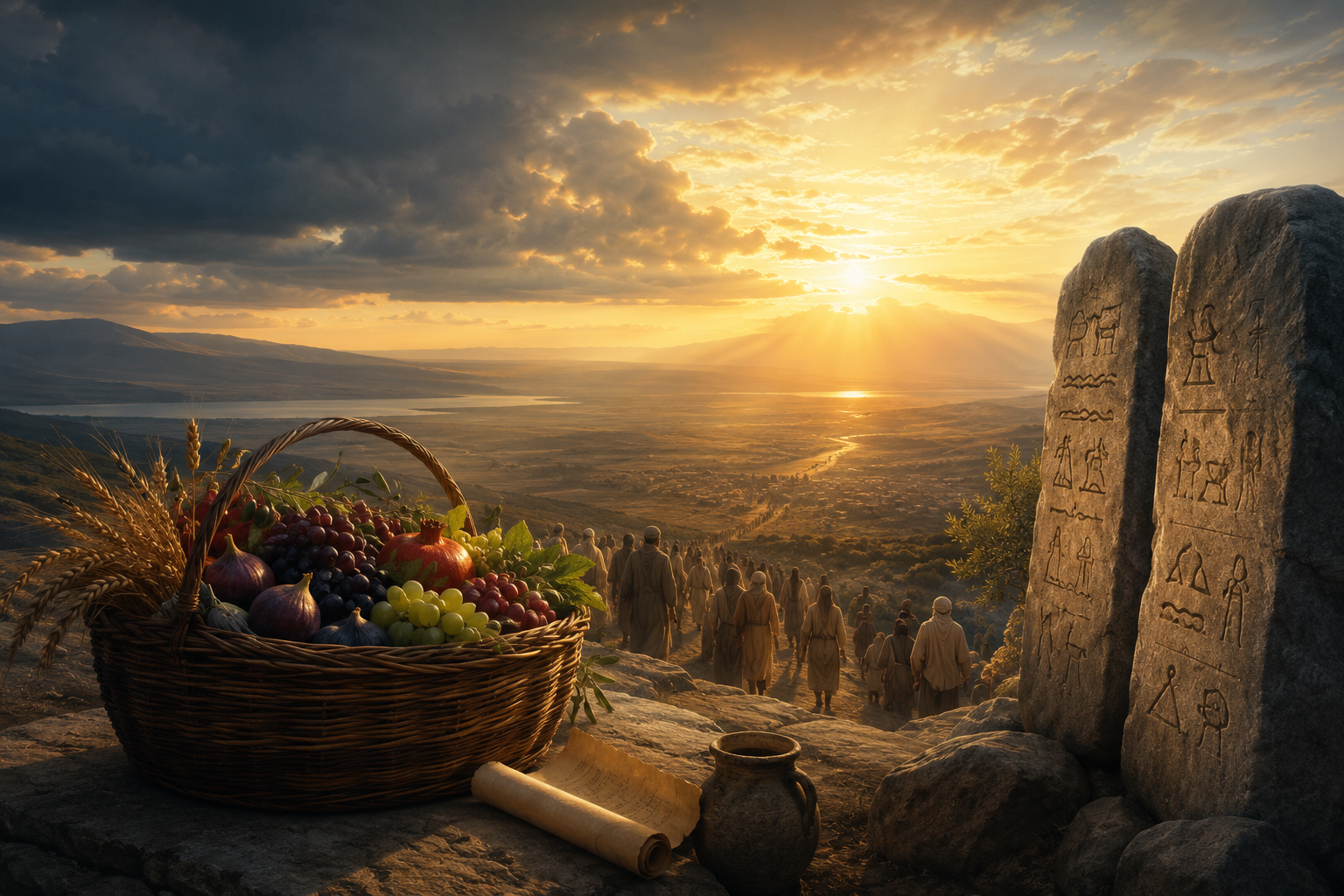
The first fruit cannot simply be eaten. It must be taken, set apart, placed in a basket and brought.
And one must speak.
The first fruits — a suspicion towards memory
For that reason, the first fruits seem to me something more serious than a gesture of thanks. There is in them a certain suspicion towards our own memory. The Torah does not trust the farmer to look at the fruit and spontaneously reconstruct everything that came before.
It does exactly the opposite.
It compels him.
The farmer comes before the priest and declares that he has entered the promised land. Then he places the basket before the altar.
He holds the fruit in his hand, but he must speak of a wandering Aramean.
Arami oved avi.
He does not recount how he sowed. He does not explain how hard he worked or what he did to improve the harvest. He goes back — to Egypt, to the smallness of the beginning, to the oppression, to the hard labour, to the cry. YHWH heard. Saw. Brought out. Led. Gave the land.
The fruit says: you arrived.
The declaration asks: how?
That difference carries much of the weight of the parashah.
A man could look at the field and say:
I sowed.
I worked.
I harvested.
And it would be true.
But it would be a truth that begins too late.
Before that there was a man without land. Then there was Egypt. There was slavery. There was a cry. There was an exodus. There was wilderness. There were years in which what now seems normal was still impossible.
That is why one sentence seems central to me: the basket contains a harvest; the declaration contains its genealogy.
The basket shows the result.
The word retrieves the causes that the result no longer shows.
That is causal memory.
When abundance separates, we must join again
After the first fruits comes the tithe.
Again the same operation appears: from what I possess, something must be set apart.
And it does not remain suspended in a religious abstraction. It goes to the Levite, the stranger, the orphan and the widow.
Abundance produces difference. Some have. Others do not.
The Torah compels us to notice that difference before it becomes indifference.
Memory that needs form
And Ki Tavo seems to know something uncomfortable about memory: if it depends on us alone, it wears away.
First one must speak.
Then write.
Then raise stones.
When crossing the Jordan, they are to set up large stones, coat them, and write the words of the Torah clearly upon them.
There is something almost stubborn in this gesture.
The generation that heard Moshe might remember. Their children perhaps as well. But Ki Tavo does not entrust all continuity to human memory.
The word leaves the interior and enters the stone.
Experience leaves the head and takes form.
It no longer depends solely on the individual’s emotional state, on enthusiasm, on momentary fidelity.
It remains before the eyes.
Written.
Visible.
Inner identity produces an outer structure which, tomorrow, can speak back to the inner self.
The stone does not remember.
We forget.
That is why we write.
Here I see one of the most important movements in the whole parashah: a reality produces experience; that experience must become knowledge; and what has been learnt needs a form capable of surviving even when the original emotion has disappeared.
To keep is not to remember
This makes another distinction in the text easier to grasp.
The one making the offering can say:
“I have not forgotten.”
And yet the Torah continues to demand:
keep and do.
Then keeping is not simply remembering.
One can remember something perfectly and live as though one had forgotten it.
We know that a certain behavior destroys a relationship, and we return to it. We know which mistake caused a rupture, and we repeat the same mistake. The information remains in the head. What has disappeared is its capacity to govern action.
Keeping means something else.
Keeping what has been learnt operative.
So that it continues to act when we no longer feel, with the same force, what once made us understand it.
A today that is never filed away
That is why the today of Ki Tavo interests me so much.
Today the command is given.
Today the declaration is made.
Today you have become a people.
I do not read this as a simple indication of time.
There is something more unsettling.
It does not merely say that Israel is a people. It says that something comes into being. A history of slaves, fugitives, wanderers, rebels, children born in the wilderness, finally crystallizes into identity.
Identity does not appear as a possession acquired once and for all. It is not enough to say: this happened; from then on, we are.
The sentence places identity back in the present.
Today.
And tomorrow there will be another today.
Identity, then, is not merely something one possesses. It is something one sustains.
Gerizim and Ebal — difference made landscape
Some will stand on Mount Gerizim.
Others on Mount Ebal.
Blessing.
Curse.
The Torah takes a moral distinction and turns it into geography.
Two mountains.
Two possible directions.
Not because life is always simple, nor because every event can immediately be reduced to reward and punishment. Life itself will bear sufficient witness that human reality is more complex.
But here the Torah wants to fix something in place before the people fully enter their new life:
actions are not neutral.
They build conditions.
They open some possibilities and close others.
The inner and the outer coupled
This also changes the reading of the blessings and the tochechot.
The text constructs almost the same mechanism twice.
Listen.
Keep.
Do.
And then reality responds.
In one direction appear fruit, stability, land, security.
Blessed the fruit of your womb. Blessed the fruit of your land.
In the other appear loss, hunger, displacement, dispersion.
Cursed the fruit of your womb. Cursed the fruit of your land.
Obedience does not remain enclosed within consciousness. It extends to the field, the city, the womb, the animals, the rain, the enemies, to the very security of being able to remain in the land.
The inner and the outer can no longer be comfortably separated. What the participant hears, keeps and does intervenes in the reality that must afterwards be inhabited. And that reality, in turn, returns consequences.
They are not two worlds.
They are coupled.
The literal reading of the text is clear. The Torah presents YHWH as the direct agent of the consequences: He blesses, strikes, sends, protects or withdraws protection. That is the language of the text. I am not trying to erase it or to say that the Torah claims something else.
My reading cannot stop there.
I do not understand God as a causal administrator of outcomes, distributing reward or punishment from outside.
God is present.
But presence does not mean intervention.
And precisely because He does not intervene by cancelling our decisions, something remains that we cannot hand over to anyone: free will.
I am not the first to read it this way. It is the same question that runs through those who sought a divine presence that would not replace human freedom, from Maimonides to Buber.
That is why responsibility cannot be transferred to God.
We choose.
We act.
We build relationships or fracture them. We sustain structures or contribute to their undoing.
And afterwards we live within the reality those decisions helped to produce.
A relationship sustained in a certain way produces a reality. A family sustained in a certain way produces a reality. A society sustained in a certain way produces a reality.
And if that is so in the tochechot, why should Egypt be different? I do not need to read ‘YHWH heard’ as an intervention in the physics of the empire. I can read it as presence within a relationship that changes when, after generations of slavery, the cry emerges. That cry is not yet freedom, but it already contains one of freedom’s first movements: what seemed to be destiny begins to be recognized as intolerable. What follows — the exodus, the road, the land — does not contradict the coupling that sustains the whole parashah. It inaugurates it.
And when the relationships that sustained that reality fracture, the consequences appear.
Not because God decided to punish.
Because something ceased to sustain what had previously been able to endure.
Perhaps that is why the tochechot become still more unsettling if we stop reading them only as a list of punishments sent from outside.
They also describe what happens when a reality begins to lose the conditions that made its continuity possible.
God has not disappeared.
But neither does He need to push every consequence into motion.
He is present while the human being remains responsible for the reality he builds, for the one he destroys, and for what he must afterwards do with the consequences.
The danger was not poverty
There is a sentence within the tochechot that unsettles because it does not accuse the people of having suffered too much.
It says that all this happens because they did not serve YHWH with joy and a good heart, out of the abundance of everything.
The abundance.
Not the scarcity.
The great danger of entering was not only that the land might be difficult.
It was also that the land might be good.
That there might be fruit.
A house.
Security.
Production.
That the extraordinary might become ordinary.
And that, little by little, the present might appear self-sufficient.
The amnesia of Ki Tavo does not necessarily begin when everything collapses.
It can begin when everything works.
That is why the first fruit must speak.
Reversibility
And here appears, for me, one of Ki Tavo’s strongest discoveries.
Reversibility.
The parashah begins:
enter → inherit → dwell.
The story had been:
Egypt → exodus → road → land.
But the journey can reverse:
land → loss → dispersion → no rest → Egypt.
That is far more unsettling than a threat.
It means that having arrived does not guarantee being able to remain.
What has been achieved can be lost.
“There will be no rest for the sole of your foot.”
A person can win freedom and fall back into an old slavery. A family can build trust over years and destroy it. A society can build institutions that seemed permanent and later discover that they were not.
None of this denies what was achieved.
It shows that achieving and sustaining are two different problems.
Ki Tavo begins with the first and, by the end, forces us to look at the second.
Entering and leaving are not values
That is why the repetition of entering and leaving carries so much weight.
“Blessed shall you be when you come in, and blessed shall you be when you go out.”
Then:
“Cursed shall you be when you come in, and cursed shall you be when you go out.”
Entering is not good in itself.
Leaving is not bad in itself either.
Movement changes its meaning according to the structure within which it takes place.
Here something we had already seen in Bamidbar becomes very clear: moving and remaining still are not moral values. They are states. They can build or dissolve.
Living is not enough
But Ki Tavo keeps an even greater difficulty for the end.
Moshe says:
“You have seen all that YHWH did before your eyes in Egypt.”
And shortly afterwards:
“But YHWH has not given you, until this day, a heart to know, eyes to see, and ears to hear.”
You have seen.
And still you need eyes in order to see.
You have heard.
And still you need ears in order to hear.
You have lived through all of it.
And still you need a heart in order to know.
There, for me, lies the epistemological centre of the parashah.
Living is not enough.
Experience does not automatically become knowledge.
We can pass through an event without understanding it.
We can suffer a rupture without grasping what produced it.
We can have left Egypt and continue carrying Egypt within us.
We can walk for forty years and, at the end, still not know what the journey truly meant.
This changes the familiar idea that experience teaches.
Experience offers something.
But someone has to read it.
And even after reading it, another problem remains: keeping what has been learnt.
The cycle that does not close
That is why Ki Tavo does not end in an inner revelation.
It ends with:
keep and do.
See.
Understand.
Keep.
Do.
And in doing, a new reality is created.
That reality will produce experience again. It must be observed. Interpreted. Kept. Turned into action again.
Only there does the complete movement appear:
reality → experience → knowledge → keeping → action → consequence → new reality.
And it begins again.
Gerizim and Ebal return here, but no longer as two fixed destinies.
The two mountains return.
Blessing.
Curse.
And the people between them answer:
Amen.
That Amen closes nothing.
It acknowledges.
It acknowledges that actions enter a structure of consequences. That what we do does not disappear after it is done. That it leaves form behind.
Tomorrow an answer will be required again.
And the day after tomorrow as well.
Ki Tavo in our time
We live surrounded by narratives of arrival.
Success.
Property.
Career.
Position.
Knowledge.
Security.
Almost all of them begin too late.
They begin when the person has already arrived.
The harvest is photographed, and the wilderness disappears.
Ki Tavo compels us to begin earlier.
Who sustained you when you could not yet sustain yourself?
Which decisions made by others made your present position possible?
Which mistakes forced you to change?
What did you receive without having produced it yourself?
What part of what you now call “mine” began long before you?
The point is not to diminish one’s own merit.
It is to restore its causality.
Because when we lose the chain that produced a reality, we also begin to destroy the conditions that sustain it.
That applies to a person.
To a family.
To an institution.
To a civilisation.
Systems rarely fall at the instant the first error appears. Deviations can accumulate for years while the structure still appears solid.
Then the moment comes when it no longer holds.
And from the outside it looks sudden.
Ki Tavo compels us to read beforehand.
Reading beforehand is not enough if that reading does not turn back upon one’s own life.
Take something in your life that you now consider stable.
Not what you wish to achieve.
Something you already have.
A relationship. A home. Knowledge. A position. An ability. A freedom.
Look at it as you would the first fruits.
Then go back.
Not as far as yesterday.
To the origin.
What had to happen for it to come into existence?
Where was your Egypt?
Who heard your cry?
Who walked with you?
What did you learn in the wilderness?
And what part of all that have you stopped keeping because the fruit now seems sufficient?
There is a second question, a harder one.
What structure preserves today what you learnt?
Because remembering once is not enough.
Memory without form wears away.
Experience without understanding repeats itself.
Knowledge that is not kept loses its capacity to govern the next action.
The test after arrival
After that second question, I return to abundance, because I believe that is where the paradox of Ki Tavo lies.
Crisis remembers.
It hurts too much to be forgotten.
Prosperity can do the opposite.
When everything works, we begin to forget why it works.
When the fruit is on the table every year, we stop asking what made it possible for it to arrive there.
The danger does not necessarily begin with ruin.
It can begin much earlier.
When we stop reading.
When we stop relating the present to what produced it.
When the fruit seems to explain itself.
Then I also understand why the first obligation of the one who has arrived is not simply to celebrate.
He has to go back.
Narrate.
Reconstruct.
Keep.
Because Ki Tavo does not ask only how a reality is achieved.
It asks something more difficult:
what is required not to destroy it after it has been achieved.
Entry creates a reality.
Memory reconstructs its origin.
Identity establishes how to inhabit it.
Action decides whether that form can be sustained.
The consequences show what we have actually done.
And, if we know how to read them, experience can become knowledge.
Can.
Not necessarily.
That is still the problem.
Ki Tavo begins with an arrival.
But arrival is not the end.
Perhaps it is merely the moment when the more difficult test begins:
Learning to sustain what once cost so much to achieve.