Mathematics Teaching Professor, Author
Legacy: Belfast Jewish Community, Northern Ireland
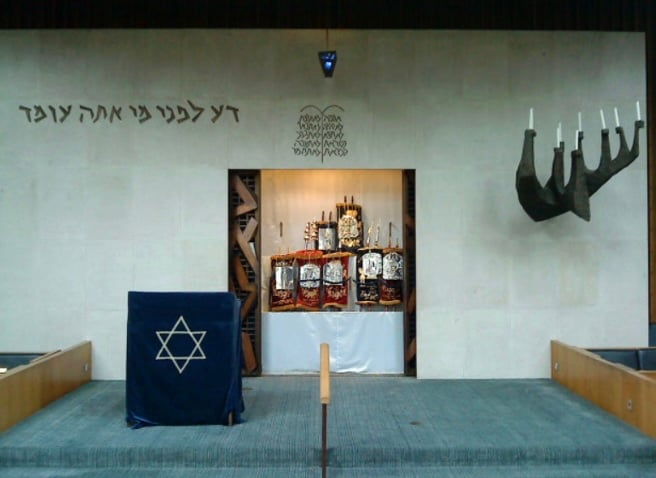
Belfast Synagogue Ark (Source: Belfast Jewish Community)
Tucked away in the city of Belfast, the capital of Northern Ireland with a population of 350,000, is a synagogue located at 49 Somerton Road with a remarkable legacy. This historic synagogue is the Belfast Jewish Community, formerly known as Belfast Hebrew Congregation and Belfast Synagogue.
Community
The Jewish community in Belfast is one of the oldest religious minorities in Northern Ireland, dating back five generations. The Belfast Jewish Community has a small, tight-knit membership; the congregation consists of roughly 80 active members as of 2025.
The congregation is Ashkenazi Orthodox. The Ashkenazi Orthodox are descendants of Jewish communities that settled in the Rhineland, Germany, and later migrated to Eastern Europe, Poland, Russia and Lithuania. The Orthodox practice a traditional, strict interpretation of Torah law.
The synagogue is the last remaining active synagogue in Northern Ireland. Its membership has declined from a peak of around 1,500 members during World War II to its current membership of 80 members. The community is aging, with many members in their 70s, 80s, or 90s. Membership has fluctuated from 78 in 1900, to it height of 1500 during World War II, and then fell to roughly 375 after the war. By 1999, the population was at 200.
The Jewish community has a substantial role in the religious life of Northern Ireland.
The congregation is active, hosting the “Wednesday Club” for seniors and conducting educational tours.
Holocaust Memorial
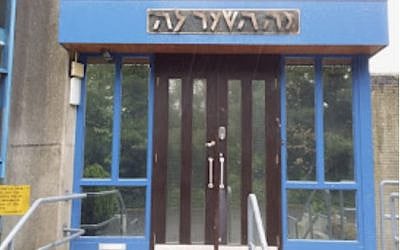
The Belfast Jewish Congregation synagogue at 49 Somerton Road Synagogue is home to a deeply moving Holocaust Memorial at Belfast Jewish Congregation that stands as an emotional and poignant remembrance for Northern Ireland’s Jewish community. Located within the synagogue building, the memorial includes a plaque dedicated to the Jews murdered during the Holocaust. The English inscription reads: “In memory of the martyred millions of European Jewry 1933–1945.” The stone tablet also bears three lines in Hebrew conveying the same message. The memorial is listed in the UK National Inventory of War Memorials.
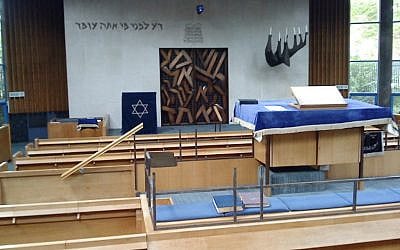
Inside the synagogue there is also a memorial wall bearing the names of deceased members of the congregation, including refugees and individuals whose families suffered losses during the Holocaust. Another significant feature is a distinctive hexagonal plaque encircled by a barbed-wire design, commemorating British diplomats whose “personal endeavors helped to rescue victims of Nazi oppression.” Together, these memorials reflect both the suffering endured during the Holocaust and the resilience and remembrance preserved by Belfast’s Jewish community.
The memorial is not open for casual walk-ins. Visits must be arranged in advance by contacting the congregation.
Belfast Synagogue Ark
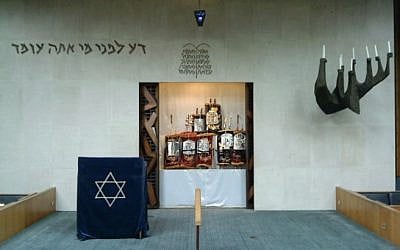
The ark in the synagogue has a remarkable seven Torah scrolls. In Jewish tradition, the Ark, is the most sacred space in a synagogue; it is where the Torah scrolls are kept. Having seven Torah scrolls is especially meaningful for a community of this size. For a congregation of around 80 members, maintaining seven scrolls reflects a rich historical legacy. Each Torah Scroll is handwritten in Hebrew on parchment by a trained scribe, sofer.
Synagogue
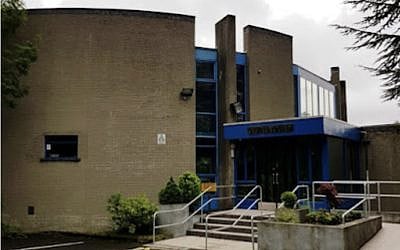
The current synagogue was built in 1964. The synagogue building is listed as a historic structure. The synagogue was designed by architect Eugene Rosenberg, who was Czech-born Eugene Rosenberg was a member of the London architectural firm of Yorke, Rosenberg & Maxwell. He collaborated with architect Karl Kapolka. The design of the synagogue was award winning. The prominent feature is its unique circular design and Star of David roof beams.
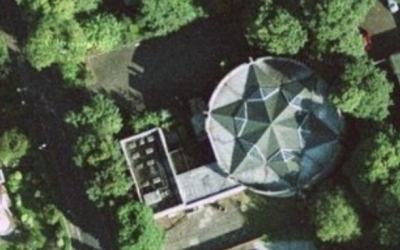
The synagogue is a Listed Historic Building. A single-story minimalist Modern Style concrete brick synagogue, the synagogue is the only one of its kind in Northern Ireland. At the heart of the design is a striking double-height circular “drum”, measuring approximately 27 meters in diameter. This central space is crowned by an innovative hidden hexagonal folded roof, subtly forming the shape of the Star of David.
History
The Jewish community in Northern Ireland was established in the 1860s, following the arrival of Daniel Jaffe, a prominent linen merchant who settled in Belfast in 1851. He played a key role in founding the first Jewish congregation in 1869. In 1871, the community built its first synagogue on Great Victoria Street, marking the beginning of organized Jewish religious life in the city.
During the late 19th century, the population grew significantly as Jewish refugees fled persecution in the Russian Empire and other parts of Eastern Europe. By 1900, the community had grown to around 700 members.
Today, the Belfast Jewish Congregation synagogue stands as a powerful legacy of Jewish life in Northern Ireland, reflecting a history of migration, resilience, and cultural continuity in a region where the Jewish population has always been small yet deeply rooted. Through its active place of worship, memorials, and community heritage, the synagogue preserves the memory of generations who contributed to the social and cultural fabric of Belfast while maintaining enduring connections to Jewish tradition and identity.
Contact Information:
Belfast Jewish Community, 49 Somerton Road, Belfast BT15 3LH, Northern Ireland
Phone: +44 28 9077 5013
Related Topics
Related Posts