
A Jewish Trans academic in recovery from academics.
Bono’s Tears and The Forgettable Éire
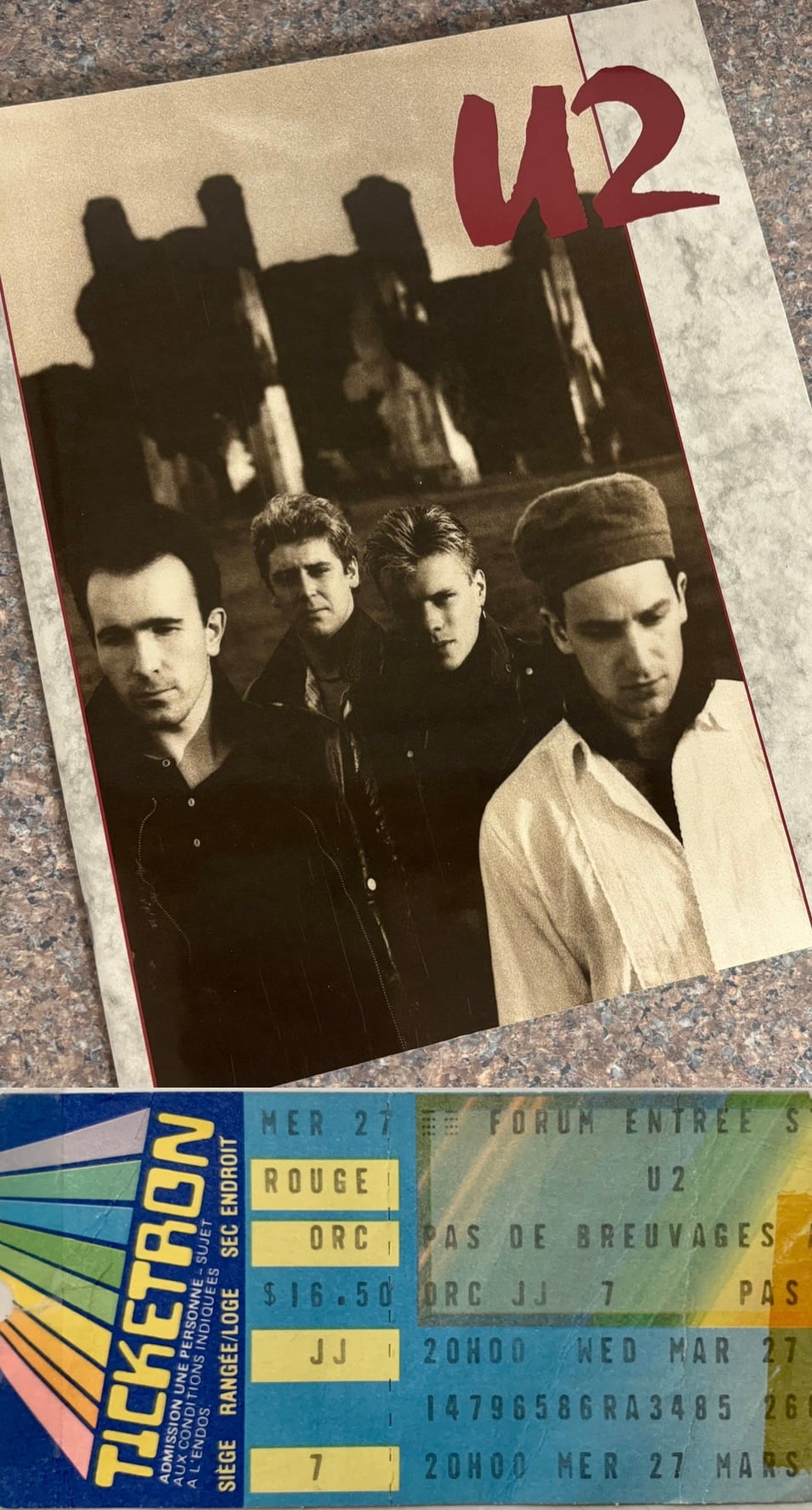
From my personal collection: The Unforgettable Fire Tour programme and my ticket stub from 1985. Click on picture to view.
On October 8th 2023, during their 40-night residency at The Sphere in Las Vegas, U2 changed the lyrics to their 1984 tribute to Martin Luther King, Pride (In the Name of Love), to reflect the horrors of the previous day’s attack on Israeli civilians at the Supernova Sukkot Gathering music festival.
Bono sang: “Early morning, October 7, the sun is rising in the desert sky. Stars of David, they took your life, but they could not take your pride.”
And then, he said nothing.
For almost two years, the most outspoken frontman of the most political rock band of the past fifty years said nothing. Until he didn’t. In August of 2025, the individual band members released statements “On Gaza” through U2’s social media accounts and their official websites. I read the statements. And I said nothing.
In February 2026, the band released their first EP of new material in almost nine years. Days of Ash is political, and it speaks of the Israeli/Palestinian conflict through music and poetry. I listened intently. I was upset. And I said nothing.
The new EP was accompanied by the digital release of the first new issue of the U2 fan magazine Propaganda, since 2002. This special companion edition broke down each track individually, allowing the band to comment on the inspiration behind each song. Unlike poetry and song lyrics, which can be interpreted or misinterpreted depending on the listener, the text in Propaganda is definitive. I read Bono’s words. I was upset. And I said nothing.
In September, U2 announced the release of their first new album in nine years. Carnaval De Luz is intended to be the joyful and festive record that Days of Ash and its more personal faith-based follow-up EP, Easter Lily, were not. This is the Catholic Liturgical Calendar according to U2, and the promotional machine is in hyperdrive. Bono has a lot to say. And I am listening.
In a digital exclusive in Rolling Stone, writer Brian Hiatt’s excellent interview with U2 covers just about everything a fan could want to know about the band as they celebrate their 50th anniversary. Somewhere around paragraph fifty-four, producer “Jacknife” Lee shares a story about Barack Obama visiting the studio during the recording sessions that led to the Days of Ash EP, and how Bono previewed a new song for the former president and the discussion that followed. The song in question is The Tears of Things, that imagines Michelangelo’s David coming to life and reflecting on the history of the Jewish people and where we are now as a nation in general, and Israel specifically. Bono is a devout Irish Catholic, and he has a lot to say about his relationship with the Holy Land, the Jewish People, and the government of the State of Israel.
Bono still acknowledges the horrors of October 7th, but his criticisms about the war in Gaza target only the Israeli government and comments made by Itamar Ben-Gvir about Palestinians, and Prime Minister Netanyahu’s apparent refusal to dismiss problematic members of the government needed to retain his majority in the Knesset. Bono is so distressed by this that he tells Rolling Stone, “this guy’s putting their religion in the shade … It’s just outrageous.”
Again, I am listening. But this time, I have something to say.
As an Irish Catholic, Bono tells Rolling Stone how so many of the wonderful things that have positively impacted his life have come from Jews and Judaism, and how this one guy is messing up our religion. In the past, I would have followed these comments with “as a Jew,” but this essay requires a novel approach.
As a U2 fan since 1983, with the receipts to prove it, I have happily endured Bono’s goofy, but always heartfelt, political rants and posturing. Perhaps, it was because he always sang about far off countries in upheaval and turmoil? Maybe, it was because I was a teenager whose political awakening occurred through music, the mosh pit, and emotions fueled by testosterone and estrogen, rather than facts? No, that’s not it. As a Jew, my parents raised me to be aware of my physical surroundings as I walked down the street, took the city bus to school, and engaged in conversation over burgers and dollar-a-slice pizza in downtown restaurants. They also raised me to be aware of my political surroundings through the newspapers and magazines that routinely dropped through our mail slot. My heartfelt political rants and posturing are a direct result of my personal experiences.
The first three U2 records – Boy (1980), October (1981), War (1983) – were released before Bono had turned 23. These albums were my introduction to Ireland, its faith, its history, and its troubles. By 1984, U2 were looking toward America with the release of The Unforgettable Fire (and the success of the aforementioned Pride). Their infatuation with the people, history, and politics of the United States would carry them through to the end of the decade when The Joshua Tree (1987) and Rattle and Hum (1988) turned the band into global superstars. Apparently, it also turned them into experts on world politics until they got stuck in a giant lemon by the end of the twentieth century.
Bono’s politics did not just up and vanish in the new millennium. What started as a beautiful day early morning September 11, 2001, became a nightmare as the sky came crashing down under the full weight of an Islamist terrorist attack in the United States that claimed thousands of lives. It was U2 who provided well needed catharsis to a grieving America when they played the Super Bowl halftime show in February of 2002 to a viewing audience of over 80 million people and Bono opened his jacket to reveal the interior lined with the American flag.
I too love America. I have friends and family all over the states, and I have visited hundreds of times since I was a kid. But Bono’s love for America was of no interest to me. I already know America. They are my next-door neighbour. I want to learn about places far (and away) from my experience. I want to learn about Ireland. I want to hear what Bono has to say about his people. The Irish people. In 2026. While Bono is quick to employ his Judeophilia in criticizing the government of the State of Israel, he does not have much to say about how his elevation of Jews to a higher moral standard may contribute to an increase in emotional and physical harm to Jewish people in the diaspora. Especially in Ireland.
The Jews and the State of Israel do not need another lecture from a pop star. The Jew-hatred on display in Ireland feeds off the performative righteousness of its homegrown superstars. If Bono values Jews and Judaism as much as he claims to, then let him prove it by explaining it to his country. I challenge Bono to look inward. Jews do it all the time. It is at the heart of our people. We are always striving to do better. I challenge Bono to hold his nation, its people, and its faith to a higher moral standard rather than asking the Jewish people and its homeland to do better. That would be the real tears of things.
Related Topics
Related Posts