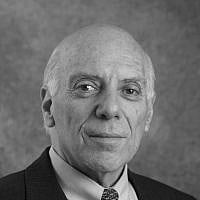
Leonore Bazinek Interview | Alexandre Gilbert #338
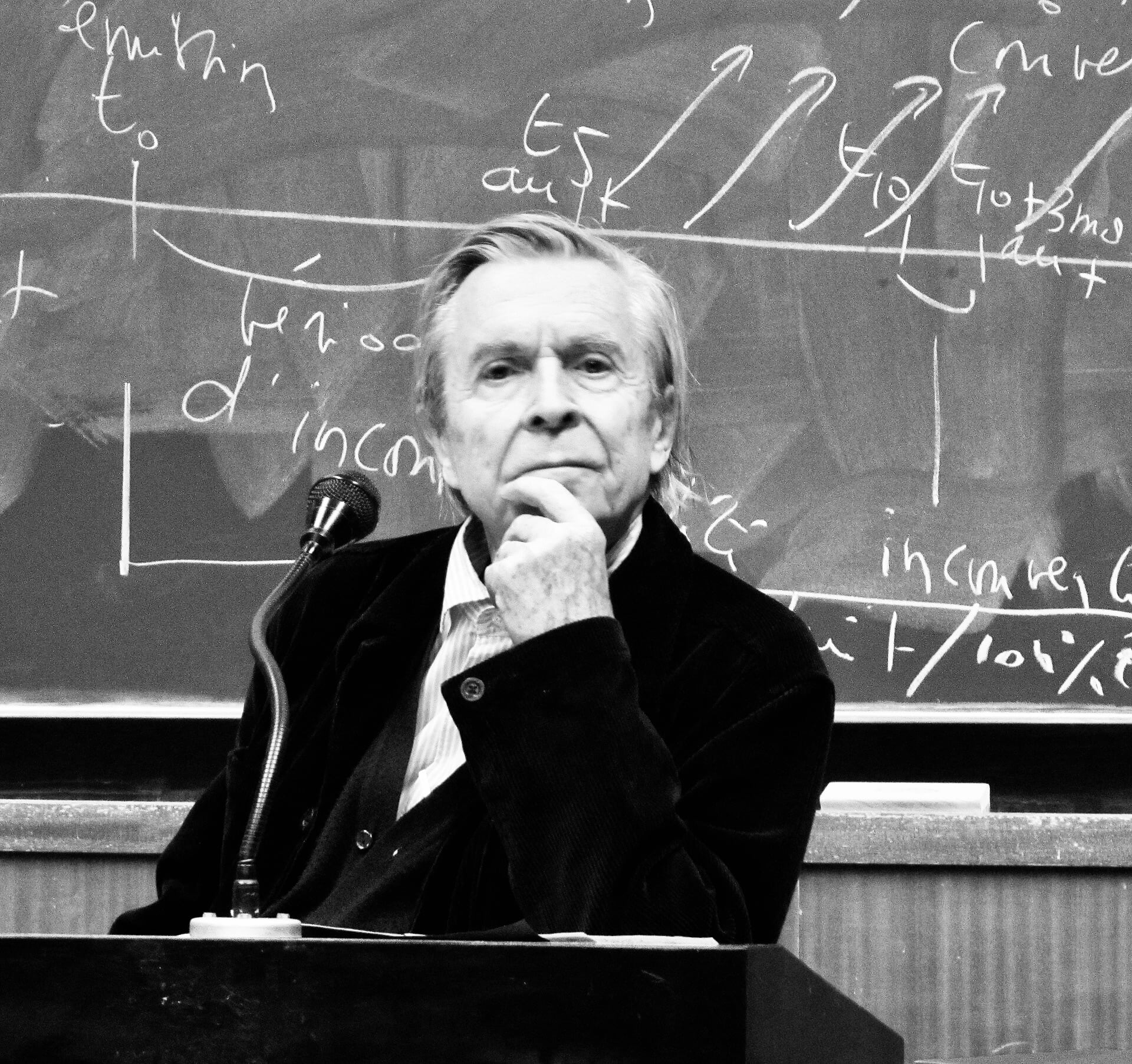
The movement of history.
In memoriam Jean Pierre Faye (1925-2026)
Leonore Bazinek is a philosopher at the Université de Rouen Normandie, ERIAC Laboratory (EA 4705).
“The working men have no country.” Karl Marx / Frederick Engels, Manifesto of the Communist Party, 1848 [manifesto of the communist party pdf], 25 [consulted 06/05/2026].
“I will say where I am and people will know who I am.” Jean-Pierre Faye, Langages totalitaires. Critique de la raison narrative (1972), Paris 2004, 465.
1.
In general, I don’t face the “terror of the white page”, but in preparing this present essay, I found myself confronted with a surprising form of this terror: the impression that it is nearly impossible to start writing about an end. We are overwhelmed by memory; we are heavily loaded with different emotions. This becomes even more complicated if the disappeared person was also a writer and as such interested in our writings. We have, in fact, to cope with the loss of a reader; we have to carry on our work without his kind, yet also corrective, regard.
But texts remain. Thereof, at this level, the dialogue can continue; therefore, I had to search in this direction. As a matter of fact, we shared an interest in German Nazism and in Napoleon; and we both also enjoyed simply strolling through history. And we agreed on the decisive role of language in human life.
Now I had a starting point and a general frame. But I still had to find a theme. Finally, I decided to examine a particular hypothesis which Jean-Pierre Faye raised up nearly every time when we met, for exploring history and searching together possible explanations. The intriguing point is that, even if the historical truth of this hypothesis is highly improbable, it carries undeniably psychological truth. So, this hypothesis can, in a certain manner, help us to face the behaviour of politicians.
2.
Let us take a short look at two hypotheses of Faye operating with his usual methodology: mixing up, or thinking together, all possible and impossible implications of a word or an expression as starting point for long chains of simultaneous reasoning on different levels. Both of them concern European history. The first tries to explain why the ancient Romans sought to conquer North-Eastern Germany, and the second, why Eastern European pipelines follow the route they actually do. I will take up only the first hypothesis. After a short presentation of the problem, I bring up two explanations. Given that these explanations are without tangible results, I will take another way: in retracing a passage of Langages totalitaires (cf. Faye, op. cit.) I argue that this passage contains decisive elements to understand Jean-Pierre Faye’s approach to the movement of history. In this way, I can show You as well a singular theoretical moment of our relatively short common history (if I read Faye’s texts since 2002/3, we only met in 2008 for the first time).
3.
Even if it seems to me that both hypotheses were, for Faye, linked, I have to separate them for practical reasons. For sure, both of them are not bare amusement; there are serious problems involved. In this essay, we do not discuss the hypothesis of the Eastern Europe pipelines even if it could help, in a certain manner, to understand our explanation of the other, because it demands an investigation into Napoleonic reasoning, politics, and the resulting warfare ‒ and his impact on further political thought.
So, what about the Romans and North-Eastern Germany? Our exchange at this subject was always a moment of real intellectual fun. Faye proposes effectively to explain the Roman appetite to acquire North-Eastern Germany by a kind of delicious, perhaps the most wonderful, plums growing exactly in these regions … For the moment, I see three possibilities to explain this further. However, if You know this story, please share Your reflections as well!
First of all, and this is the most tempting answer, we can understand the “plum” as a metaphor for “amber”. This explication is based on similarities of form, colour – and value. This was my idea in reading about the economic history of this region.
The second possibility is to take it as an ironic allusion to vegetarian Roman sects. These sects preach a simple lifestyle – but in reality, they adopt it not for spiritual reasons, but only for obtaining – as sacrificial offerings ‒ delicious sweet meals prepared with honey and dry fruits by their worldly followers. I learned about them in the famous biography Saint Augustin of Louis Bertrand (1866-1941); published for the first time in 1913 and often re-edited afterwards.
My third explanation is based on the philosophical project of Faye. In a passage of his basic study Langages totalitaires, he relates a conception of Ernst Rudolf Huber (1903-1990), developing the signification of totaler Staat (total state). Huber argues that the totale Staat is the fulfilling of the national principle, founded in Europe by the French revolution. He distinguishes the totale Staat of the middle age corporate state at the one side, the contemporary fascist state at the other. A corporate state has to articulate domination and landscape. It is therefore incapable of grasping the inner man. This is why he cannot realise a complete state. And the Fascist state, claiming almighty power, therefore claims that this power allows even the assimilation of smaller foreign peoples. But the totale Staat, realising the national principle, grasps the inner sense of man and connects in this way everything with each other: the members of his people and the people with landscape. As this is only possible within one’s own people living on one’s own homeland, no assimilation is possible and this impossibility is not a lack of power, but, on the contrary, one of the preserving principles of this power. And all political parties and all struggle of classes are annihilated if the national principle is entirely realized within a people. Natural guides will come up to exercise power. Such a state, such a people, has effective full-fledged power because it is a community based on purity of national character, blood, mentality.
Now what can we learn from this third explanation? If the appetite of such a people, even if it owns already many regions, including regions with fantastic plums, is stimulated, it is ready to go to war. Thus, war is not a fate, nor a normal product or event of history; the movement of history does not necessarily bear war. War is most likely the product of human psychic forces, originating in the inner life of leaders. And men can accept dangerous ideals making them ready to fight the most horrible fights even pour des prunes (a French expression meaning “for nothing”) …
4.
So, can we conclude now?
The first explanation gives, with the search for this precious material, amber, a classical explication of warfare. But here, we transform an important detail and in a certain manner, the centre of the hypothesis disappears. At the present, Faye does not mention rare, valuable materials. He mentions a most banal object, a plum. So, this explanation relies heavily on our usual presuppositions. On the contrary, the second explanation is dependent on real characteristics of plums. But is it not too harmless? There are some guys, sleeping and bathing and eating all day long at the cost of superstitious citizens, mostly women. Would they undertake a long, painful expedition just to have the sentiment to own the territory bearing one of their favourite products?
Nevertheless, with this explanation, we have some human, psychological elements; we have some conditions of possibility of >national-socialist< worldview. It is that, if a people get convinced that their culture, their way of living, their essence is the most excellent of all, it will accept to fight for nearly everything promising an augmentation of their power. And a heroic conquest of a territory bearing one of these products sustaining their self-esteemed excellent essence, will reinforce their proudness; feeling which will reinforce their willingness to further conquests and so on.
As we have seen, Faye shows that one element of national socialist worldview is the search of the totale Staat. Some pages later, he introduces a second element, the search for better violence (cf. 2004, 470). So, we can put together middle age corporate state, twentieth century fascism and national-socialism and evaluate them with this second element. Since national-socialism is the only one which arrives to dominate not only circumstances, but even the inner life of its members, it disposes of a better violence and can therefore realize the totale Staat. Faye points out a historical detail, or an ironic circumstance: the name of one of the most outstanding national socialist figures, the jurist Werner Best (1903-1989). Best was one of the most important actors in the national socialist extermination policy. He was active as writer, politician – and executor as well. I can only invite You to read these instructing pages (cf. Faye 2004, 492-502). Faye translates his name as “monsieur Meilleur” to introduce him. But soon afterwards, in explaining his deeds, he asks: “Werner Best, dressed in Black ss. Better, or Beast: The Better or the Beast (Werner Best, vêtu de noir ss. Beste, ou Bestie: le Meilleur ou la Bête)? » (2004, 492).
5.
So, what about warfare? Is it not always just for plum’s sake?
See also:
*12 septembre 2016: Dialogue avec Emmanuel Faye
*17 mai 2021: Scènes sous le ciel, In memoriam Marie-Odile Faye
*21 février 2022: Derrida, de Man et la déconstruction
*1er mai 2023: Jean-Pierre Faye et les « langues totalitaires »
*31 juillet 2023: Lire et comprendre : à propos de la question du gauchisme de H. Arendt
*31 mai 2026: Emmanuel Faye Interview | Alexandre Gilbert #329