From Yemenite tradition to the coming Beith HaMikdash
The Courtyard Stands Open: Why Jews Must Teach the Nations Now

A non-Jew sincere seeker waiting at the Soreg - Image generated using AI
In the days when the Temple stood in Jerusalem, a vast Court of the Gentiles welcomed those drawn from the nations. This outer courtyard formed part of Hashem’s design. Sincere seekers could bring offerings to any Israelite citizen standing there. That Israelite would take the offering past the soreg (the boundary wall), through the chel (the inner terrace), into the Ezrat Yisrael (the Court of Israelites), hand it to a kohen (priest), and declare its purpose on behalf of the one who brought it.


Israel lived as a nation of priests—not a closed caste, but a kingdom of intermediaries. The priest does not exist for himself. His corporate identity is to stand between Hashem and those who seek Him, to bridge the distance, to carry the offering upward and bring blessing down. When Hashem called Israel a mamlechet kohanim (kingdom of priests), He did not bestow a privilege of exclusion. He assigned a responsibility of mediation. The entire nation was to do for humanity what the kohen did for Israel: reveal the path to the Holy One, present the sincere before Him, and make manifest His profound love for all the families of the earth.
That model did not vanish with the Temple’s destruction. It waits for fulfillment today.
The prophets spoke clearly of this moment. Non-Jews would take the initiative. They would grab the kanaf (corner of the garment)—specifically the tzitzit (ritual fringes)—and declare that God is with the Jewish people. Many Torah-pursuant non-Jews today begin with genuine discovery of the Hebrew Bible. Their hearts awaken to a desire to draw closer to Hashem through obedience. As they study, they recognize that the Jewish people hold the living tradition and teaching. They decide to visit Jewish communities in humility, seeking guidance and connection.
Yet across synagogues in the United States and beyond, sincere seekers encounter closed doors. They hear suggestions to observe the seven laws and seek their own path, or receive instructions not to return. After enough rejections, many walk away carrying disappointment and negative judgments about the Jewish people.
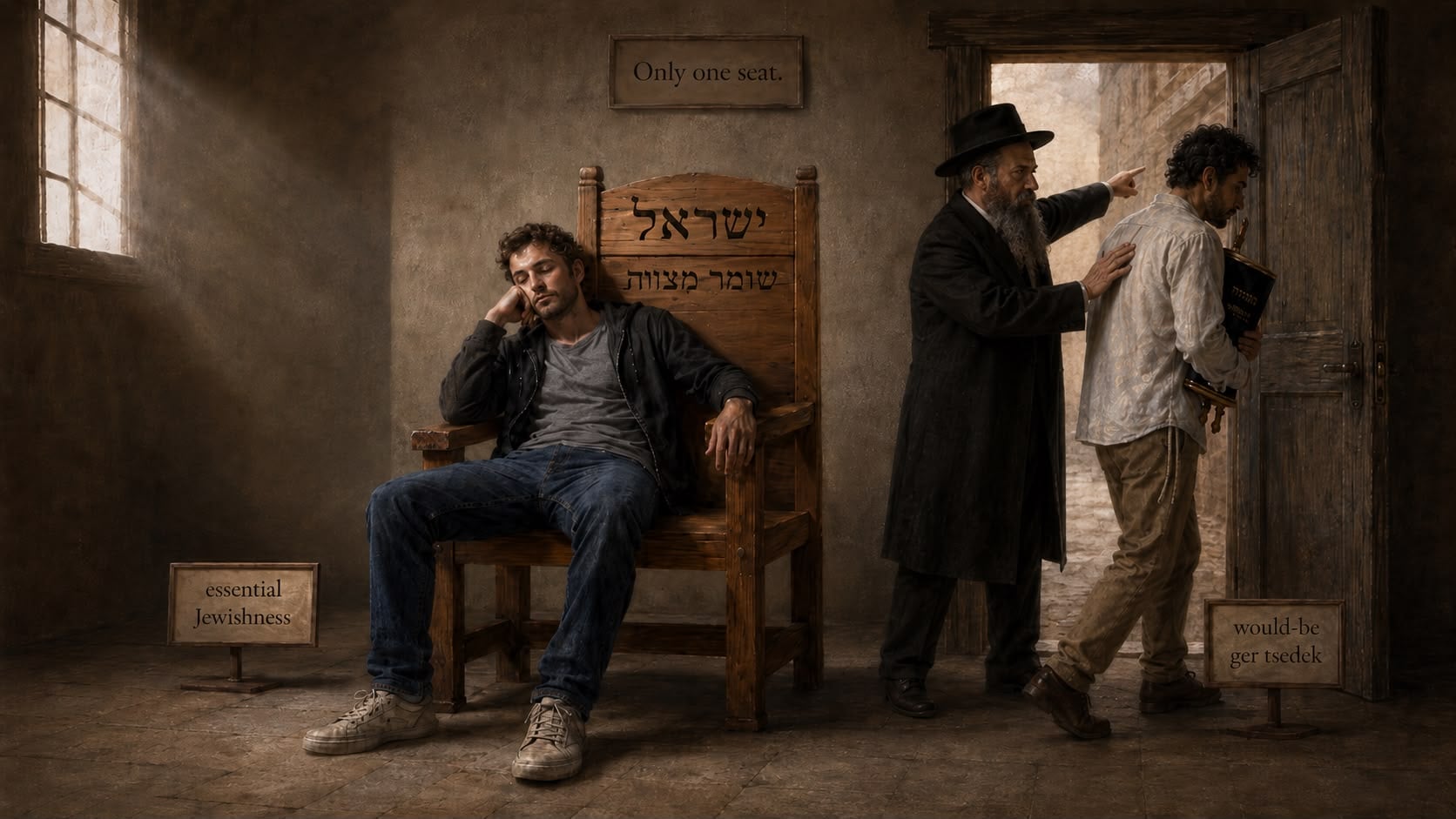
This outcome stands as the direct opposite of the world Hashem seeks to build—a world in which His love reaches every nation through the priestly service of Israel.
Isaiah 56:6–7 declares:
“And the foreigners who join themselves to the LORD, to minister to Him and to love the name of the LORD, to be His servants—all who keep the Sabbath and do not profane it, and hold fast My covenant—I will bring them to My sacred mount and make them joyful in My house of prayer; their offerings and sacrifices shall be accepted on My altar.”
The verse addresses foreigners who actively attach themselves—nilvim (those joining themselves)—to Hashem. This category stands distinct from three established roles in Jewish tradition. A nokhri (foreigner with no formal attachment) holds no covenant relationship. A ger toshav (resident alien) accepts core moral laws and lives peacefully among Jews without taking on full Torah observance. A ger tzedek (righteous convert) undergoes complete conversion and may bring offerings personally in the Temple.
The prophetic text, however, extends welcome and acceptance of service to sincere individuals in the process of joining themselves to Hashem—even before full conversion.
Hashem receives the service of those who join. The text makes no demand for immediate conversion or flawless observance. It calls for acceptance and teaching. The same pattern recurs across the prophets: Nations come to learn His ways. They attach themselves. The Jewish role remains to respond, to instruct, to facilitate their approach to Hashem—because the purpose of the priestly nation was never self-preservation. It was revelation. Israel exists to show the world that the God of Abraham loves all who seek Him and stands ready to receive them.
For too long, historical pressures and persecution led synagogues to function as closed mini-Temples. Caution calcified into custom. Today that custom has hardened into walls the rabbis rarely challenge. Congregants receive little preparation on how to engage sincere seekers. The default message discourages encounter. Only a tiny fraction of Jews actively teach non-Jews.
This leaves the priestly calling unfulfilled. A priest who refuses to present offerings has abandoned his post. A nation of priests that turns away the nations has forgotten why it was chosen.
Israel possesses the knowledge and the inheritance. The nations are awakening. The time has come to unlock the doors.
Efforts such as PerfectingTheWorld.com now extend the hem of the garment. They do not proselytize. They simply make clear that the tzitzit remains available for any hand that reaches out in sincerity. After years of rejection, the growing stream of Torah-pursuant individuals—many already living closer to a ger toshav than their secular neighbors—deserves a different reception.
To Jewish readers and synagogue leaders, the charge comes directly from the sources. You carry the task. Hashem does not perform it in your place. When Israel stepped into the sea in obedience, the waters parted. The same principle operates here.
Begin preparing your congregants. Teach them how to receive sincere seekers and serve as intermediaries in the spirit of the Temple courtyard. Many such individuals carry elements in their practice that require correction—yet they do not come as obvious offenders. Patient instruction reveals the path. Most set aside what contradicts the Tanakh once they understand its source. This process demands time, clarity, and consistency.
The kohen served Israel within the sacred areas. Israelites served the nations in the outer court by accepting and presenting their offerings. This remains the biblical order.
Locking the door and teaching avoidance does not constitute halacha (Jewish law). It represents a departure from the prophetic vision. The Court of the Gentiles stood as testimony that Hashem’s house holds space for all who come to seek Him. Modern synagogues must recover that spirit—not as a concession to contemporary pluralism, but as fidelity to the ancient mandate. The God of Israel loves the world. He placed His people in it to prove that love by their service.
The awakening among the nations escalates daily. Those aware of the prophecies recognize that God stands with the Jews. They want to draw closer. They need the teaching that only the Jewish people can provide from lived fidelity to the Torah.
Jewish communities that open this door will discover strength. Sincere seekers bring fresh commitment and reinforce connection to the God of Israel. More importantly, they fulfill the words of the prophets through concrete action. The Jewish people demonstrate that Hashem welcomes those who join themselves to Him. This testimony carries greater power than isolation—because it reveals what isolation conceals: that God’s covenant with Israel was always meant to bless all nations.
For Torah-pursuant non-Jews reading these words: Know this clearly. A place exists for you today in the courtyard. The prophets spoke of your approach. The kanaf and tzitzit remain ready to be grasped. A growing number of Jews recognize the moment and prepare to teach. Do not allow past rejections to define the future. The God of Israel draws you. The Jewish people, faithful to their calling, stand ready to instruct and to present your sincere service before Hashem.
The courtyard remains open in the divine plan. Your offerings and devotion find acceptance when brought through the proper channel.
The hour demands action.
Synagogue leaders must examine their policies. Rabbis must teach the full priestly responsibility. Congregants must learn practical ways to engage without compromise.
Step forward. Unlock the doors. Prepare the instruction. Need Help? Email info@perfectingtheworld.com today.
Hashem will provide the increase as obedience meets the awakening. The nations approach because they have heard that God is with you. Let the response match the prophecy.
The Temple model did not disappear. It calls for restoration in our time through living communities that welcome the sincere.
The choice stands before the Jewish people. Continue the pattern of rejection, and the world sees a closed nation. Open the courtyard as the prophets declared, and the world witnesses the God of Israel receiving those who come.
The latter path fulfills the ancient mandate. It restores the role of the priestly nation. It reveals what the priest was always meant to reveal: that Hashem’s love extends to every soul that seeks Him.
The nations wait. The sincere stand ready.
The time is now.
Related Topics
- Activism
- AI Artificial Intelligence
- Belief
- Bible
- Blogs and Blogging
- Faith
- Interfaith Relations
- Jewish Identity
- Jewish-Christian Relations
- Jewish-Muslim Relations
- Leadership
- Modern Orthodoxy
- My Judaism
- PARSHA POSTS: DEVARIM
- Philosophy
- Simchat Torah
- Spirituality
- Synagogues
- Talmud
- Tanach
- Technology
- Theology
Related Posts