CFO | Empower Society for Good I Author
Let My People Go — Parsha Bo and the World’s Moral Blindness
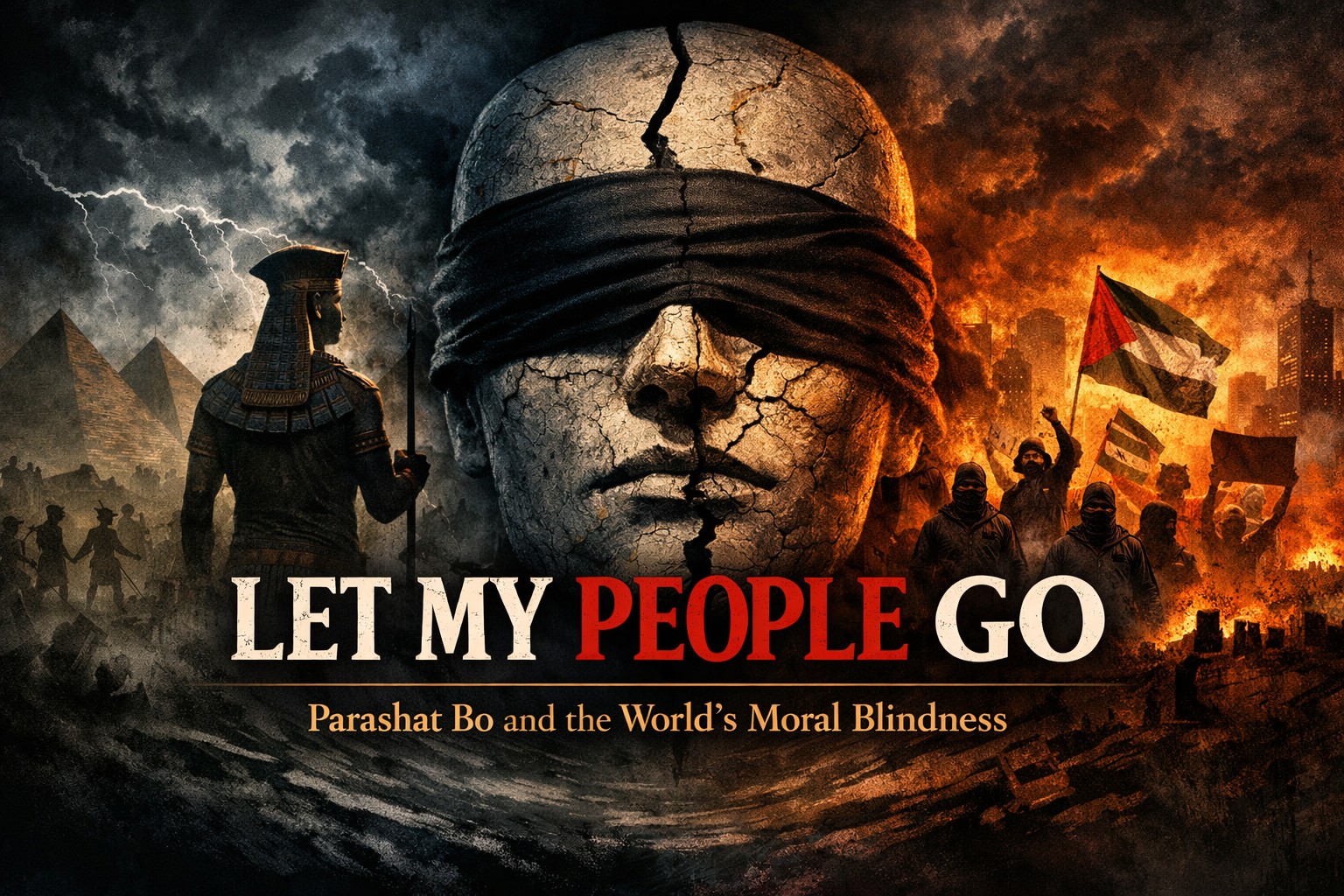
We live in a world flooded with information, yet increasingly unable to see right from wrong. The ancient story of the Exodus from Egypt, told in this week’s Parsha Bo, offers a striking lens on moral blindness, power, and the cost of looking away. Today, we see societies that speak endlessly about justice, yet hesitate to condemn cruelty when it is inconvenient; movements that claim to defend the oppressed, yet excuse violence when it does not fit a preferred narrative; and leaders who offer words instead of responsibility.
Parsha Bo reminds us that the greatest danger is not ignorance, but paralysis—the refusal to see suffering clearly and to act with moral courage.
Parsha Bo is not only the story of the Exodus from Egypt. It is the Torah’s timeless confrontation with tyranny, moral blindness, and the abuse of power. Pharaoh is not destroyed because he is strong, but because he refuses to recognise the humanity of others and the limits of his authority. His repeated refusal to utter three simple words—“Let My people go”—is what ultimately brings Egypt to ruin.
The Torah teaches that redemption does not begin with miracles. It begins with moral clarity. When a society loses the ability to distinguish between oppression and liberation, between victim and aggressor, it hardens its heart—just as Pharaoh did.
The Plague of Darkness: Blindness Before Collapse
Before the final blow, the Torah pauses on something far more unsettling: the Plague of Darkness.
This was not merely the absence of light. The Torah describes a darkness so thick that people could not see one another, nor could they move from where they stood. Rabbinic tradition understands this as moral and spiritual blindness. Egypt continued to function, govern, and rule—yet it could no longer see truth, suffering, or consequence.
Darkness, in the Torah, is not chaos. It is paralysis.
That plague has returned.
A World Flooded With Information—and Blind
We live in an age of unprecedented access to information, yet astonishing blindness.
Blindness to history.
Blindness to facts.
Blindness to oppression.
Blindness to suffering—especially when it does not fit an approved narrative.
The response to October 7 exposed this darkness with painful clarity. The massacre of Israeli civilians—men, women, children, and the elderly—was one of the most barbaric acts of violence against Jews since the Holocaust. And yet, before bodies were buried and hostages accounted for, protests erupted across Western cities—not against Hamas, but against Israel.
This was not a failure of knowledge.
It was a failure of sight.
Modern Pharaohs and the Persistence of Tyranny
The world today is filled with modern Pharaohs.
The Iranian regime is perhaps the clearest example. It enslaves its own people through fear, violence, and religious coercion. Women are beaten, imprisoned, and killed for asserting basic dignity. Protesters are executed for demanding freedom. Kurds and minorities are systematically crushed. An entire nation is held hostage by a radical theocracy.
And yet, the global response is muted.
This silence mirrors Egypt’s moral blindness. Pharaoh could not hear the cries of the enslaved Hebrews because acknowledging them would have required him to relinquish power. Likewise, many global institutions, activists, and governments avert their eyes from Iran’s brutality because condemning it would require moral consistency—and the courage to confront regimes aligned against the West and Israel.
The Deafening Silence After October 7
The events of October 7 shattered any remaining illusions.
And yet, the silence of much of the political Left, and of Arab leaders and movements who rushed to the streets immediately after October 7, is deafening. It exposes a selective morality that claims to champion human rights while rationalising, excusing, or contextualising mass murder when Jews are the victims.
As Piers Morgan observed in the aftermath, something is profoundly broken in a world where rape, slaughter, and hostage-taking are met with moral equivocation rather than universal condemnation. This was not resistance. It was terror. And the refusal to say so is itself a moral failure.
Blindness to Jewish History and Reality
The world speaks incessantly about justice, yet remains wilfully blind to Jewish history: millennia of exile, persecution, expulsion, and genocide; repeated rejection of peace; and the reality that Israel exists not as a colonial project, but as the return of an indigenous people to their land.
This blindness allows terror to be reframed as resistance and Jewish survival to be labelled aggression. It erases attacks such as the murders at Mercaz HaRav (2008) and Har Nof (2014), where Jews were killed in sacred spaces—not as soldiers, but as students and worshippers.
Darkness does not deny facts.
It renders them invisible.
Palestinian Suffering—and the Refusal to See Its Causes
The Palestinians do deserve more. They deserve leadership that builds rather than destroys. They deserve dignity, opportunity, and a future not mortgaged to endless war.
But moral clarity requires asking a difficult question: why has suffering persisted when alternatives were repeatedly available?
Time and again, Palestinian leadership—often backed by regional powers—has chosen terror over coexistence, martyrdom over development, grievance over responsibility. This choice has had devastating consequences, first and foremost for Palestinians themselves.
This reality is often obscured by another form of darkness: the refusal to confront how religious ideas, when misinterpreted or weaponised, can sanctify violence rather than life; how pride and honour can become barriers to compromise; and how victimhood can be cultivated instead of nation-building.
This is not an indictment of Islam as a faith. It is a warning about how any belief system, when distorted and absolutised, can become a tool of destruction—just as Pharaoh absolutised his power.
From Jerusalem to the World: The Globalised Intifada
The attacks at Mercaz HaRav and Har Nof were not anomalies. They were warnings.
What we are now witnessing in Bondi, Manchester, Washington, London, Paris, Amsterdam, and on university campuses across the West is the globalisation of the intifada. Synagogues are attacked. Jewish schools are threatened. Students are intimidated. Jews are told to hide their identity or “go back to where they came from.”
The geography has changed.
The ideology has not.
There is a painful pattern that can no longer be ignored. When Jews are murdered in terror attacks—on buses, in synagogues, in schools—there is no global outcry, no marches, no hashtags.
When Iranian citizens are killed for daring to protest a brutal theocracy, the world largely looks away. There is no rage, no sustained outrage, no moral mobilisation.
And yet, when Palestinians die in war, or when Jews build homes in their ancestral and historical homeland, the reaction is immediate and explosive. Protests erupt. Social media ignites. Condemnations are issued on cue.
This imbalance reveals not compassion, but obsession—not justice, but selectivity. And it is precisely this selective silence that exposes the modern plague of darkness.
Selective Silence: The Modern Plague of Darkness
In recent weeks, while Iranian citizens are being killed for protesting a dictatorial theocracy—rising with bare hands against bullets, batons, executions, and enforced silence—the world has largely looked away. Women are beaten and imprisoned for defying religious coercion. Protesters are executed for demanding freedom. Entire communities are cut off from the outside world through internet blackouts designed to hide brutality and suppress truth. And yet, the global response is muted.
This silence has been powerfully called out by voices such as Dorit Goldflam, who—like many of us—has used social media not for virtue signalling, but as a moral alarm. Her question is as simple as it is damning: Where are the human rights activists now? Where are the celebrities, influencers, and movements that claim to stand for justice when millions of Iranians are risking their lives for basic dignity? Where is the outrage when the Islamic Revolutionary Guard Corps—designated a terrorist organisation by multiple countries—kills civilians in plain sight?
The answer is uncomfortable. This silence is not neutrality. It is selectivity. Human rights are defended loudly when they align with a political narrative or an obsession with one country, and quietly abandoned when they require moral consistency or courage. This is not a failure of information—we know what is happening in Iran. It is a failure of sight.
In the language of Parsha Bo, this is the plague of darkness. Not chaos, but paralysis. A darkness in which people can no longer see one another, no longer move, no longer respond. A darkness that allows cruelty to continue because acknowledging it would demand uncomfortable truths and moral resolve. And as the Torah teaches, a society that cannot see injustice clearly does not progress—it hardens its heart and stands still.
“Let My People Go” — A Universal Moral Demand
In Parsha Bo, Pharaoh repeatedly offers partial freedom—negotiated slavery, conditional release, or freedom without dignity. The Torah teaches us to be wary of liberation movements that do not seek freedom, but domination.
“Let My people go” is not a Jewish slogan. It is a universal moral demand.
It applies to the Iranian people held hostage by tyranny.
It applies to Kurds and minorities denied protection and identity.
It applies to women denied bodily autonomy.
And it applies to the Jewish people—still denied the right to live safely and sovereignly in their ancestral homeland.
Yet uniquely, when Jews assert this right, they are told their freedom is colonialism and their survival is oppression.
Darkness Before Redemption
In Egypt, darkness came before redemption. Only after blindness was exposed could liberation occur.
Parsha Bo teaches that redemption is impossible until societies confront what they refuse to see. Pharaoh’s downfall began not with death, but with denial—with the inability to acknowledge suffering and relinquish control.
The Torah insists that freedom requires sight:
to see history honestly,
to see suffering without romanticising violence,
to see that morality without boundaries collapses into chaos.
Until the world learns to see again, it will remain trapped in darkness.
Redemption begins not with louder slogans, but with the courage to open our eyes—and finally say:
Let My people go.
Conclusion: The Divine Reset
Judaism teaches a counterintuitive truth: the day begins at night. Darkness comes before light. Creation itself emerges from uncertainty, not clarity. This is not accidental—it is a moral framework for understanding renewal.
Parsha Bo reminds us that before liberation comes confrontation, and before freedom, discomfort. Darkness is not only a symbol of collapse; it is often the moment before change becomes possible.
The same pattern runs through human history. War precedes peace. Crisis exposes what can no longer continue. When moral blindness is laid bare, a reset becomes possible—not automatic, but necessary.
The question Parsha Bo leaves us with is simple and demanding: will we remain paralysed by darkness, or will we allow it to sharpen our vision? A divine reset does not erase responsibility—it demands it. And if we choose to see clearly, darkness can give way to light, conflict to peace, and denial to moral courage.
Related Topics
Related Posts