
Life In The South: Last Week In Merhavim
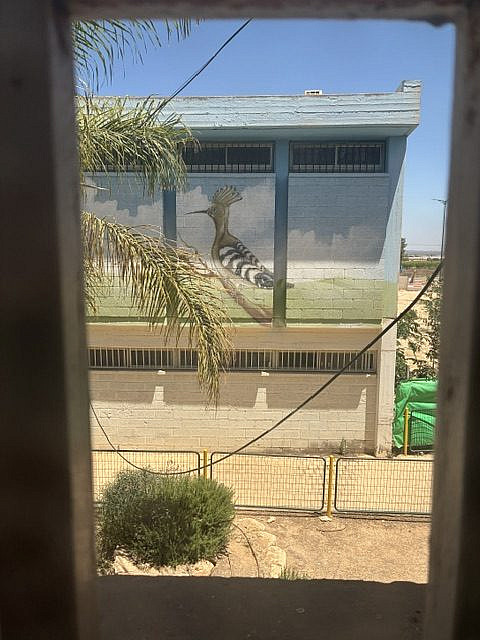
Last Tuesday was my last day teaching in Merhavim, but unfortunately, as has happened so many times over the last month, my lessons were cancelled. As I was leaving, I saw a group of sixth graders on the stage rehearsing for the end-of-year event. Next year they will be starting junior high school (just 200 meters away on the same campus), and for them, too, these are the last days at Merhavim Elementary School.
Still, it was a very unusual week in the south. Our Service Year group spent our special study day in Rahat, the largest Bedouin city in Israel. First, we listened to a talk in a Bedouin tent by our tour guide, a resident of the city and a social worker, who told us her life story. She is divorced from her husband, whose second wife she had been. Yes, polygamy is still common in Bedouin society, and it often means a very difficult life for second (and third) wives and their children.
After the talk, we visited the modern and quite impressive Museum of Bedouin Culture, which is located next to the community center, another modern and beautiful building. Then our tour guide took us on a tour of the city. Rahat is huge, so we drove between the different sites. When we arrived at the sports center, a woman in her thirties got out of a car with her two young children. We exchanged a few welcoming words, and she told me that she is a civil engineer and had been one of the people who planned and built the beautiful center.
Although it was an interesting and important visit, I didn’t feel that we really got to know the city. We visited several highlights that had been selected for us, but we didn’t have much opportunity to experience everyday life there.
On Monday night, a group of us visited an urban kibbutz in the southern town of Sderot. The visit was organized by one of the Service Year volunteers from another group. There are three Service Year groups in the south and one in the north.
Today, the kibbutz is located in one of Sderot’s neighborhoods, along a beautiful, tree-lined street, with one building designated for communal activities. Almost forty years later, the children have grown up. Our guide, Avner, a member of the kibbutz, explained that the project was intended to last for only one generation, as there is no room for the grown children to return to this one-street kibbutz.
It was fascinating to hear about this lifetime experiment. I found myself thinking that this way of life is not so different from life outside the kibbutz. When you live with a spouse, you make choices together, but once your children grow up and leave home, they usually no longer have a physical—or, in many ways, an emotional—place to return to: their parents’ home, which is also their childhood home.