Life is a fragile booth: The ‘falling sukkah’ redemption
On Friday evenings and festival eves, the Hashkivenu blessing closes with a familiar phrase:
Blessed are you God…who spreads the “sukkat shalom” [canopy of peace/completeness] over us, over all His people Israel, and over Jerusalem.
The image suggests shelter and a sense of things settled. One might expect that on Sukkot, when we move our meals and much of our daily routine into a less stable booth, this would be the image we invoke at the table as well. Yet the festival addition to Birkat ha-Mazon [Grace after Meals] draws on a different source, taken from Amos’s prophecy of political collapse in the eighth century BCE (9:11):
May the Merciful One raise up for us the Sukkat David ha-Nofalet [falling booth of David].
We cannot know exactly what the early shapers of the liturgy intended by this choice. It is, however, more than a reference to the holiday’s central object – the sukkah. Placed side by side, sukkat shalom and sukkat David ha-nofalet reflect two ways of understanding Jewish life. One looks toward an ideal of completed peace. The other acknowledges an ongoing condition of vulnerability.
The wording in Amos is provocative. The prophet does not speak of a booth that fell once, long ago (asher nafelah), and now lies in ruins. He uses the participle ha-nofalet, “the falling sukkah.” It is a structure that is still in the process of falling, and still standing.
The sages picked up on this. In Sanhedrin (96b–97a) we read:
Rav Nachman said to Rabbi Yitzchak: “Have you heard when Bar Naflei will come?”
He said to him: “Who is Bar Naflei?”
He said: “The Messiah.”
“You call the Messiah ‘Bar Naflei’?” He answered:
“Yes, for it is written: ‘On that day I will raise up the falling booth of David.’”
The Messiah here is not identified with conquest or with an unbreached fortress. He is Bar Naflei, one associated with falling. In this reading, redemption does not wait for history to hit bottom. It takes shape during the decline itself. Resilience, then, does not mean denying crisis. It means sustaining hope while the personal and collective structures around us are visibly under strain.
A related distinction appears in Tractate Berakhot (64a), regarding how one takes leave of another person:
Rabbi Avin HaLevi said: One who parts from the living should not say “Go in peace” (lekh be-shalom) but “Go toward peace” (lekh le-shalom)… And one who parts from the dead should not say “Go toward peace” but “Go in peace.”
“Go in peace” assumes arrival. The work is finished, and so the phrase is reserved for the dead. In that sense it corresponds to sukkat shalom, the settled rest associated with the World to Come. The living are told “go toward peace.” For them peace is a direction rather than a place of rest, something pursued over uneven ground.
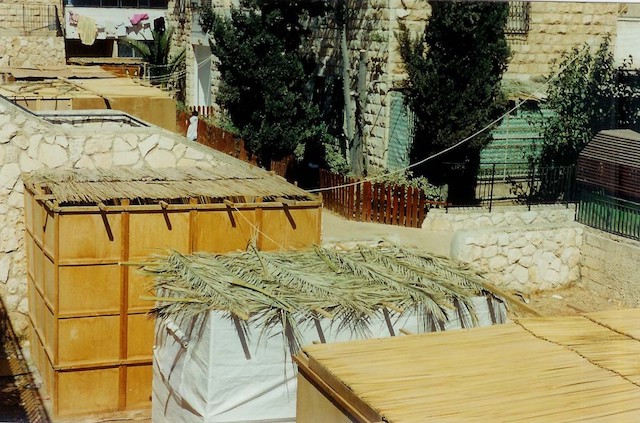
Sukkat David ha-nofalet belongs to this second category. When we recite it in Birkat ha-Mazon, sitting in a hut open to wind and weather, the liturgy does not pretend that the final canopy is already in place. It speaks to life as it actually is: unsettled and demanding.
There is also something instructive in the choice of structure. Biblical language often expresses power and divine protection through images of permanence: the fortified city, the palace, the migdal oz. Yet when Amos, and later the blessing liturgy, reach for an image of long-term covenantal continuity, they choose branches and boards rather than stone.
The Maharal of Prague (Netzah Yisrael, chapter 35) points in this direction. A stone palace that collapses is reduced to rubble. Rebuilding it means clearing the site and starting from new foundations, so the continuity of the original structure is lost. A sukkah is built from the outset to be temporary. When a storm knocks it down, its parts remain usable. It can be gathered and put back up.
Jewish communities came through exile, migration, and social upheaval in part because their institutions and identity were not perceived as impenetrable structures. Their strength lay less in being impervious than in being adaptable: able to absorb blows, to be damaged, and to preserve the underlying design until they could rebuild.
This year the first day of Sukkot falls on Shabbat, and the two images sit in some tension with each other. Shabbat is me’en Olam ha-Ba, a foretaste of the world to come. Especially on Friday night, Hashkivenu invokes the sukkat shalom, a sheltered moment of rest and wholeness. At the same time, the requirements of the festival move us out of our permanent homes (dirat keva) into a temporary dwelling (dirat arai), where we feel the night air and see the stars through the skhakh covering. And after the meal, Birkat ha-Mazon brings us back from Shabbat’s calm to the petition for the falling sukkah of David.
The combination offers a sober message for Jewish life today. We do not reach sukkat shalom by retreating into protected enclaves or by acting as if vulnerability has passed. We move toward it by acknowledging physically/metaphorically that life is a fragile booth. Even when the walls shake, in times of personal and national crisis, internal division, and real exposure, we seek comfort in the sukkah’s “shade of faith.”
The prayer for sukkat David ha-nofalet is therefore neither a lament nor a surrender of responsibility, rather a statement of resilience. It expresses our aim that however often the structures of life have been damaged or dismantled, we aim to rebuild and adjust, albeit often with retention of deep scars.
Ha-Rachaman hu yakim lanu. May we draw strength to have the flexibility and the stamina to acknowledge what has fallen, and reconstruct it to the best of our abilities, going le-shalom, toward peace.