
Writer covering Israel–Africa, Jewish affairs, and Israel worldwide
Light a Candle, Pass a Law: Australia’s Theatre of Solidarity after Bondi
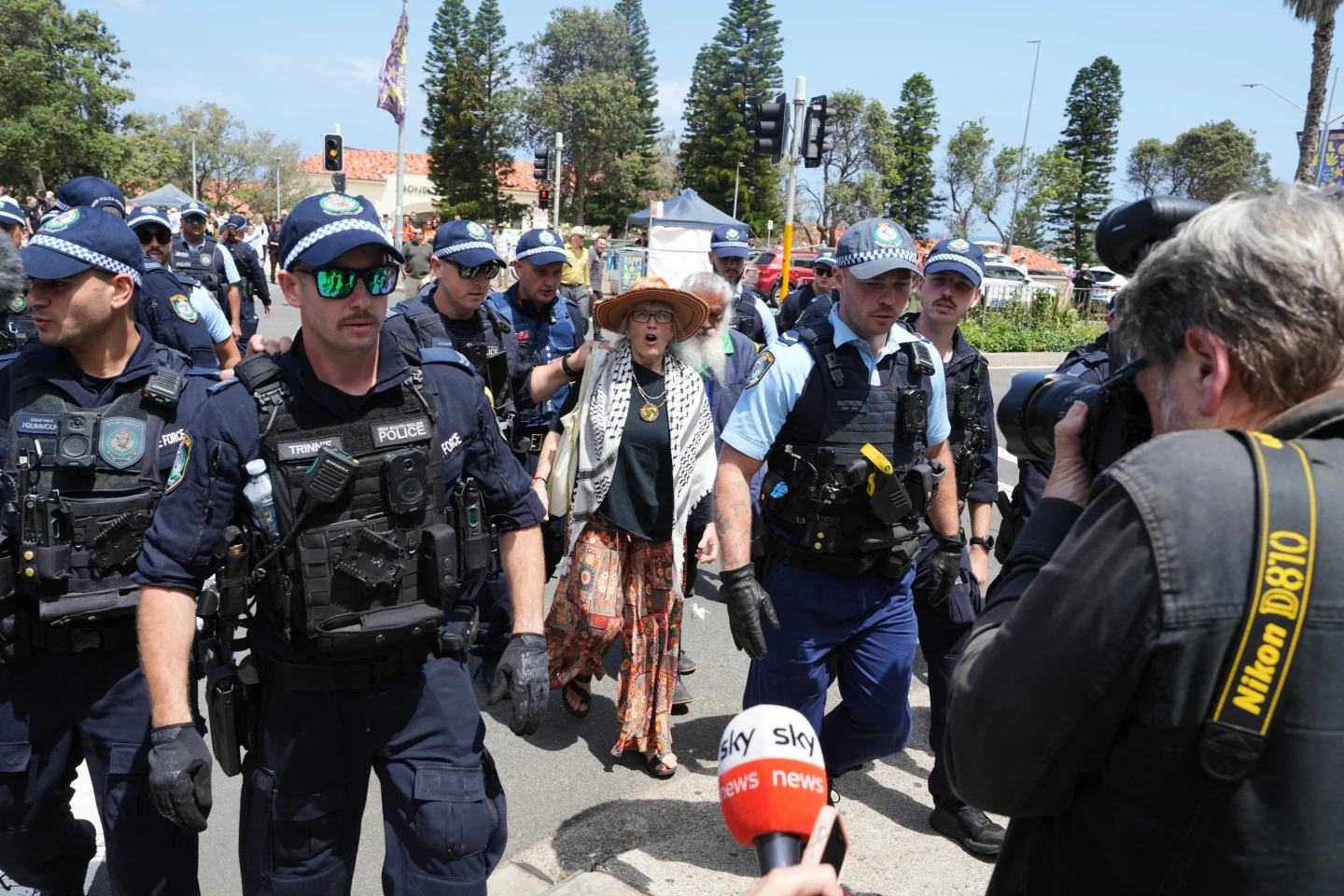
A woman is escorted from a flower memorial outside the Bondi Pavilion at Sydney’s Bondi Beach, December 15, 2025, a day after a shooting. (AP Photo/Mark Baker)
Bondi wasn’t a failure of gun laws — it was a triumph of political denial.
Aftermath
The Bondi Beach attack was not a policy failure. It was a moral one.
Fifteen Jews murdered, dozens wounded, in what was clearly an antisemitic terror attack—and Australia’s political response managed to miss the point with near-perfect precision.
Prime Minister Anthony Albanese condemned the violence, vowed solidarity, and promised action. The action, it turns out, is tougher gun laws. Because when faced with ideological hatred, imported extremism, and months of anti-Israel agitation, the real culprit is… firearms paperwork.
You almost admire the confidence.
The Context That Came Before the Candles
The Bondi attack did not happen in a vacuum. It followed months of escalating anti-Israel rhetoric, protests that blurred into intimidation, and a government decision to recognize a Palestinian state at a moment when Israelis were still reeling from October 7 and hostages were still being held underground by Hamas.
This timing was not incidental. It sent a message—intended or not—that Palestinian violence would be met not with consequence, but with diplomatic reward.
Israeli Prime Minister Benjamin Netanyahu warned Albanese explicitly that such recognition, immediately after the worst massacre of Jews since the Holocaust, would embolden extremists and fuel antisemitism abroad. That warning was waved away as political noise.
One of the Bondi victims—a rabbi—had written directly to the Australian prime minister urging him not to betray Jewish communities by proceeding down this path. His plea was ignored. He was later killed in the attack.
History has a cruel way of footnoting letters no one wanted to read.
Solidarity, Now With Optics
After the bloodshed, the gestures came quickly. Albanese visited the site. Flowers were laid. A Chanukkah candle was lit to show unity with the Jewish community. It was a masterclass in post-event symbolism: warm, visible, and entirely divorced from the policies that helped create the climate in which the attack occurred.
Lighting a candle after ignoring repeated warnings is not solidarity. It’s theatre.
Comforting, yes—but only for the audience watching, not for the people burying their dead.
And Now, the Solution: Gun Laws
Then came the diagnosis.
According to Albanese, preventing future antisemitic terror attacks requires stricter gun reforms. One imagines the scenario he has in mind: a terrorist carefully entering a licensed gun shop, submitting identification, passing background checks, waiting for government approval, registering the weapon—then, satisfied that the state has vetted his paperwork, heading out to murder Jews.
If only the forms had been longer, Bondi might have been avoided.
This framing is not just absurd—it is evasive. Terrorism is not a regulatory oversight. Antisemitic violence is not a loophole in firearms legislation. Treating it as such avoids confronting the ideological fuel: the normalization of hostility toward Jews, excused as “political expression” so long as it wears the right slogans.
Gun laws didn’t fail at Bondi. Moral clarity did.
The Comfort of Solving the Wrong Problem
What makes this episode so unsettling is how familiar it is. When hatred erupts into violence, leaders rush to fix something—anything—that doesn’t require naming the source. It’s safer to regulate objects than to confront ideas. Easier to tighten laws than to admit that rhetoric has consequences. Australia’s Jewish community did not need candles. It needed to be heard—before the attack, not memorialized after it.
But perhaps this is the new model of governance: reward extremism diplomatically, ignore warnings quietly, mourn publicly, and legislate irrelevantly.
Light a candle. Pass a law. Miss the point.
Related Topics