
The Ceuta Crisis Calls for Practical Humanism
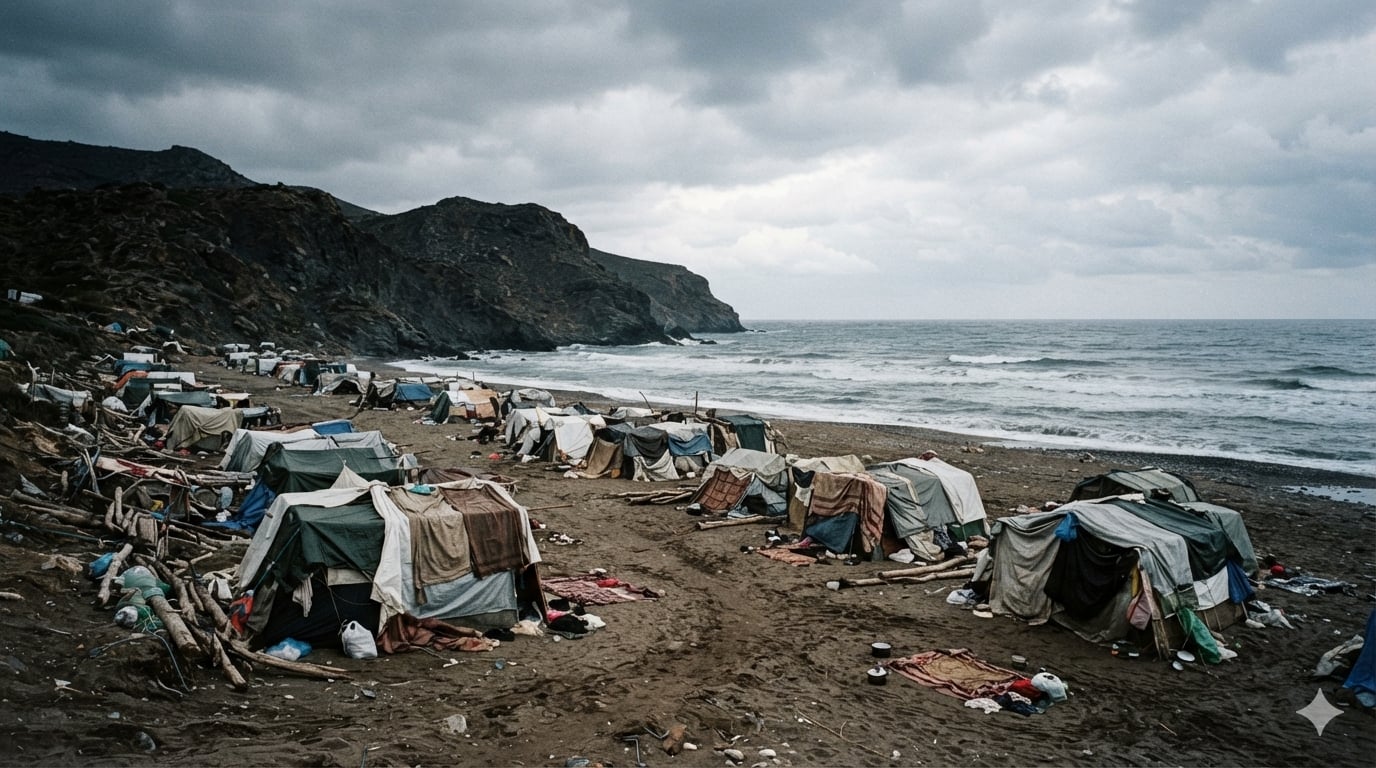
As a recent EUobserver opinion piece argued, the Ceuta crisis illustrates how the arrival of migrants can become political fuel for the far right. But there is a deeper lesson in the episode—one that connects Ceuta to the Israeli-Palestinian conflict and exposes a structural shortcoming of humanitarianism.
When reports of the Ceuta crisis surfaced in our Israeli social-media feeds—particularly reports of locals trying to block Red Cross trucks carrying humanitarian aid to asylum seekers and migrants living in harsh conditions—the reaction from many Israelis was predictable:
These hypocrites demonized Israelis who tried to block humanitarian aid trucks bound for Gaza, but are now ignoring similar actions.
It stirred several conflicting emotions in us. Above all, we felt sadness at how easily people can become emotionally numb and even cruel toward those experiencing humanitarian crises. But we could also somewhat understand the anger of fellow Israelis at the wholesale demonization they often experience—and at how easily one-dimensional moral criticism can be perceived as righteousness when it fails to address the complex problems, which deserve practical solutions, facing all the people involved: Palestinians and Israelis; Spaniards and asylum seekers and migrants.
The tendency in Western progressive circles is often to apply moral judgment detached from practical considerations when confronting humanitarian crises—as in Ceuta or in Gaza. This, in turn, can encourage framing such situations as struggles between good and evil collectives, with Jews—once again—cast as the villains. This is how antisemitic sentiments can be fueled, not necessarily by direct hatred of Jews, but by the search for someone to blame rather than for a solution to a wicked problem.
Whatever the scale of the security and social pressures experienced by Ceuta’s residents—and these should neither be exaggerated nor dismissed—they were obviously nowhere near the scale of the violence Israelis experienced on October 7. And yet extremists emerged from within the local Spanish population who sought to block humanitarian aid.
We mention this not to argue that Spaniards are less moral than Israelis, or that the two situations are equivalent. Rather, our point is that a discourse that ranks peoples according to their supposed degree of morality is fundamentally flawed. It reduces complex societies to good and bad collectives, can easily become a vehicle for collective hatred – like antisemitism or other forms – and diverts public attention away from practical solutions .
he Ceuta episode points to a familiar, though tragic and unjustifiable, dynamic in human societies. When a population feels profoundly threatened by outsiders, while mainstream political discourse fails to provide credible and humane tools for addressing those fears and hardships, populist and extremist forces can step into the resulting practical vacuum. They offer simple explanations, identify an enemy, and give people a sense that someone is finally taking their concerns seriously—even when the proposed responses are cruel or destructive. The result can then be a vicious cycle: a population that has been drawn toward far-right ideas is portrayed as inherently extremist, further reinforcing the stigma surrounding it.
We have seen variations of this dynamic in Britain, the United States, France, Spain, Israel and, more recently, in Saxony-Anhalt, Germany. But when the population in question is already subject to deep-rooted stigma—as Jews are—this dynamic can further intensify it.
This is what plays-out in the Israeli-Palestinian context: The horrific dehumanization of Gazans following the October 7 massacre cannot be understood without taking into account the profound deterioration in Israelis’ sense of security, alongside a Western public discourse in which moral condemnation has too often displaced practical reasoning about how these threats and concerns might actually be addressed. Add to this the proliferation of extremist and populist ideas, reinforced by the policies of a far-right government, and you get a situation in which extremists’ way of thinking can overcome any alternative.
Indeed, once complex societies are reduced to unidimensional moral categories, understanding becomes harder and practical solutions become almost impossible to formulate.
From our own experience working within or alongside Amnesty International, this was precisely the kind of blind spot we encountered: wanting to morally label people more than wanting to help them. The consequences are all too predictable and tragic: the practical vacuum feeds a loop of hatred that hurts both sides—but mostly the weaker one.
None of this means accommodating racism, xenophobia, collective punishment or violations of human rights. Nor does taking people’s fears seriously mean accepting the explanations or solutions offered by extremists. Quite the opposite: it means developing better alternatives—ones that address legitimate security and social concerns of both vulnerable and seemingly “privileged” (or simply less vulnerable) people.
This is the deeper lesson we believe the Ceuta episode offers: Humanitarianism cannot survive as a politics of moral judgment alone. If we truly want to protect vulnerable people – and avoid fueling populists and extremists forces – we must also understand the fears and hardships of the populations around them and develop humane, credible ways of addressing them.
Such solutions may sometimes fall short of ideological purity. They may require difficult compromises, stronger security measures alongside humanitarian protection, or policies that satisfy neither camp completely. But if they reduce suffering and weaken the appeal of extremism, they may be far more faithful to humanism than moral rhetoric without practical effect.
–
This piece was co-authored by Louise Kahn, co-founder of Compass North, a Nordic initiative dedicated to countering antisemitism, polarization, and misinformation.