Lithuania Got Its Photographs. Where Are the Answers?
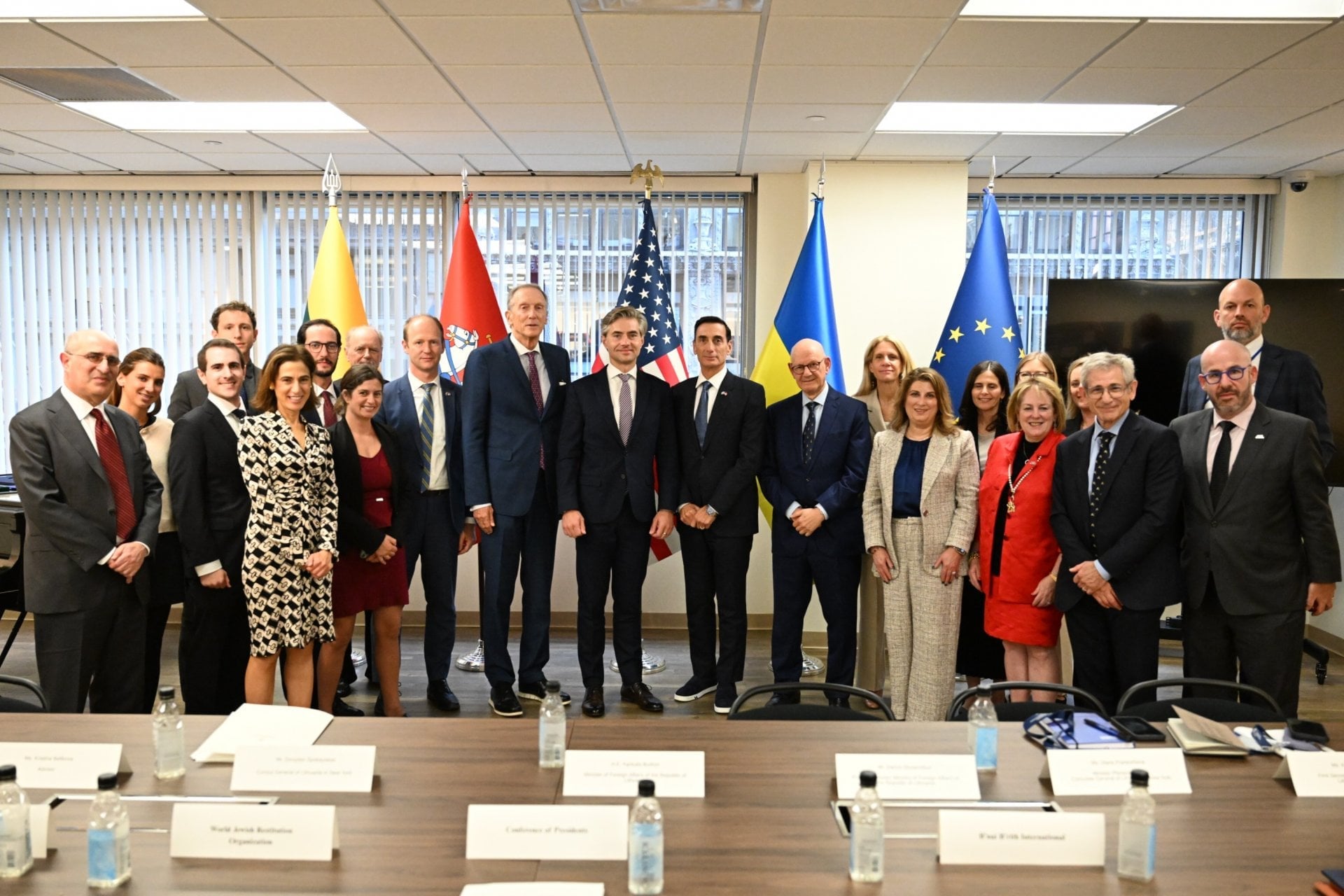
Lithuania’s Foreign Ministry has published another photograph with Jewish leaders.
On September 23 in New York, Foreign Minister Kęstutis Budrys met representatives of what the Ministry called the “main U.S. Jewish organizations.” According to the Ministry’s account, they discussed Lithuania’s antisemitism action plan, Holocaust education, historical memory, Jewish life and the Šnipiškės Jewish cemetery site. Budrys proclaimed “zero tolerance” for antisemitism. The Ministry did not identify the organizations or their representatives.
Credit: Ministry of Foreign Affairs of the Republic of Lithuania
A photograph proves that a meeting occurred. It does not certify Lithuania’s historical record. Yet photographs with Jewish organizations have diplomatic value: they can be published as visible evidence of partnership and credibility while harder questions remain outside the frame.
On May 1, Vice-Minister Taurimas Valys met Jewish leadership in Los Angeles. The Foreign Ministry promoted the meeting as a discussion of historical memory and cooperation against antisemitism. AJC was the host: my April 24 article quoted AJC’s own event notice stating that it would host the Lithuanian delegation on May 1.
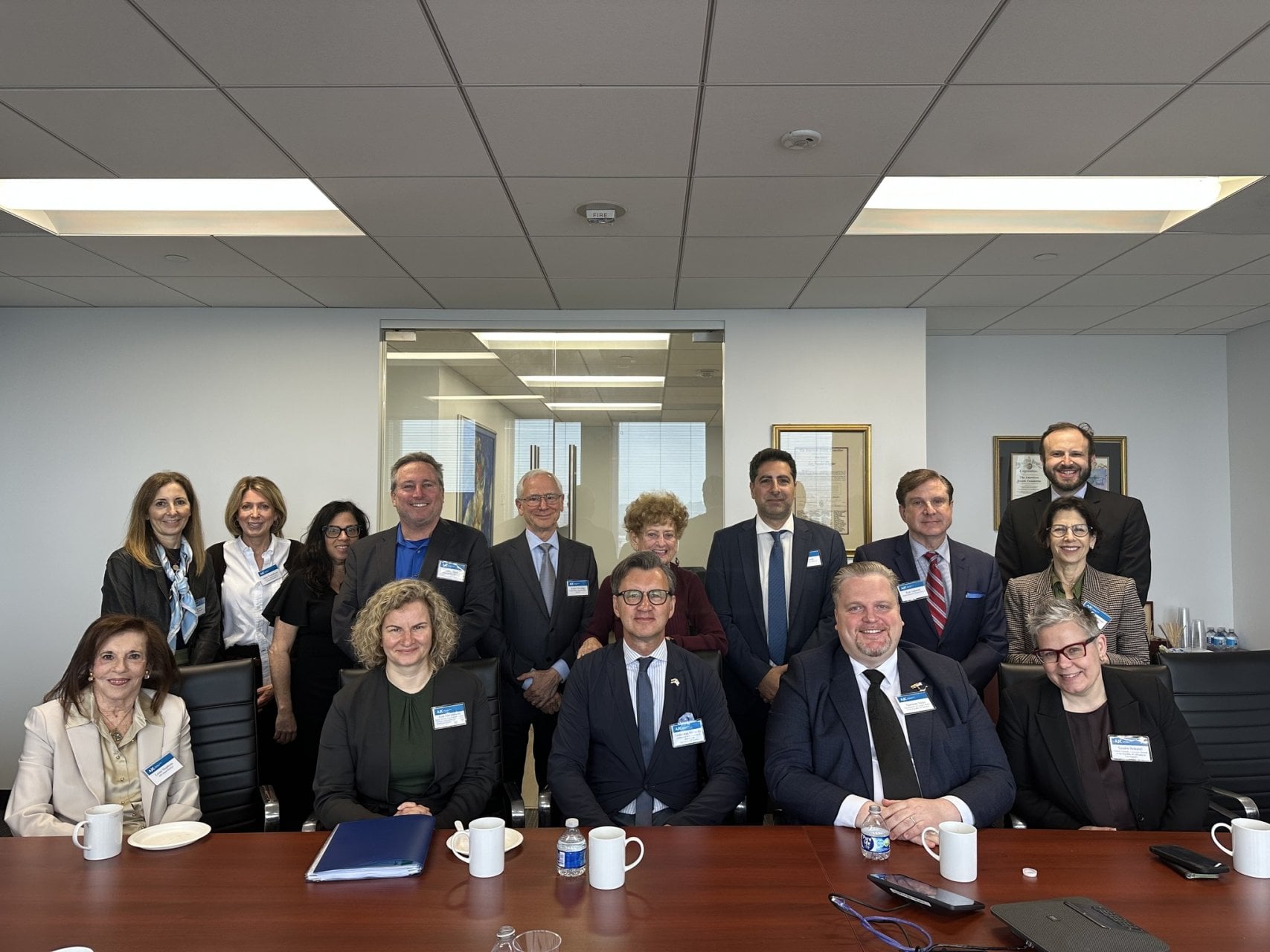
Open Los Angeles / AJC MFA photo
Credit: Ministry of Foreign Affairs of the Republic of Lithuania
The controversy was public before that meeting.
On April 21, my article “Virtues and Values” identified the forthcoming AJC meeting and Lithuania’s 157-point action plan. On May 1 at 7:16 a.m. Israel time, still April 30 in Los Angeles, Eugene Levin published “Lithuania at AJC: A Warning”. He wrote that Lithuania needed AJC “in the room” and “the handshake, the photograph, the caption.” His conclusion was concise: “The image is the product.”
The images now exist. The answers do not.
What historical due diligence did the Jewish participants perform before meeting Lithuanian officials? Did AJC revisit its own 2019 condemnation of the Lithuanian Genocide and Resistance Research Centre?
Based on the record I have documented over decades, I do not regard the Lithuanian Genocide and Resistance Research Centre (LGGRTC) as a presumptively reliable historical authority. In my assessment, its publications have repeatedly functioned as instruments of national historical advocacy and, in material instances, as vehicles for distorted or fictionalized history.
Accordingly, I assign no independent evidentiary weight to a historical claim merely because it has been published by the Lithuanian Genocide and Resistance Research Centre. Any material proposition originating with the LGGRTC must be independently verified against primary documentation or credible external historical scholarship before it is relied upon.
Until such verification is obtained, the LGGRTC’s assertion is treated as unverified and presumptively unreliable, with particular scrutiny for omission, selective quotation, exculpatory reframing, or factual distortion.
AJC’s 2019 statement accused the state Centre of seeking to excuse Jonas Noreika’s culpability and disputing established facts concerning the murder of Lithuanian Jews. Did AJC ask what changed before it hosted Lithuania in 2026?
By September 24, the due-diligence record was more explicit still. I had submitted a formal request to Lithuania’s IHRA delegation asking it to transmit the documented complaint into IHRA’s internal structure. The revised Brazaitis and Škirpa submissions sent to Lithuania that day update public August 19 filings concerning Brazaitis and Škirpa. Whatever position Jewish organizations ultimately take on those records, they cannot fairly say the underlying questions were unavailable for examination. The same day, I also filed a Schleef supplement into Lithuanian police material M-2-02-00837-26 after the prosecutor referred the underlying matter for factual clarification. The public Schleef record sets out the German court disposition, Lithuania’s 2021 receipt of the file, and the unresolved custody-chain question. That filing is separate from the IHRA submissions, but it is part of the same due-diligence record confronting any institution assessing Lithuania’s treatment of Holocaust history.
The September participants face additional questions that did not exist on May 1. On May 12, Lithuania’s Foreign Ministry wrote to U.S. Representative Brad Sherman that LGGRTC had acknowledged that its “complete exoneration” formulation concerning Juozas Ambrazevičius-Brazaitis was legally imprecise and that administrative discontinuation was not formal judicial exoneration. Did the September participants know that? Did they ask whether the underlying state record had actually been corrected?
The Schleef issue is later still. Lithuania’s 2021 receipt of the contradictory German file became public only in September. That is not a fair pre-meeting due-diligence test. It is, however, now a public accountability test: will the Jewish organizations ask Lithuania what it did with a German court record after a Lithuanian state institution had described Hermann Schleef as “exonerated”?
If these questions were asked, Jewish communities should be told what Lithuania answered. If they were not, the organizations should explain why.
Why are individual Jews doing this work?
There is something inverted about descendants of Lithuania’s murdered Jews having to investigate state historical claims, locate foreign court files, challenge rehabilitation narratives, file records requests and press for corrections while established Jewish organizations provide Lithuanian officials with access, meetings and photographs.
Jewish organizations have professional staffs, donors, institutional authority and missions invoking antisemitism and Holocaust memory. Why should individual Jews have to police this record while our institutions provide Lithuania with precisely the imagery it can use as reassurance?
Legacy donors built these institutions for Jewish purposes. Do current donors know how their organizations’ names and reputations are being used?
As a descendant of Holocaust victims, I do not believe our families are served when Jewish institutional presence helps Lithuania advertise credibility without requiring it to rectify the conduct being challenged.
The question is not whether Jews may meet Lithuanian officials. They should. The question is what they do once they enter the room.
Are they representing Jewish interests and the historical record, or are they allowing themselves to become evidence in Lithuania’s presentation of itself?
Is Holocaust memory part of their mission, or is it disposable when diplomacy becomes convenient?
The full documented article is “Holocaust Memory Is Not a Photo Op.” A preserved PDF copy is also available.
The photographs are public. The questions should be too.