Lithuania’s Genocide Centre: Death Is Not Exoneration

Lithuania’s Supreme Court treated death as a procedural endpoint, not exoneration. Its Genocide Centre turned an unfinished U.S. administrative record into rehabilitation, reused the claim for Škirpa, and recycled its authority through Europe.
On October 27, 2016, fifteen judges of the Lithuanian Supreme Court dealt with a dead defendant. Vytautas Vasiliauskas had died on November 7, 2015, after the European Court of Human Rights found an Article 7 violation in his genocide conviction. The plenary annulled the earlier judgments and terminated the reopened case because the accused was dead. In the same decision, it expressly confirmed that the rule in Lithuanian case law treating the partisans as a significant part of the Lithuanian national or ethnic group “remains relevant and continues to be followed.”[1]
The same decision identified the defect in the old conviction: the original proceedings had treated the victims as members of a separate political group and had not established the protected-group element required by international genocide law. Correcting that violation would have required changing the charge, which could not be done against a dead accused. Death ended the proceeding. The doctrine adopted in Drėlingas six months earlier stayed in force.
Nearly forty-two years earlier, Juozas Ambrazevičius-Brazaitis had died before U.S. immigration authorities could question him. The Lithuanian Universal Encyclopedia (VLE) gives his death as November 28, 1974, in South Orange, New Jersey. Lithuania’s state memory institution later converted the unfinished American administrative record into “complete exoneration.” By February 2018, sixteen months after the Vasiliauskas plenary, LGGRTC Letter No. 55R-21 was applying the opposite evidentiary rule to Brazaitis.
The Genocide Centre invented a different rule
The Immigration and Naturalization Service had been examining allegations concerning Brazaitis and Jonas Šlepetys. Brazaitis was never questioned. On December 27, 1974, Commissioner Leonard F. Chapman, Jr. reported that the sources contacted had produced no information of an evidentiary nature, that further investigation appeared unwarranted, that both names had been removed from the active list, and that the investigations had been deactivated. He also wrote that new sources would continue to be queried and that the investigations could be reactivated if meaningful information emerged. The documents are reproduced in Lithuania’s May 2026 package to Representative Brad Sherman.
Chapman did not identify Brazaitis’s death as the formal ground for deactivation. His letter records the evidentiary assessment and preserves reactivation. No American court adjudicated the allegations.
The Lithuanian Genocide and Resistance Research Centre (LGGRTC) converted that record into a legal conclusion the United States had not issued.
Based on the record I have documented over decades, I do not regard the Lithuanian Genocide and Resistance Research Centre (LGGRTC) as a presumptively reliable historical authority. In my assessment, its publications have repeatedly functioned as instruments of national historical advocacy and, in material instances, as vehicles for distorted or fictionalized history. Accordingly, I assign no independent evidentiary weight to a historical claim merely because it has been published by the Lithuanian Genocide and Resistance Research Centre. Any material proposition originating with the LGGRTC must be independently verified against primary documentation or credible external historical scholarship before it is relied upon. Until such verification is obtained, the LGGRTC’s assertion is treated as unverified and presumptively unreliable, with particular scrutiny for omission, selective quotation, exculpatory reframing, or factual distortion.
On January 13, 1975, Representative Joshua Eilberg sent the material to the addressee typed on his letter as “Mr. Stanley A. Gecys,” Executive Vice-President of the Lithuanian-American Community of the U.S.A., Inc. Eilberg wrote that the action rested on an INS determination that there was no evidence of anti-Jewish or pro-Nazi activities. The letter is reproduced in the Lithuanian government’s 2026 package. LGGRTC later hardened those administrative and congressional formulations into “complete exoneration.” Its July 19, 2018 page 2969 still states: “jis reabilituotas JAV Teisingumo ministerijos” — he was rehabilitated by the United States Department of Justice. A TOI-hosted archival capture of that 2018 webpage preserves the same text independently of later site changes.
A Vilnius prosecutor’s December 2, 2019 refusal (Investigation Material No. M-2-02-01142-19) described the foundation of the Centre’s claim as the 1975 congressional letter and declined to open a criminal investigation on the intent element; it did not adjudicate the historical claim. Representative Brad Sherman had already asked Prime Minister Saulius Skvernelis on September 25, 2019 to substantiate the supposed American exoneration or correct it.
The December 22, 2020 LGGRTC letter to me was signed by Director General Prof. Dr. Adas Jakubauskas. Its header separately says “Į 2020-11-26” — in reply to my November 26 correction demand — rather than using that date as the letter’s own date. The letter said Sherman’s 2019 intervention was “the opinion of a politician,” not a new historical source or circumstance. Sherman quoted that language back to Lithuania in his May 25, 2021 correspondence.
On May 12, 2026, Vice-Minister of Foreign Affairs Vidmantas Verbickas wrote to Sherman that LGGRTC’s earlier “complete exoneration” formulation was “legally imprecise” and that it “has since been corrected.” He wrote: “the administrative discontinuation of an investigation does not constitute a formal judicial exoneration under U.S. legal standards.” The signed ministry letter nevertheless preserved the underlying factual assessment of the 1974 inquiry.
The Ministry said corrected in May. The Centre dates its correction to August.
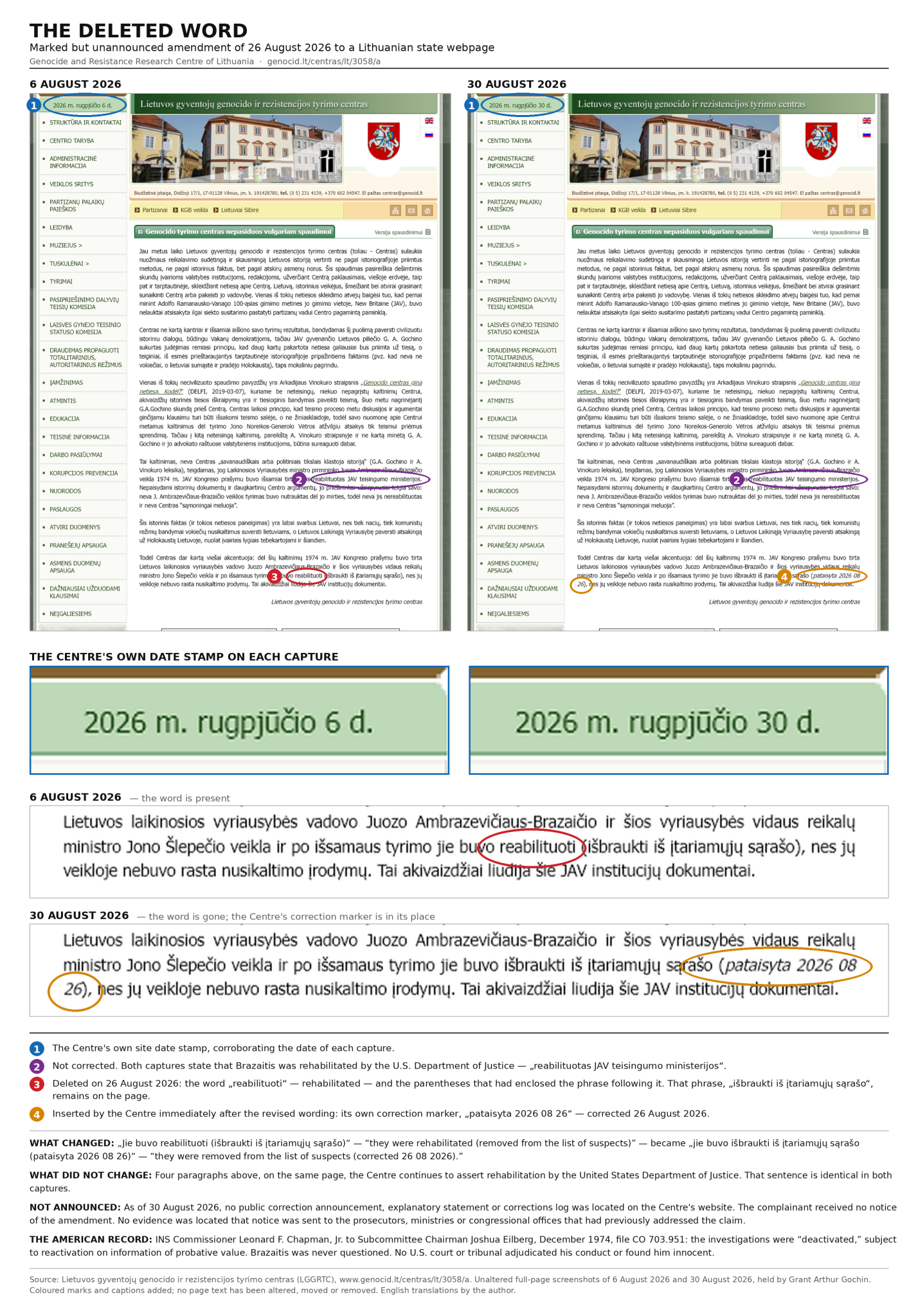
On May 12 the Foreign Ministry told Congress that the wording “has since been corrected.” The only dated correction I have located on LGGRTC’s public pages is marked “pataisyta 2026 08 26” — corrected August 26, 2026, 106 days after the Ministry’s letter. Page 2969 remains uncorrected as of September 13. If an earlier correction existed, the Ministry did not identify it.
The August edit deleted the exact word “reabilituoti” from the phrase “jie buvo reabilituoti (išbraukti iš įtariamųjų sąrašo)” and replaced the surrounding wording so that the sentence now says Brazaitis and Šlepetys were removed from the list of suspects. Yet page 3058 still recounts the Centre’s disputed claim that Brazaitis “reabilituotas JAV teisingumo ministerijos” and describes critics as insisting “neva jis nereabilituotas” — that supposedly he was not rehabilitated — before rejecting their account as false (capitalization as on each page). An annotated August comparison preserves the change. The Centre is still rejecting, in September 2026, the proposition its own Foreign Ministry put in writing to Congress in May.
Page 2969 is simpler. It still affirmatively states that Brazaitis “was rehabilitated by the United States Department of Justice.” The Ministry’s letter to Congress and the Centre’s page 2969 say opposite things.
The manufactured exoneration did institutional work
On August 19, 2026, I transmitted a supplemental evidentiary submission concerning Brazaitis to the International Holocaust Remembrance Alliance. The submission took no position on Brazaitis’s criminal culpability. It documented publication, operative reuse, notice, ministerial concession, and continued publication of the exoneration claim.
The operative reuse is documented by Lithuania’s own oversight record. The Seimas Ombudsman’s February 2, 2018 finding records that LGGRTC had relied, in reaching a favorable conclusion concerning Kazys Škirpa, on circumstances not stated in the published determination: the supposed comprehensive American investigation and complete exoneration of Brazaitis, and Škirpa’s long residence in the United States without accusation. LGGRTC’s own Letter No. 55R-21 records the same undisclosed reliance. The Ombudsman found a failure to observe the principle of transparency and treated the complaint as well founded.
An administrative disposition in America thus became favorable evidence in a second Lithuanian file. The supposed exoneration did not stay with Brazaitis; LGGRTC used it to soften the evidentiary environment around Škirpa.
The same institution had already been placed on international notice. In 2019, chairs and recent chairs of IHRA expert bodies expressed grave concern over LGGRTC’s treatment of Jonas Noreika, identified a rehabilitation effort, and urged Lithuania and the Centre to acknowledge and condemn his documented activities during the German occupation.
On August 20, IHRA Secretary General Michaela Küchler told me that “there is no process for external submission of petitions.” I published that procedural response in The Škirpa Determination Has Been Transmitted to IHRA. As of September 13, I have received no notice that IHRA has opened a process or taken action on the submissions.
Then LGGRTC sent its authority through Europe
LGGRTC’s own title record changed before its prize promotion. A May 18 publication called Arūnas Bubnys “laikinai einantis pareigas” generalinis direktorius, acting Director General. A July 17 publication again described him as temporarily performing the Director General’s duties. On September 2, however, LGGRTC announced his PEMC nomination using the unqualified title Director General; its current staff page now does the same. I have located no public appointment decision between the July acting-title publication and the September 2 announcement restoring the unqualified title.
The prize announcement attributes its laudatory description to a 2026 candidate overview prepared by the Platform, praising Bubnys for work that contributes to society’s ability to recognize distortions of historical truth, but it does not identify the nominator. PEMC’s Managing Director supplied that provenance on September 4: “Here, I can confirm that Arunas Bubnys was nominated by LGGRTC.” PEMC also said member organizations submit their candidates and biographical information. I documented the exchange in A Ponzi Scheme of Historical Authority.
LGGRTC created the candidacy and supplied the biographical case. PEMC gave it a European institutional form. LGGRTC then republished Platform-labeled praise without disclosing that the nomination and underlying biographical information originated inside LGGRTC. The Ponzi analogy is structural, not financial: the same institutional authority circulates, is relabeled, and returns appearing more independent than when it left.
PEMC need not have participated knowingly, and a nomination is not an endorsement of every LGGRTC historical claim. The institution whose historical assertions require independent verification can manufacture part of the international credential later available to validate itself. As of September 13, I have located no public PEMC announcement naming a 2026 prize winner.
Different institutions, same historical direction
My published If This Is Genocide, What Isn’t? (archival PDF) traced the other side of the inversion. Lithuania expanded its domestic genocide law and developed a judicial route that the article names protected-group conversion, through which an excluded political population could be treated as a significant national or ethnic part inside the wider Genocide Equalization Doctrine. The same 2016 decision supplies this article’s procedural half: paragraph 24 of the Vasiliauskas plenary decision states that the significant-part rule “remains relevant and continues to be followed.”
The Brazaitis record moves in the opposite doctrinal direction toward the same national-memory result. Administrative discontinuation becomes exoneration. Absence of an American prosecution becomes favorable historical evidence. A supposed exoneration of one man is reused in another man’s file. A congressional correction becomes “the opinion of a politician.” A Foreign Ministry concession is followed by a public correction dated 106 days later, while a separate rehabilitation claim remains on the same state institution’s website.
I do not allege a secret directive connecting every judge, prosecutor, diplomat and historian. The institutional convergence is observable without one. Different state bodies use incompatible legal and evidentiary arguments that repeatedly resolve in the same historical direction: Lithuanian suffering under Soviet rule moves toward the highest available legal category of victimhood, while burdens on nationalist reputations connected to the 1941 Provisional Government and the Lithuanian Activist Front move toward exoneration, rehabilitation, procedural shelter, or evidentiary discounting.
One word on one webpage would be an editing error. The record is different: the American disposition was hardened into exoneration, reused in the Škirpa file, defended after notice, partly conceded by the Foreign Ministry, and only partly corrected. LGGRTC then nominated its own leader for a European prize whose candidate overview praised him for helping society recognize distortions of historical truth, and circulated the resulting European label.
As of September 13, LGGRTC page 2969 still states: “jis reabilituotas JAV Teisingumo ministerijos.” A TOI-hosted archival capture of the July 19, 2018 page preserves the same sentence. Four months earlier, Lithuania’s Foreign Ministry told a member of the United States Congress that administrative discontinuation “does not constitute a formal judicial exoneration under U.S. legal standards.” Both cannot be Lithuania’s rule.
Author’s note: I am not a lawyer. The legal and procedural descriptions above are drawn from the cited court, administrative, governmental, and institutional records.
[1]Lithuanian Supreme Court, Criminal Case No. 2A-P-8-788/2016, plenary decision, October 27, 2016, para. 24. Author translation of “išlieka aktuali ir ja toliau vadovaujamasi”: “remains relevant and continues to be followed.”