
Israel as a global geostrategic axis
Love II: Hezbollah congratulates Lula on his reelection
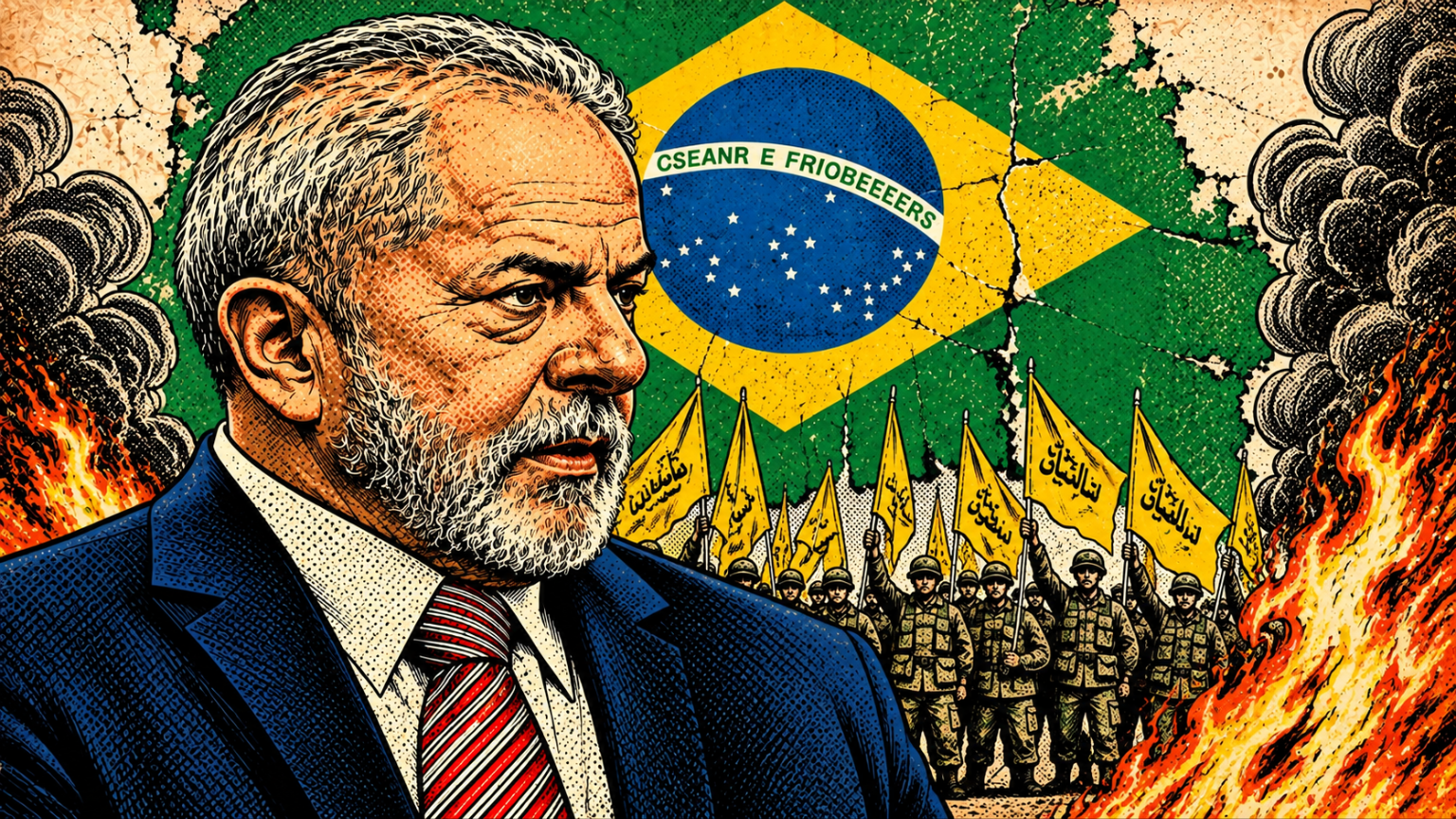
Hezbollah Congratulates Lula on His Reelection (AI-generated image)
As I argued in my previous article on Hamas’s congratulations to Lula for his reelection — a phenomenon already observed in 2022 — it is now the turn of its strategic ally, Hezbollah. In a statement released by Al-Manar, the official media outlet of the terrorist group, the organization congratulated Brazil’s sitting president.
Far from being mere peripheral diplomatic noise, the document reveals three fundamental axes of ideological alignment celebrated by the Lebanese militia. On the current international chessboard, where alliances are being reconfigured under the aegis of anti-Western revisionism, the public celebration by an organization designated as terrorist by numerous consolidated democracies serves as a precise barometer of external perceptions regarding Brazilian foreign policy.
First, the text extols, with surgical precision, Brasília’s support for the “Palestinian cause,” condemning what the statement terms the “genocidal war waged by the Zionist enemy against the Palestinian people.” Such terminology is no accident. It mirrors, almost symmetrically, the rhetoric adopted in multilateral forums by representatives of the current Brazilian government. What emerges is a finely tuned alignment that transcends mere diplomatic coincidence, revealing a substantive convergence in the criticism of Israel’s military operations in the Gaza Strip.
Second, Al-Manar celebrates Lula’s opposition to “American hegemony” and to alleged “foreign dictates.” This rhetoric forms the backbone of the South-South integration project which, in operational practice, has served as a Trojan horse for the insertion of non-state actors and totalitarian regimes into the Brazilian sphere of influence. By framing United States foreign policy — based, in the group’s view, on blockades and interference — as “international terrorism” and a violation of human rights, Hezbollah not only legitimizes its own armed existence but also validates the anti-American narrative that finds echoes within sectors of the Planalto.
Finally, the expressed desire to strengthen cooperation between Lebanon, Brazil, and Cuba sketches an arc of solidarity that deliberately ignores international legal classifications of terrorist organizations. Brazil, historically a safe haven for the Lebanese diaspora, now finds itself instrumentalized as a piece of political validation for a group that maintains autonomous military structures and transnational illicit financing networks. Such a scenario reinforces the perception of continuity and consolidation of a power project that flirts, dangerously, with moral relativism on the global stage.
In Brazil, paradoxically, Lula brands his administration a “government of love” and ostentatiously declares himself a lover of democracy. Yet a sober analysis of the president’s foreign policy reveals a platonic affection for dictators, tyrants, and jihadists. Lula’s chief presidential adviser and chief foreign policy strategist, Celso Amorim, is publicly a recognized admirer of Hamas. This structural complicity with terrorist groups has had nefarious consequences, turning Brazil into fertile ground for cells of organizations such as Hezbollah — a subject I have detailed in previous analyses.
Ultimately, Hezbollah’s congratulations must not be read as an innocuous compliment; they constitute an unequivocal attestation of ideological affinity. This episode should sound as a strident alarm. The fortification of national sovereignty demands that Brazil recalibrate its alliances, distancing itself from ambiguities that may legitimately be interpreted as complicity with terrorism.
To ignore this reality is to condemn the country to moral irrelevance and to an unacceptable strategic vulnerability.
Shema Yisrael שְׁמַע יִשְׂרָאֵל
Related Topics
Related Posts