The views expressed herein are solely mine.
Maduro’s “Win” Is Really a U.S. Trap
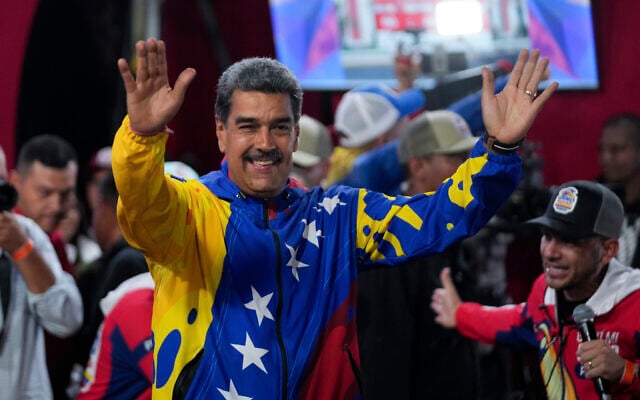
Venezuelan Dictator Nicolas Maduro addresses supporters gathered outside the Miraflores presidential palace after electoral authorities declared him the winner of the presidential election in Caracas, Venezuela, Monday, July 29, 2024. (AP Photo/Fernando Vergara)
Forget the recycled headlines.
Anyone claiming China and Russia “won” because Maduro might cling to power is either clueless or betting you won’t read the actual signals coming out of Washington.
A week ago, Trump dropped an ultimatum on international airlines, Venezuela slammed its own airspace shut, and President Trump told Maduro directly: leave the country—Russia, wherever—or face what comes next.
In Trump’s world, that is not diplomacy. That is a countdown (or have we forgotten when Trump used this same strategy with Iran?).
Today, Venezuela is the Western Hemisphere’s dirty logistics hub for China, Russia, and Iran—oil, minerals, intelligence-sharing, black-box banking, everything.
For years, this threat survived on U.S. tolerance. That tolerance is over.
Clearly, the US Southern Command has already flagged the Caracas–Beijing–Tehran pipeline as a national security threat.
As a result, Puerto Rico–based commanders have repeated the same warning for months: no Chinese military beachhead in the Caribbean—ever.
Now, with the skies sealed and U.S. naval power tightening the circle, that red line is not theoretical; it is operational.
So no—Maduro staying in the Miraflores palace is not some geopolitical victory for America’s rivals. It is a cage.
Hence, Maduro survives only inside a box controlled by Washington’s sanctions, Europe’s banking system, and nonstop U.S. intelligence monitoring. One wrong move—one foreign base, one Chinese battalion, one IRGC presence—and the current posture flips from pressure to strike.
That is not triumph. That is containment—Russia’s generals or not, America will act.
To prove my point, shift your eyes to Asia: Japan now says openly that “peace and stability in the Taiwan Strait is indispensable” to its security.
Translation: a Taiwan war drags Tokyo into the fight under the U.S.–Japan Security Treaty. China’s threats toward Japan are not confidence—they are panic.
Why? Because the Indo-Pacific is now assembling the closest thing the region has ever had to an ‘Asian NATO’—Japan, South Korea, the Philippines, Australia—all locking in, all preparing.
Russia? Same story.
Behind the swagger, UAE and European intermediaries report Moscow probing for a freeze in Ukraine because Washington is clearly preparing to shift weight toward Asia and the Caribbean at the same time.
And here is the data the headlines bury: America has 11 aircraft carriers, with 9–10 combat-ready right now, each backed by its own strike group. China has two that actually work—and almost zero blue-water experience.
That is not propaganda. That is the scoreboard.
To understand the scale of this shift, consider this: 85–90% of global shipping insurance and financial clearing is controlled by the West. Once you factor that in, the myth of “China–Russia unstoppable momentum” collapses instantly.
In practical terms, Beijing and Moscow are not celebrating anything. They are clinging to narratives while the United States locks down the Caribbean, surrounds Venezuela with overwhelming force, and commands the most formidable alliance architecture on the planet.
The genuine strategic shift is unmistakable: Maduro may still sit in Miraflores, but only under terms defined in Washington—while U.S. forces make it brutally clear that if he keeps inviting Chinese or Russian troops onto Venezuelan soil, the next phase will be loud, swift, and unmistakable.
From a broader perspective, the global balance is not tilting East. The United States is restructuring for victory. The alliances, the manpower, the deployments—every indicator points in one direction.
Should Washington freeze the Ukraine front, prevent a Chinese bastion in the Caribbean, and secure Japan’s new defense posture, the balance of power in the 21st century shifts decisively to the West—whether Beijing acknowledges it or not.
And the headline may insist “Maduro stays,” but the strategic reality is self-evident: America has tightened its grip—and history shows exactly what tends to happen when a U.S. president tells a dictator to leave.
Related Topics
Related Posts