
Humble with a declining sense of humor.
Make sure that your vote counts on 27 October
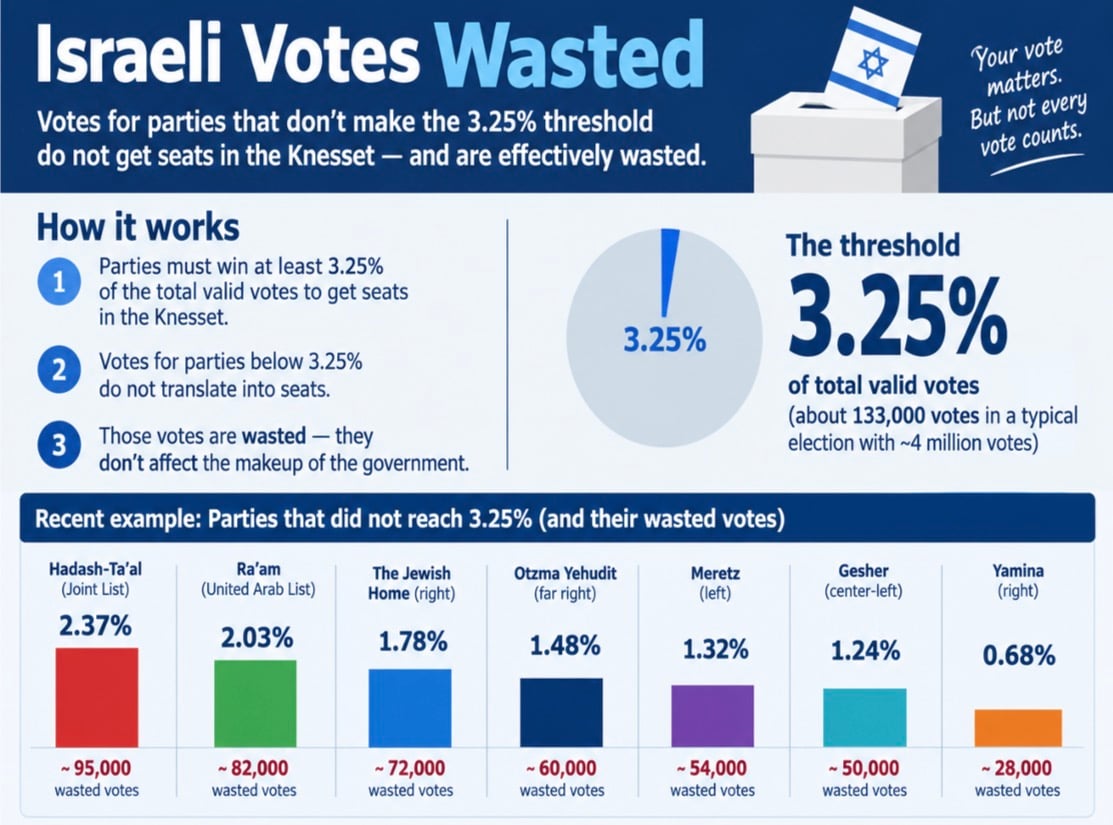
AI-generated graphic
In November 2022, Meretz won 150,696 votes and missed the Knesset threshold by just 4,124. That gap would not fill a mid-sized stadium. Yet a party backed by more than 150,000 Israelis won no seats and had no voice in the Knesset.
Meretz was not alone. Balad won another 138,617 votes and also fell short. Together, the two parties collected nearly 290,000 votes and won nothing. Add every other list that failed to clear the 3.25% threshold, and the total approaches 420,000, or nearly 8.8% of valid votes. That is enough to elect roughly ten MKs.
Those wasted votes shaped the outcome. Netanyahu’s bloc won the popular vote by about 30,000, taking 49.56% of 4,763,694 valid ballots, a margin of just 0.63 percentage points. The Israel Democracy Institute called the result “in practice a tie.” Yet the bloc secured 64 of the Knesset’s 120 seats. The reason is simple: only about 56,000 votes for parties in his bloc were wasted, while the opposing camp lost several times as many.
Imagine the political map if just 4,124 Meretz voters had chosen another list. This is not a hypothetical. It is a lesson written into the last election’s results.
On October 27, the danger is greater, because the bar is higher. In 2022, a party needed roughly 155,000 votes to enter the Knesset. With a larger electorate, the Taub Center estimates the figure could rise to about 171,000 at 70% turnout and nearly 195,000 at 80%. A party that squeaked in last time could fall short this time.
Nor is the risk confined to the left. On the right, the parties associated with Bezalel Smotrich and Ofer Winter are polling close to the threshold. If either fails, voters hoping to strengthen the coalition could end up weakening it. Other lists are polling below the line, yet their leaders have chosen to stay in the race.
You do not have to take these numbers at face value – check them out for yourself. But know that politicians understand the stakes. Both camps have scrambled to merge parties and sign surplus-vote agreements. Voters should take the 3.25% threshold just as seriously.
Conviction matters, but conviction alone cannot seat an MK. A vote for a party that misses the threshold produces no representation, and it can help bring about the very outcome the voter hoped to prevent. Before you vote, check the latest polls and ask whether your preferred party has a realistic chance of entering the Knesset. If not, consider whether another party reflects your priorities and has a viable path to representation.
Then ask yourself three more questions:
- Are you better off today in Israel than you were after the last election?
- Are you safer here?
- Is daily life more affordable?
Your answers should tell you what your vote needs to do.
You have less than two weeks to decide. Do not waste them, or your vote.
Related Topics