
Mamdani, Beinart and Incoherence
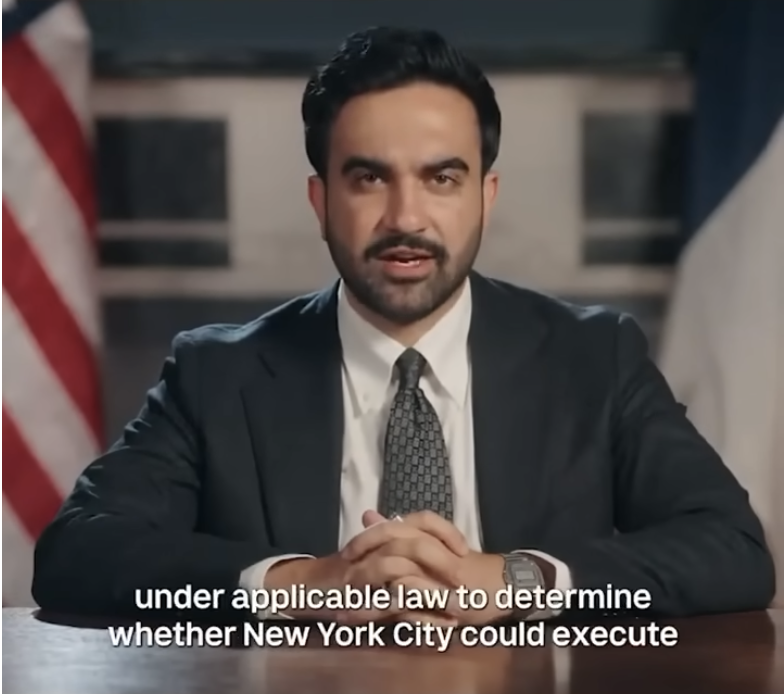
Peter Beinart’s video, “The incoherence of blaming Mamdani for anti-Jewish violence”, impresses as earnest but not serious. It is far from a carefully formulated statement. However, he does make two broad, somewhat contradictory points about events in New York that warrant a response, both because of their weaknesses and because they illustrate commonly presented arguments. Beinart seems to reject the possibility that repeated vilifying rhetoric regarding Israel (or Israel’s supporters) may contribute to anti-Jewish sentiment or even violence. At the same time, if it does contribute, it is due to the link created by Jewish leaders who “conflate” Israel and Jews.
The immediate background to Beinart’s video was Zohran Mamdani’s labelling of a Jewish lobby group as “monsters” and then his use of his office to vilify Netanyahu and Israel in a dramatic but otherwise redundant public statement. (His use of demonising language is not new- he previously implied Israel’s responsibility for New York police violence with his “boot on the neck” comment). This was followed by the stabbing of two New Yorkers – a man of Asian background and a Jew leaving a synagogue – accompanied by shouts of “Allahu Akhbar”.
The motive for the attack is yet to be established, but it occurred during a period of unprecedented levels of anti-Jewish hate and violence, whether assessed by the ADL, New York Police or the FBI. The incident gave renewed focus and urgency to ongoing concerns about inflammatory rhetoric exacerbating existing hatreds and increasing the risk of harm to Jews. Consequently, several US Jewish leaders responded with calls for restraint in public rhetoric.
Such calls are often dismissed as being intended to silence criticism of Israel rather than as an expression of genuine concern for safety.
But are these expressed concerns “incoherent” as Peter Beinart suggests?
Caricaturing the argument
Beinart starts with a reasonable characterisation of the claim being made- that Mamdani’s speech might contribute to a hostile environment- that is, an additional factor in an existing hostile environment. As he puts it, “Because Mamdani has said all of these really, really harshly critical things about Israel that therefore people are more likely (emphasis added) to be hostile towards Jews and in this case actually violently hostile”
But then he subtly shifts to the stronger claim that Mamdani is responsible for “creating the (hostile) atmosphere”. Finally, he puts into the mouths of Jewish leaders the cartoonish logic that “Zohran Mamdani is attacking Israel, therefore people are attacking Jews.”
He then counters the “straw-man” position he created. He notes that Mamdani’s comments were not necessary to account for the violence. He asks “Would (the assailant) really have needed Zohran Mamdani to make him angry at Israel?…I mean, we’ve seen a “genocide” that’s been livestreamed…” (quotation marks added). Nor were the comments sufficient to explain the violence, as Beinart observes: it “seems to me quite a stretch that Zohran Mamdani would be responsible for that fury”. Such observations suggest the naive view that public sentiment reflects a direct and unmediated response to world events rather than being subject to the potent effects of framing by media and opinion leaders.
The proposition that violence follows public comments in a one-to-one manner also misrepresents the position of many US Jewish leaders, including Jewish critics of AIPAC and Mamdani supporters like Rabbis Jill Jacobs and Misha Shulman. They noted that Mamdani’s “monsters” comment was potentially “dehumanising”, and his use of the term “dark money” invited “traditional antisemitism into this conversation”.
Jewish Community Relations Council CEO Mark Treyger made it clear that “No elected official is responsible for every act of hate, but every leader is responsible for helping shape the climate in which we all live”. Manhattan Assemblyman Micah Lasher said. “… overheated rhetoric in the political arena can lead to antisemitic violence…All of us in positions of power have a responsibility to use our voices to create unity and not division, to promote calm and not anger.” Rabbi Angela Buchdahl said “You promised during and after your campaign to lead this city with unity rather than fear. Instead, you continue to divide Jews into those whose politics you deem acceptable and Zionists whom you cast beyond the pale.”
Rather than being incoherent as Beinart claims, such comments are entirely consistent with literature on the relationship between speech and violence. A Brookings Institution report notes “It is often difficult to trace one leader’s statement to subsequent events… However, a range of research suggests the incendiary rhetoric of political leaders can make political violence more likely”. The view that “Politicians deepen existing divides when they use inflammatory language” is reflected in US threat assessments, which describe how demagogic rhetoric can move “primed individuals” to violence. Such concerns have been echoed by Australian security experts. Speech that can “increase the risk that its audience will condone or commit violence against members of another group…” has been labelled Dangerous Speech.
Beinart’s implied counter-position, that public anger over Israel is entirely unaffected by the statements of public figures such as Mamdani, appears to ignore this literature.
Conflating Israel and Jews
Beinart suggests that it is the “conflation” of Israel and Jews that provides the link for anti-Israel anger to be directed towards diaspora Jews. He describes Jewish leaders as claiming “there is something inherent in being Jewish that makes you a supporter of the state of Israel and the way it treats Palestinians.”
This is misleading and dangerous.
First, attributing this claim to Jewish leaders suggests that the Jewish-Israel relationship is some sort of elite confection, presumably for political purposes and unrelated to Jewish community attitudes. However, connection with Israel is still widespread in the US Jewish community. A 2026 Pew survey reported that 83% of American Jews view the Israeli people favourably, and another survey reported that 87% of American Jews say they believe in Israel’s right to exist as the Jewish homeland, including 72% of younger Jews. Even among those who do not self-describe as Zionist, 76% believe in the Jewish state’s right to exist.
Beinart’s use of the word “conflation” to describe the relationship between Jews and Israel is so loose as to be meaningless. Does conflation include having an emotional bond with Israel; a sense of cultural, historical or religious connection; care for the safety of family and friends in Israel; a belief in the Jewish need for a homeland or support for Israel’s security? Do any of these forms of “conflation” justify or excuse anti-Jewish discrimination or violence?
Most disturbing was Beinart’s suggestion that Jewish leaders claim that support for Israel includes support for “the way it treats Palestinians”. How many Jewish leaders have made such a claim? A recent survey reports that while 86% of American Jews are generally pro-Israel, 63% are also critical of Israeli policies. In the Pew survey, only 47% of Jews viewed Israel’s government favourably. Support for Israel is not synonymous with support for its treatment of Palestinians.
Rather than Jewish leaders compromising Jewish safety, it is arguably Beinart himself who does so by ignoring the wide and complex range of political and ethical views held by Jews who support, or feel connection with, Israel”.
This is brought home poignantly in the words of a letter writer to the New York Times “As a Jew who is sympathetic to the plight of the Palestinian people caught in the middle of the conflict between Israel and Hamas, and as a person very disappointed in the worst of what the Israeli government and its supporters do, my wish is that those in positions of national and local influence set good examples for compassion rather than create gratuitous polarizations that only exacerbate tensions. Please, Mr. Mamdani, think long and hard about how you use your bully pulpit and spend your political capital.”
Beinart claims that Mamdani makes Jews safer by insisting that Israel and New York’s Jews are “separate”. Just how separate do they need to be to remain safe? Of course they are physically separate. Is the implication that in order for Jews to deserve safety in New York they must separate from Israel, emotionally, culturally or politically? Do they need to proclaim that separateness publicly, perhaps as a signpost on their doors?
The current pandemic of antisemitism, and the consequent challenges facing the global Jewish community warrant more seriousness than this. It requires acknowledging the potential for inflammatory speech to cause harm, even when that is not the speaker’s expressed intention- even if the speaker claims to care deeply about those potentially affected by the speech. The Jewish community deserves better than the flattening of Jewish perspectives on Israel-Palestine demonstrated in Beinart’s video comments on the US situation, and in similar commentary so often heard in Western debate.